

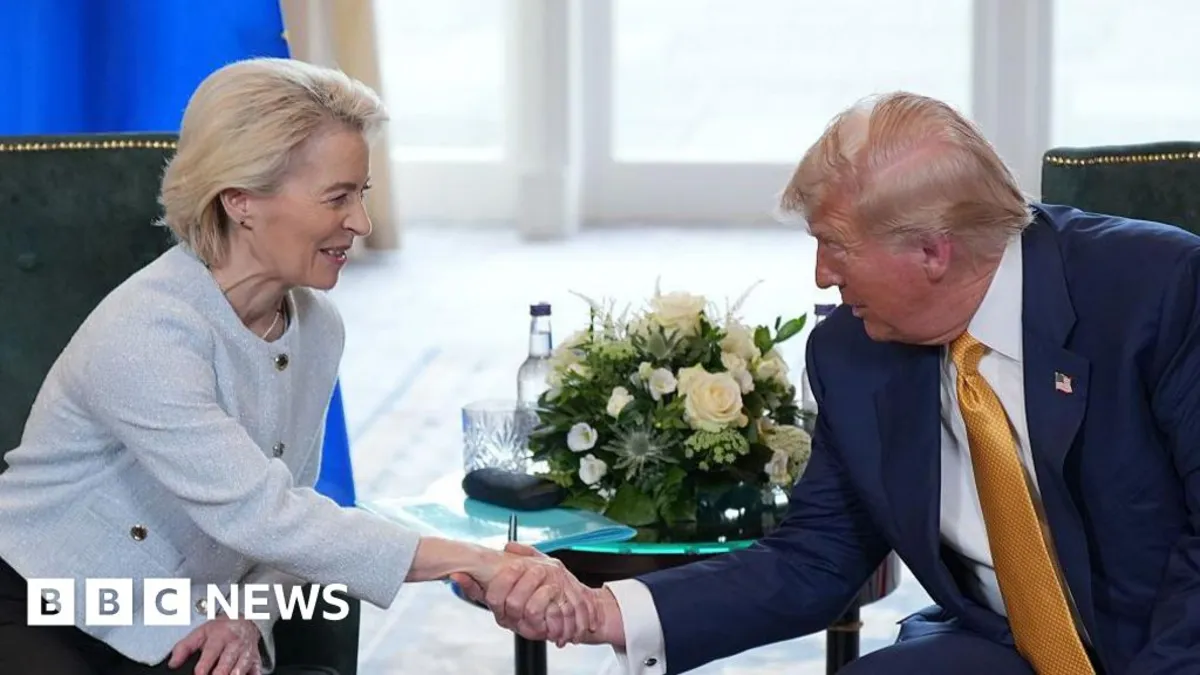
The European Parliament has officially suspended the approval of a crucial US trade deal reached in July, in response to President Donald Trump's controversial demand to take over Greenland. This significant suspension was announced in Strasbourg, France, as President Trump was addressing the World Economic Forum in Davos.
This latest move signifies a renewed escalation in trade tensions between the US and Europe. Trump has been threatening to impose tariffs against European nations in his pursuit of acquiring Greenland. Although he has stated that he would not resort to military force, the situation has unsettled financial markets, leading to renewed fears of a potential trade war and the possibility of retaliation against the US.
Trade relations between the US and Europe had improved since the two parties agreed to a deal at Trump's Turnberry golf course in Scotland last July. Under this agreement, US tariffs on most European goods were reduced to 15%, a significant drop from the initial 30% that Trump had threatened during his Liberation Day tariff wave in April. In return, Europe committed to investing in the US and making regulatory changes that would promote US exports.
However, the suspension of the trade agreement is a direct consequence of Trump's recent threats concerning Greenland. Bernd Lange, chair of the European Parliament's International Trade Committee, announced that the committee had no choice but to halt progress on the two legislative proposals related to the deal. He emphasized that the trade plans would remain on hold until the US demonstrates a willingness to engage in cooperative dialogue rather than confrontation.
Following Trump's threats regarding tariffs related to Greenland, European stock markets experienced a decline, marking a second consecutive day of losses. However, optimism returned on Wednesday after Trump clarified that he would not use military force to acquire Greenland, resulting in a rebound in share prices. In the US, major indices such as the Dow Jones, S&P 500, and Nasdaq all surged by approximately 1% in early trading on Wednesday, while London's FTSE 100 saw a modest increase of 0.25%.
In the commodities market, the price of gold reached a new high of over $4,842 (£3,604) per ounce, while silver prices remained slightly below their record high of $95 an ounce, fluctuating around $94. Precious metals are typically regarded as safe-haven assets during periods of uncertainty, and their values have surged significantly over the past year.
During his address in Davos, Trump reiterated his interest in acquiring Greenland from Denmark, emphasizing the strategic importance of the territory for both US and global security. He stated, “I don't have to use force, I don't want to use force, I won't use force,” while calling for immediate negotiations with Denmark regarding the potential acquisition.
The suspension of the trade deal raises critical questions about the EU's future actions, particularly regarding possible retaliatory measures against the US. The European bloc had previously announced potential tariffs worth €93 billion ($109 billion, £81 billion) on American goods in response to Trump's initial tariffs but had postponed these plans while finalizing the trade deal.
The reprieve from these tariffs is set to end on February 6, meaning that EU levies could be enforced on February 7 unless the bloc seeks an extension or approves the new deal. French President Emmanuel Macron has been vocal in urging the EU to consider its retaliatory options, including the use of an anti-coercion instrument, colloquially referred to as a trade bazooka. Lange has expressed support for this approach, with a decision on its implementation expected to be made on the upcoming Monday.
In a concurrent statement from Davos, US Treasury Secretary Scott Bessent cautioned European leaders against any form of retaliation, advocating for a measured response as tensions continue to rise. He advised, “I tell everyone, sit back. Take a deep breath. Do not retaliate.” The US has previously shown impatience with the pace of European progress regarding the approval of the trade deal, amidst lingering disagreements over technology and metals tariffs.