

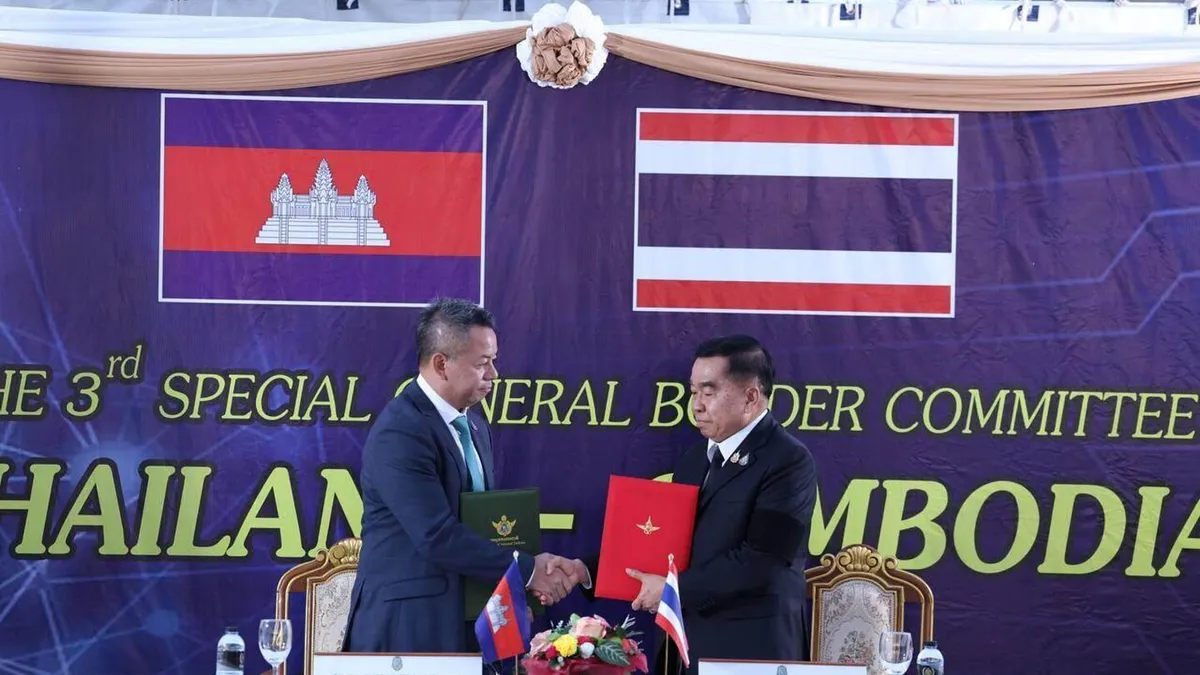
BANGKOK (AP) — On Saturday, Thailand and Cambodia reached a pivotal ceasefire agreement aimed at halting weeks of armed conflict along their border, sparked by competing territorial claims. The ceasefire took effect promptly at noon local time, marking a significant step towards restoring peace in the region.
The newly signed agreement not only seeks to end hostilities but also imposes strict restrictions on military movements by both nations. It explicitly prohibits any violations of each other’s airspace for military operations. Notably, only Thailand has conducted airstrikes during this conflict, with the Cambodian defense ministry reporting strikes occurring as recently as Saturday morning.
In a notable gesture, the agreement stipulates that Thailand will repatriate 18 Cambodian soldiers who have been held as prisoners since clashes in July, provided the ceasefire remains intact for 72 hours. The release of these soldiers has been a significant demand from the Cambodian side throughout the negotiations.
The ceasefire deal was formalized by the defense ministers of both countries, Tea Seiha of Cambodia and Nattaphon Narkphanit of Thailand, at a border checkpoint. This agreement follows three days of discussions among military officials under the auspices of the already-established General Border Committee.
Importantly, this new agreement reaffirms commitments to a previous ceasefire that ended five days of fighting in July and encompasses 16 de-escalation measures. The initial ceasefire was facilitated by Malaysia, with significant diplomatic pressure from former U.S. President Donald Trump, who threatened to revoke trade privileges if both countries did not agree to peace talks. The ceasefire was later detailed during a regional meeting in Malaysia attended by Trump in October.
Despite previous peace deals, both nations have continued a bitter propaganda war, resulting in minor cross-border skirmishes that escalated into heavy fighting in early December. Official reports indicate that Thailand has suffered 26 military casualties and one civilian death since December 7. Moreover, Thailand has reported collateral damage resulting in 44 civilian deaths.
On the Cambodian side, while official military casualty figures have not been disclosed, authorities report 30 civilian fatalities and 90 injuries due to the ongoing conflict. The violence has led to the evacuation of hundreds of thousands of residents from both sides of the border.
Both nations have accused each other of instigating the conflict, each claiming to act in self-defense. The ceasefire agreement also obliges both parties to adhere to international treaties prohibiting the deployment of land mines, a critical issue for Thailand. Reports indicate that Thai soldiers have been injured in at least nine incidents this year involving newly planted Cambodian mines, while Cambodia attributes these mines to remnants from its prolonged civil war that concluded in the late 1990s.
Another significant clause in the agreement emphasizes the need for both sides to "refrain from disseminating false information or fake news," highlighting the importance of truthful communication in maintaining peace. The agreement also calls for the resumption of previously established measures to demarcate the border and emphasizes cooperation in combating transnational crimes, particularly referencing online scams that have defrauded victims globally of billions of dollars annually. Cambodia is noted as a hub for such criminal activities.
This ceasefire agreement marks a crucial turning point for Thailand and Cambodia, as both nations strive to mend relations and ensure stability along their shared border.