

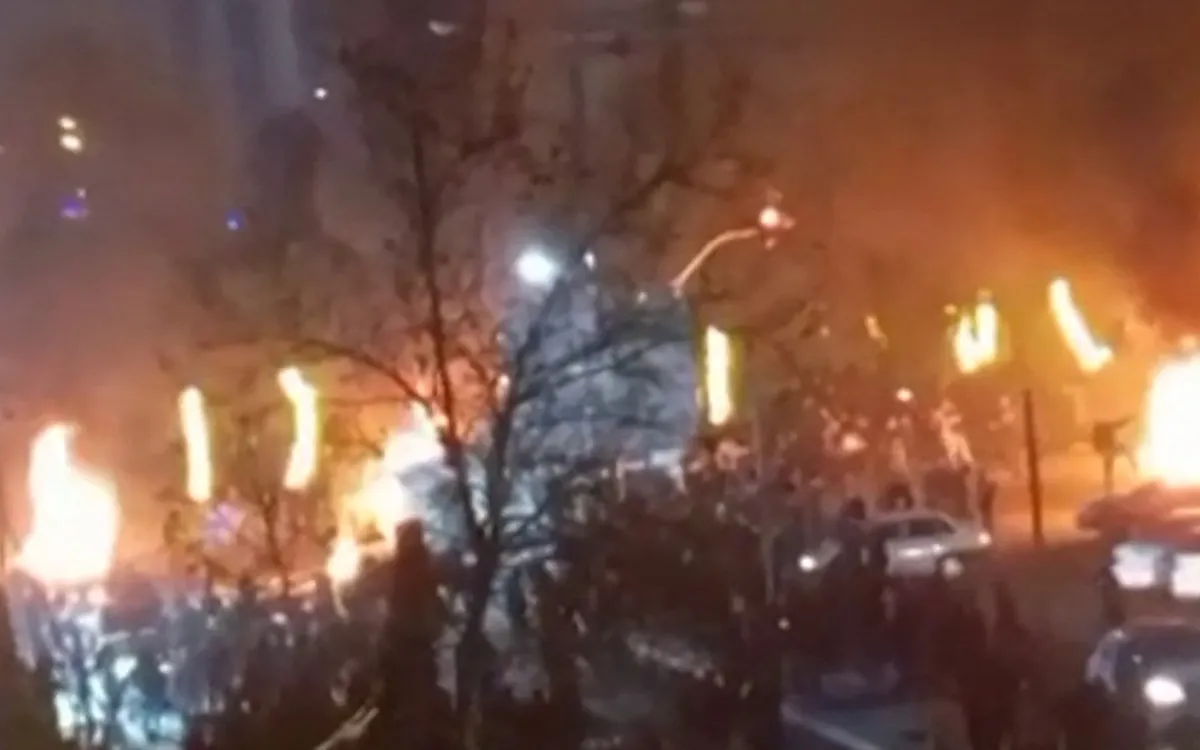
The ongoing protests in Iran have captured global attention, especially with United States President Donald Trump repeatedly threatening military intervention if the Iranian government violently suppresses demonstrators. Recent reports indicate that personnel at the al-Udeid Air Base in Qatar have been advised to leave by Wednesday evening, escalating fears of a potential US strike and possible Iranian retaliation.
The protests in Iran, which began in late December 2025, have stemmed from the country's deteriorating economic conditions. However, they have transformed into a significant challenge to Iran's clerical leadership, which has governed since the 1979 Islamic Revolution. As tensions rise, Trump's social media statements have fueled speculation about imminent US intervention.
On Tuesday, Trump utilized his Truth Social platform to reach out to Iranian protesters, stating that help was “on its way.” He urged them to continue their protests and take control of their institutions. His message included a warning to those responsible for violence against protesters: “They will pay a big price.” Additionally, he mentioned that he had canceled all meetings with Iranian officials until the violence ceased, reinforcing his commitment to support the protesters.
In a previous post on January 2, Trump warned that if Iran continued to "violently kill peaceful protesters," the United States would intervene, stating, “We are locked and loaded and ready to go.” This rhetoric has led to concerns about what form US intervention might take.
On January 2, White House Press Secretary Karoline Leavitt emphasized that while Trump prefers diplomatic solutions, he is willing to consider military options if necessary. She stated, “Air strikes would be one of the many options that are on the table for the commander-in-chief.” The Trump administration has shown a readiness to use military force, especially given the history of US strikes against Iranian targets.
The US military presence has seen a reduction in the Middle East, with the USS Gerald Ford, the largest US Navy aircraft carrier, recently deployed to the Caribbean for Operation Southern Spear. The operation aims to target alleged narco-terrorists in Latin America, significantly decreasing US military capabilities in the Middle East compared to previous months.
Despite this reduction, the US maintains a network of military bases across the region. The al-Udeid Air Base in Qatar, which houses approximately 10,000 troops, remains a key installation. Reports of personnel being instructed to leave have raised questions about the US's immediate military posture in the area.
Experts suggest that if the Trump administration considers military action, it may opt for short, targeted operations rather than a full-scale invasion. Shahram Akbarzadeh, a political expert, highlighted Trump's preference for operations with minimal risk to US troops, referencing past actions like the assassination of Iranian General Qassem Soleimani.
However, targeting Iran’s leadership poses significant risks. Akbarzadeh noted that if the Supreme Leader were targeted, it could lead to the Islamic Revolutionary Guard Corps (IRGC) taking control, potentially resulting in an even more hostile regime towards the US.
Military experts agree that a ground invasion is unlikely. Trump has shown little interest in establishing a long-term presence in countries like Iran, especially after withdrawing from Afghanistan. Akbarzadeh emphasized that Trump’s administration is not focused on nation-building, which makes a military commitment in Iran improbable.
As the situation in Iran continues to develop, the international community remains watchful of both domestic unrest and the potential for US intervention. The balance between supporting Iranian protesters and avoiding escalation with Iran will be a critical challenge for the Trump administration moving forward.