

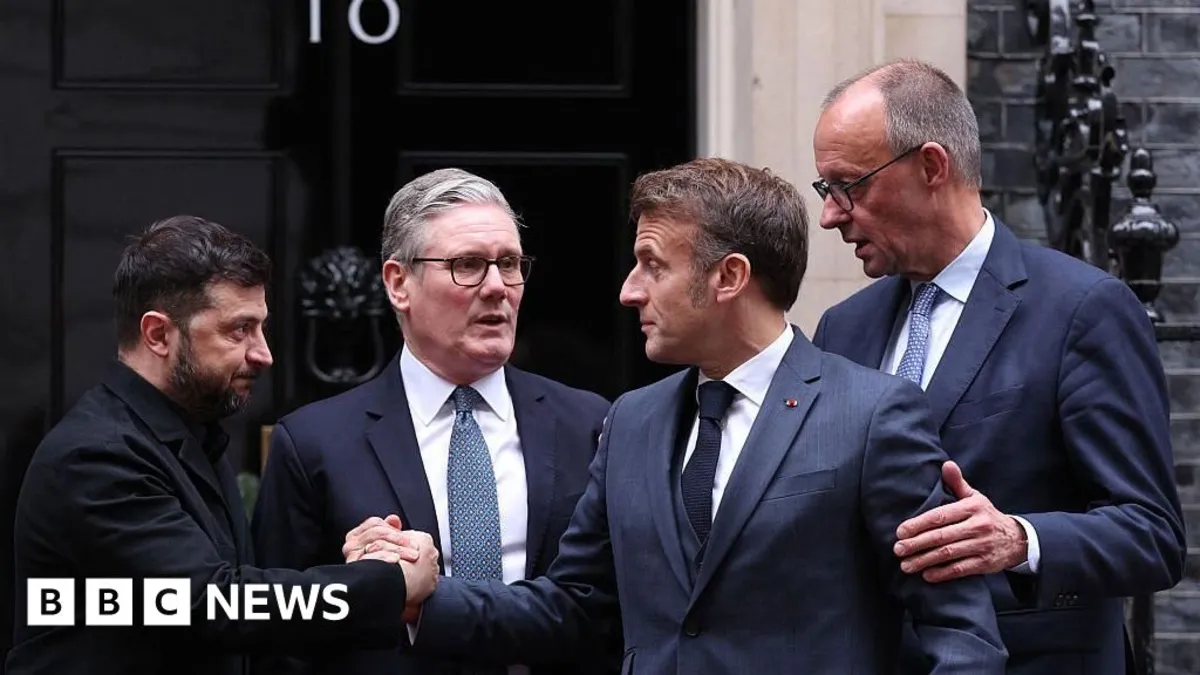
In a significant diplomatic move, Ukraine's President Volodymyr Zelensky recently met with influential European leaders, including UK Prime Minister Sir Keir Starmer, French President Emmanuel Macron, and German Chancellor Friedrich Merz. This meeting in London comes as the United States exerts pressure on Ukraine to expedite a peace agreement with Russia amidst the ongoing conflict.
The discussions in London are critical for Ukraine, particularly regarding complex issues such as the potential cession of territory to Russia and the necessity for robust security guarantees to ensure compliance with any future agreement. Prime Minister Starmer emphasized the importance of "hard-edged security guarantees," reiterating that Ukraine must determine its own future without external imposition.
The stakes of these talks extend beyond Ukraine's borders, affecting the entire continent's security. There are rising concerns that conceding Ukrainian territory to Russia could embolden further aggression against other European nations. The question remains: will these high-level discussions lead to significant progress in peace negotiations?
While the visuals of European leaders standing united with President Zelensky convey a powerful message, the reality is more complex. In light of the recent National Security Strategy released by the US, which criticized European expectations regarding the war's resolution, European leaders find themselves navigating a precarious relationship with Washington. They fear that former President Donald Trump may seek a quick resolution to the conflict, potentially at the expense of a lasting peace.
Recent incidents, such as drone disruptions at civilian airports in Germany, Denmark, and Belgium, along with acts of sabotage and cyber-attacks attributed to Russia, have underscored the immediacy of the threat. These developments have brought the war closer to ordinary Europeans, fostering a growing awareness that Russia aims to destabilize the continent.
Despite the urgency, European leaders have remained reticent about publicly voicing their concerns regarding US policies and peace strategies for Ukraine. In a show of solidarity, Starmer commended the progress made under the current US administration, indicating a willingness to engage in the ongoing peace negotiations. Chancellor Merz expressed skepticism about specific details in the US documents but acknowledged the necessity for dialogue.
The reality is that European nations are heavily reliant on US military support. Following decades of under-investment in their own defense, they are not equipped to independently secure their continent. The US remains the most powerful member of NATO, providing essential intelligence, command capabilities, and advanced military technology, including air-to-air refueling.
European governments are grappling with significant budgetary constraints. In the UK, discussions about struggling public services are prevalent, while France is facing a substantial budget crisis, allocating only €120 million (£105 million) for Ukrainian aid in the upcoming draft budget. These financial limitations contribute to Europe's cautious public stance regarding US relations and the peace process.
The differences between European and US approaches to Russia are stark. While European leaders, especially those from border nations, view Moscow as a destabilizing force, the US National Security Strategy emphasizes the need for strategic stability with Russia, raising questions about Europe's long-term reliability as an ally.
In conclusion, European leaders are striving to balance their need for Ukrainian sovereignty and security with the delicate relationship they maintain with the US. This intricate diplomatic dance continues as the future of Ukraine and broader European stability hangs in the balance.