

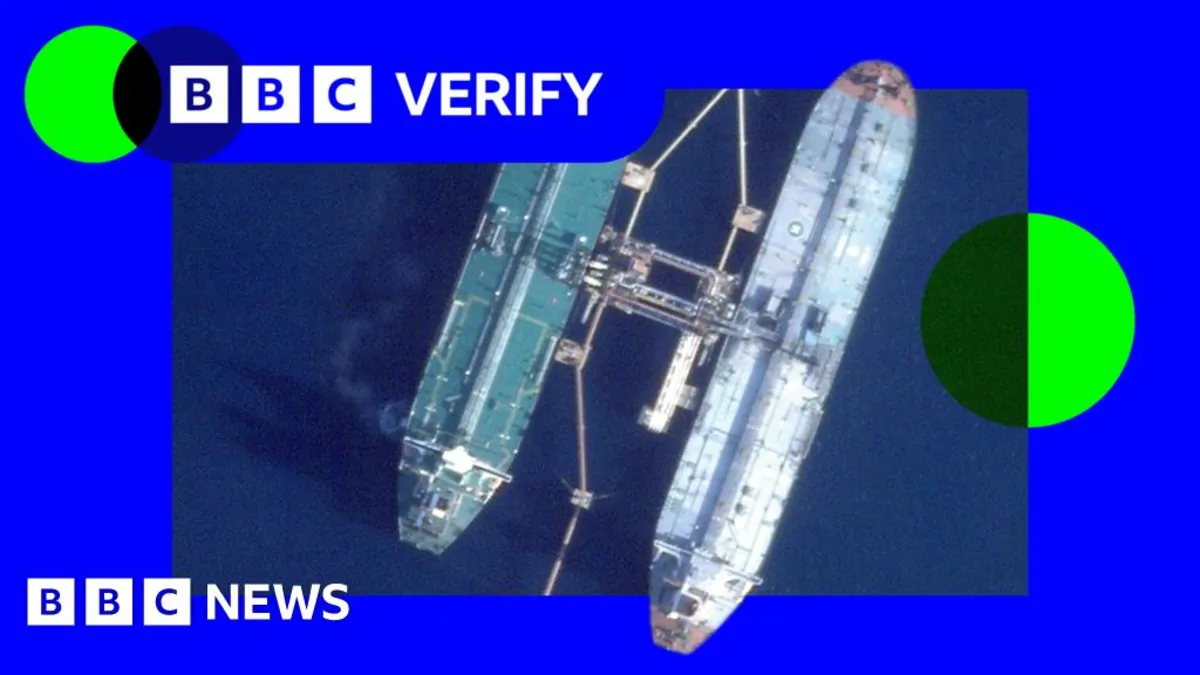
The oil tanker seized by US forces on Wednesday, known as the Skipper, has a long history of faking and concealing its location information. This tactic appears to have been employed to obscure its illicit activities, as revealed by ship tracking data. On Wednesday evening, the US confirmed the seizure of the vessel during a helicopter-launched raid near the coast of Venezuela.
BBC Verify identified the seized ship as the Skipper by matching a sign visible in footage released by the US to a reference photo provided by TankerTrackers.com, a site dedicated to monitoring oil shipments. Prior to its seizure, the Skipper had not declared its position since November 7, leading to an incomplete understanding of its movements through publicly accessible tracking sites.
According to maritime analytics firm Kpler, the vessel had likely engaged in a ship-to-ship transfer of oil, further complicating its tracking. US Attorney General Pam Bondi described the Skipper as a crude oil tanker involved in transporting sanctioned oil from both Venezuela and Iran. The US Treasury Department initially sanctioned the ship in 2022 when it was operating under the name Adisa, accusing it of participating in an international oil smuggling network.
The Skipper has been sailing under the flag of Guyana, but the Guyanese government quickly clarified that the 20-year-old tanker was not registered in their country, indicating it was falsely flying their flag. Experts categorize the Skipper as part of the so-called dark fleet, a global network of oil tankers that aim to evade oil sanctions by obscuring their ownership, identities, and travel histories.
Under a UN treaty, all ships above a certain tonnage are required to have an onboard tracker known as an Automatic Identification System (AIS). These trackers broadcast essential information about the vessels, including their locations, which can be monitored on platforms like MarineTraffic. However, the public record of the Skipper's movements has been incomplete and misleading.
MarineTraffic indicates that the Skipper's last known port call was at Soroosh in Iran on July 9, after stops in Iraq and the UAE. Yet, Kpler suggests this is part of a larger pattern of misleading entries. Analysts from Kpler have noted that the ship has loaded crude oil from both Venezuela and Iran while falsifying its location through its onboard tracker, a process referred to as spoofing.
Venezuela boasts some of the world's largest oil reserves, but its exports have faced sanctions since 2019, a move by the US aimed at forcing a transition of power from President Nicholas Maduro's administration, which has faced widespread allegations of election rigging. Kpler noted that while the AIS indicated the Skipper was at Iraq's Basrah Oil Terminal on July 7 and 8, terminal reports showed no evidence of the vessel being present. Instead, the Skipper was involved in loading crude oil at Kharg Island in Iran.
Afterward, the Skipper sailed east, and Kpler suggests it conducted a ship-to-ship transfer between August 11 and 13, with the cargo later unloaded in China, where it was declared falsely. The vessel returned via Iran and headed towards the Caribbean. The Skipper last declared its position on November 7, several miles off the coast of Guyana, and only reappeared on December 10 after the US raid.
During the interim period, satellite images identified by TankerTrackers.com and confirmed by BBC Verify indicated that the Skipper was in the Port of Jose in Venezuela on November 18, yet it was not visible on any tracking sites at that time. Analysts estimate that the tanker loaded at least 1.1 million barrels of Merey crude by November 16, listing Cuba as its destination. Furthermore, evidence suggests that the Skipper was involved in another ship-to-ship transfer with a different vessel on December 7, just days prior to the US boarding.
This transfer occurred off the coast of Venezuela, near the city of Barcelona. MarineTraffic reported that the Skipper had last been noted off the coast of Guyana weeks earlier. Such activities aimed at evading sanctions are not uncommon within the context of Venezuelan oil exports; Kpler noted that tankers often transfer their cargo off the coast of Malaysia before the oil is ultimately imported into China.
Former Belgian naval lieutenant and analyst Frederik Van Lokeren stated that while ship-to-ship transfers are not inherently illegal, they are quite uncommon and typically indicate an effort to evade sanctions. He emphasized that Venezuela's refining capacity has diminished significantly in recent years, making the country reliant on allies like Iran and Russia to refine its crude oil into more profitable products.
The seizure of the Skipper not only highlights the challenges of monitoring maritime activities but also underscores the ongoing complexities surrounding sanctions and the global oil trade. As the situation evolves, continued scrutiny of such vessels and their operations will be crucial in understanding the dynamics of international oil markets and compliance with sanctions.