

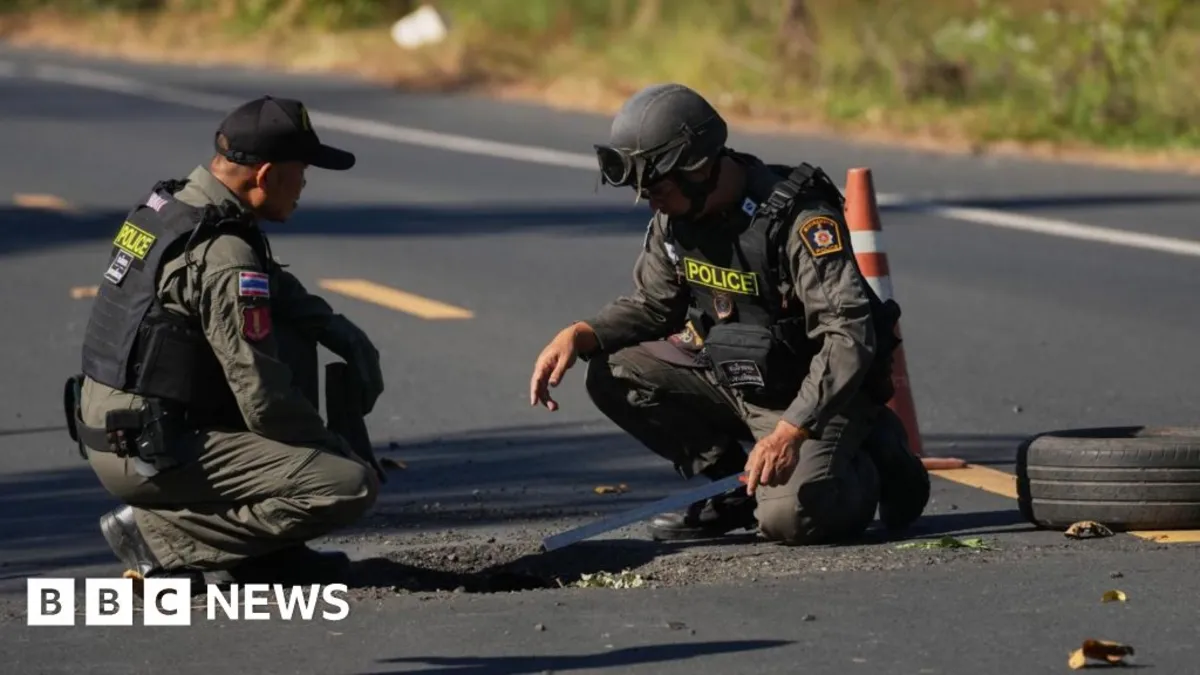
Thailand and Cambodia have reached a significant milestone by agreeing to an immediate ceasefire, as announced by the defence ministers of both nations in a joint statement released on Saturday. This agreement marks a crucial step in halting weeks of intense border clashes that have resulted in the tragic loss of at least 41 lives and have displaced nearly one million individuals.
The ceasefire took effect at noon local time (05:00 GMT), bringing a moment of relief to civilians residing in the border regions. As part of the agreement, both sides have committed to freeze all troop movements, allowing affected civilians to safely return to their homes. Furthermore, after the ceasefire holds for 72 hours, 18 Cambodian soldiers currently held by Thailand will be released, according to the joint statement.
This breakthrough follows several days of negotiations between Thai and Cambodian officials aimed at de-escalating the recent hostilities. The joint statement outlines critical terms for de-escalation, including a complete cessation of attacks on civilians, civilian infrastructure, and military objectives from either side. Both parties are required to refrain from unprovoked firing and from advancing troops towards each other’s positions.
The joint statement also emphasized that the release of the 18 Cambodian soldiers will be conducted in alignment with the Kuala Lumpur Declaration, a peace agreement signed by both nations in October, during a ceremony attended by former US President Donald Trump. This earlier ceasefire agreement had unfortunately collapsed earlier this month, leading to renewed clashes. Both Thailand and Cambodia have exchanged accusations regarding the breakdown of the truce, with Thailand claiming it was responding to fire from Cambodian troops in Ubon Ratchathani Province, resulting in the death of a Thai soldier. Conversely, Cambodia's defence ministry has asserted that Thai forces were the aggressors in Preah Vihear province, claiming they did not retaliate.
Despite the ceasefire announcement, skirmishes have persisted throughout December. In a recent development, Thailand conducted air strikes in a disputed border region in Cambodia, targeting a fortified military position after civilians had vacated the area. The Thai Air Force justified the airstrikes, while Cambodia’s defence ministry condemned them as indiscriminate attacks against civilian homes.
The border disputes between Thailand and Cambodia have a long history, stretching back over a century. However, tensions escalated significantly in May, when a Cambodian soldier was killed during a clash. The situation further deteriorated in July, leading to five days of intense fighting that resulted in numerous fatalities among soldiers and civilians and displaced thousands more.
After interventions from Malaysia and former US President Donald Trump, a fragile ceasefire was negotiated and signed in late October, which Trump referred to as the Kuala Lumpur Peace Accords. This agreement mandated both nations to withdraw heavy weaponry from the disputed areas and set up an interim observer team for monitoring purposes. Unfortunately, the agreement was put on hold in November when Thai Prime Minister Anutin Charnvirakul stated that the security threats had not diminished.
The recent ceasefire is a pivotal moment in the ongoing conflict, and the international community will be closely watching the developments as both nations strive for lasting peace.