

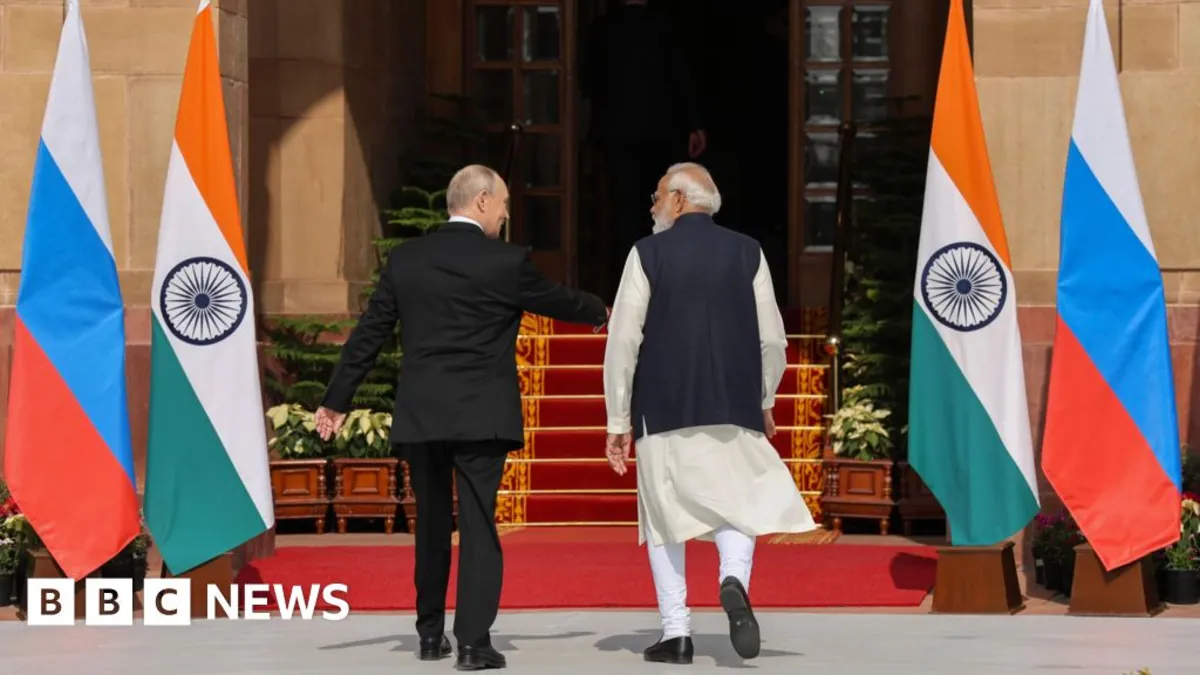
In a significant diplomatic engagement, Russian President Vladimir Putin concluded a packed day in India, starting with a ceremonial banquet at the presidential palace, where he was honored with a guard of honor. This high-profile visit included talks with Indian Prime Minister Narendra Modi, participation in a business forum, and the announcement of the launch of Russia Today, a Kremlin-funded state-controlled TV network. With Putin facing increasing diplomatic isolation since the onset of the Ukraine war in 2022, the warm reception in Delhi sent a powerful message to the West. However, what were the key takeaways for both Delhi and Moscow from this meeting?
Putin's arrival in India was marked by a grand welcome that resonated well with Russian audiences. The ultra-pro-Kremlin news outlet, Komsomolskaya Pravda, highlighted the impressive display featuring a cavalcade, cannon salutes, and the opulent 340-room palace where the meeting took place. Despite the grandeur, the actual agreements reached during the visit were sparse. Nevertheless, both countries were able to showcase their strategic partnership, with Putin emphasizing efforts to enhance cooperation.
Among the few agreements made, notable mentions include the Russia-India economic cooperation programme and a deal concerning critical minerals and supply chains. Additionally, plans were unveiled for a Russian-Indian pharmaceutical factory to be established in Russia's Kaluga region, indicating a move towards strengthening economic ties.
One of the most contentious issues discussed was the ongoing oil trade. India has significantly increased its imports of Russian oil, which has been vital for supporting Russia's economy amid sanctions. This has drawn criticism from the United States, which has accused India of financially aiding the Kremlin's military efforts. During the visit, Putin reiterated Moscow's commitment to providing uninterrupted oil supplies to India; however, no specific details were disclosed, leaving the ball in India's court regarding future purchases.
Speculation was rife regarding potential defense deals, particularly concerning advanced Russian fighter jets and air defense systems. However, no major defense agreements were announced, suggesting that India is carefully balancing its historical ties with Russia against its growing relationship with the United States. This balancing act was evident as the focus of the visit shifted away from defense deals to trade and economic collaboration.
The visit was characterized by high-profile optics, including Modi's notable reception of Putin at the airport, a rare honor that underscores the value India places on its long-standing relationship with Russia. Despite the fanfare, significant trade deals were noticeably absent. Both leaders emphasized the mutual respect between their nations, yet there were no groundbreaking announcements. Instead, the focus remained squarely on trade, which is critical for both countries, given their current economic challenges.
With Western sanctions impacting Russia and India facing heavy tariffs from the U.S., both nations are keen to explore alternative markets. The current trade volume between Russia and India has surged to approximately $68.72 billion, a significant increase from just $8.1 billion in 2020, primarily driven by India's purchase of discounted Russian oil. While Putin's statement about ongoing fuel shipments serves as a reminder of the importance of this trade relationship, it also signals India's challenge in navigating U.S. pressure to halt oil imports from Russia.
Beyond discussions on oil and defense, several agreements were signed across various sectors, including shipbuilding, training Indian seafarers for polar operations, and investments in new shipping lanes. Modi highlighted the importance of enhancing business ties, reflecting India's desire to tap into new markets. The leaders discussed the ongoing negotiations for a potential free trade agreement with the Eurasian Economic Union (EAEU), which comprises Russia, Armenia, Belarus, Kazakhstan, and Kyrgyzstan.
This trade agreement is aimed at facilitating greater market access among the member countries, and both leaders expressed their ambition to achieve a target of $100 billion in bilateral trade within five years. Although this goal may seem ambitious, especially without relying heavily on discounted oil, the emphasis on diversifying trade partnerships is crucial for both nations as they seek to strengthen their economic ties.
In conclusion, while the absence of a major defense deal may raise questions about the future of military collaboration between India and Russia, the ongoing discussions and negotiations indicate that both countries remain committed to deepening their strategic partnership through trade and economic cooperation.