

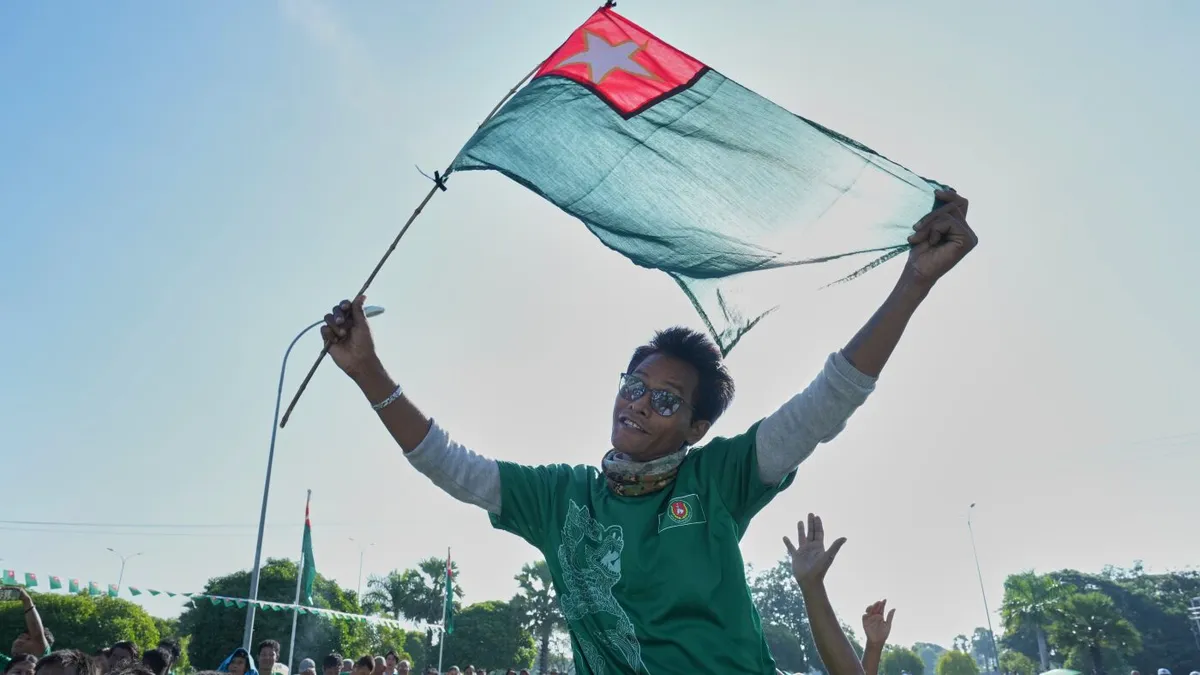
In a move that has raised eyebrows internationally, Myanmar's military rulers have announced a staggered general election set to commence on December 28 and conclude in late January. The junta's primary objective is to restore some semblance of stability to the nation while attempting to mitigate its ongoing diplomatic isolation on the world stage. This election is taking place against the backdrop of a brutal civil war that erupted following the military's coup in 2021, which has plunged Myanmar into a state of chaos.
Since the coup, the military has indiscriminately targeted civilians, resulting in thousands of arrests and displacing millions. Current reports from aid agencies indicate that over 11 million people are facing food insecurity, a clear indicator of the humanitarian crisis exacerbated by the ongoing conflict. The military's attempts to reclaim territories lost to opposition forces have become increasingly desperate, as the junta struggles to control large swaths of the country.
At a recent summit of the Association of Southeast Asian Nations (ASEAN) in Malaysia, United Nations Secretary General António Guterres raised serious questions regarding the possibility of free and fair elections in Myanmar. He remarked, "It is quite obvious that in the present state of conflict... the conditions for free and fair elections are not there." The reality is that, under the current circumstances, many observers doubt the integrity of the electoral process.
In a bid to control the electoral narrative, the military has enacted a new law banning what it describes as interference in the election process. Human Rights Watch reported that nearly 100 individuals had been detained under this law by November, a number that has since more than doubled. Some detainees are facing severe penalties for merely expressing their opinions online regarding the election, or for engaging with critical social media posts.
Most Western governments have condemned the upcoming election as a sham, refusing to send observers. Critics argue that the military is attempting to establish a parliament dominated by its proxy party, the Union Solidarity and Development Party (USDP), which suffered a crushing defeat at the hands of Aung San Suu Kyi's National League for Democracy (NLD) in the 2020 elections. Notably, the NLD is banned from participating in this election, and Suu Kyi, along with other prominent leaders, remains imprisoned.
As the military seeks to regain lost ground, analysts like Morgan Michaels from the International Institute for Strategic Studies (IISS) highlight that the junta has begun to turn the tide in the conflict. The implementation of a conscription campaign and the use of advanced drones have contributed to the military's resurgence. However, the opposition remains fragmented and has made several strategic errors, complicating their ability to mount effective resistance.
China has emerged as a significant player in this complex situation, viewing Myanmar's military as a "necessary evil." Yun Sun from the Stimson Center emphasizes that while Beijing disapproves of the military and its coup, the resulting chaos threatens China's extensive infrastructure investments in Myanmar, notably the China-Myanmar Economic Corridor. This corridor is crucial for China's geopolitical ambitions, linking it to South Asia and the Indian Ocean.
Another factor that may bolster the military's chances is the growing fatigue among the opposition. Nearly five years into the conflict, many young fighters are beginning to lose hope and are seeking better opportunities abroad, particularly in Thailand. Analyst Min Zaw Oo points out that this trend signifies a shift in commitment among those who initially joined the armed struggle against the military.
Despite the grim realities, some opposition members, like rebel commander Ko Ta Mar, remain resolute in their fight against the junta. He expresses frustration over the lack of unity and direction within the opposition but emphasizes the existential importance of their struggle. "If you see the crisis in the country as a disease, the election is like injecting steroids into a patient," he comments, illustrating the complex dynamics at play.
As Myanmar approaches the election period, many citizens express a desire for relief from the ongoing turmoil. However, the shadow National Unity Government, which represents the ousted government, is perceived as lacking a coherent plan. David Mathieson, a seasoned analyst on Myanmar, notes that many citizens desire a semblance of stability, even if it means accepting a regime they detest.
The second and third rounds of elections are expected to take place in January, as the junta continues to gamble on restoring order domestically while easing its diplomatic isolation. The future of Myanmar remains uncertain, and the international community watches closely as events unfold.