

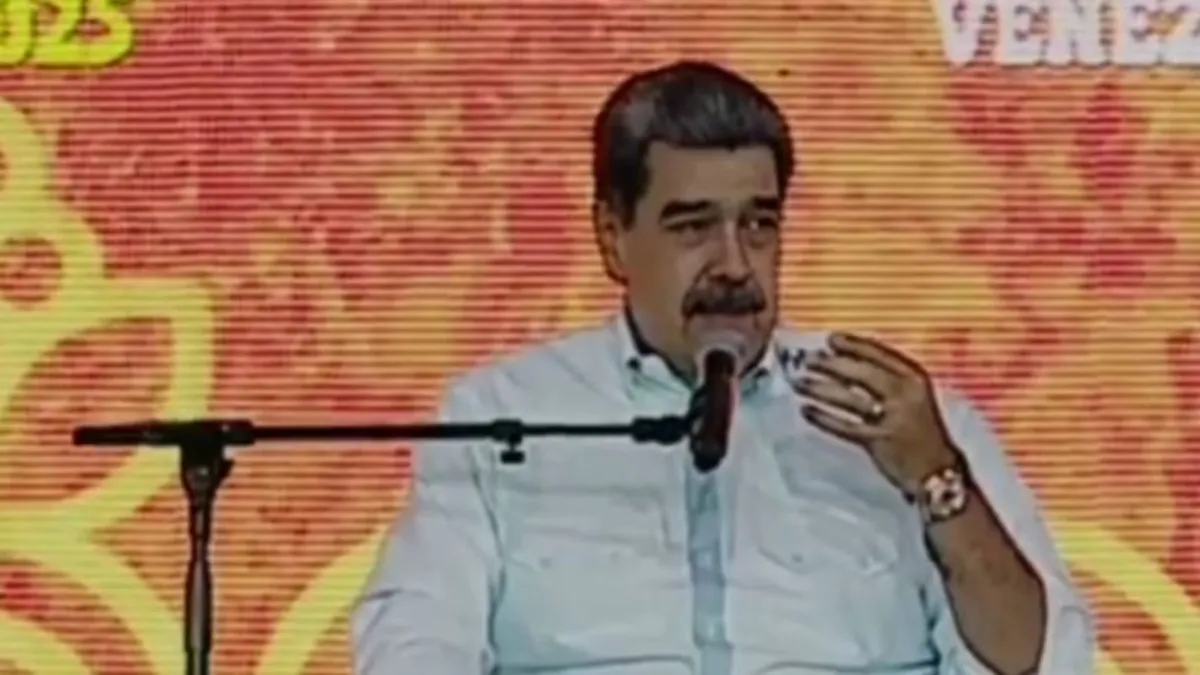
Venezuelan President Nicolás Maduro made his first public appearance in several days on Sunday, effectively quelling speculation regarding his potential flight from the country amidst increasing tensions with the United States. Typically a frequent presence on Venezuelan television, Maduro had not been seen in public since Wednesday, when he shared a video of himself driving around Caracas on his Telegram channel. His absence sparked intense rumors about his whereabouts and the stability of his regime.
On Sunday, Maduro emerged at an annual specialty-coffee awards event held in eastern Caracas. Photographs broadcasted online showed him seated before an audience, distributing medals to coffee producers who showcased their finest products. Throughout the event, he sampled various coffees and delivered brief remarks that notably avoided addressing the ongoing crisis in Venezuela. In a show of defiance, he concluded his speech by asserting that Venezuela is “indestructible, untouchable, unbeatable,” a statement perceived as a direct response to the escalating tensions with the US.
The backdrop of Maduro's appearance is marked by the US deploying over a dozen warships and approximately 15,000 troops to the surrounding region under the guise of combating drug trafficking. However, the Venezuelan government interprets these actions as a strategy to destabilize Maduro’s administration. This speculation intensified immediately after US President Donald Trump confirmed a phone call with Maduro, stating, “I wouldn’t say it went well or badly. It was a phone call,” during a press conference aboard Air Force One.
Jorge Rodríguez, who leads Venezuela’s National Assembly, refrained from discussing the Trump-Maduro conversation during his press conference. Instead, he focused on announcing an inquiry into recent US maritime strikes on alleged drug boats in the Caribbean, which reportedly resulted in over 80 fatalities. In a bid to further assert pressure on Maduro, Trump has warned that land strikes against drug trafficking networks could occur “very soon” and cautioned commercial airlines and pilots to avoid Venezuelan airspace.
In a dramatic escalation of the situation, Maduro accused the US of attempting to seize Venezuela’s oil reserves through military force. In a letter directed to OPEC Secretary General Haitham Al Ghais, dated November 30, Maduro claimed the US has made “constant and repeating express threats” against Venezuela, jeopardizing both national stability and the international oil market. Venezuela’s oil reserves are among the largest globally, making this accusation particularly significant.
Maduro’s Foreign Affairs Minister, Yvan Gil Pinto, reiterated this stance on Telegram, vowing to defend Venezuela’s natural energy resources and stating, “Nothing will stop us. We will continue to be free and sovereign!”
Venezuela has vehemently condemned the US military strikes, labeling them as “murder.” This marked the first acknowledgment from Caracas that Venezuelan citizens were among those killed in these strikes. Rodríguez emphasized the lack of a declared war between the two nations, thus categorizing the attacks as unlawful. He stated, “Every human being has the right to due process; no human being can be killed in a brutal manner.”
As the nation grapples with these accusations, the Maduro government is under scrutiny for past allegations of human rights abuses, including extrajudicial killings. According to the Office of the UN High Commissioner for Human Rights, Venezuelans facing government repression are routinely denied fair trials. Human rights groups have reported that over 50 individuals were detained for political reasons in October alone, further complicating the human rights landscape in Venezuela.
In conclusion, Maduro's recent public appearance and the subsequent political developments highlight the fragile state of affairs in Venezuela, as rising tensions with the US continue to pose a significant threat to the Maduro administration and its legitimacy.