

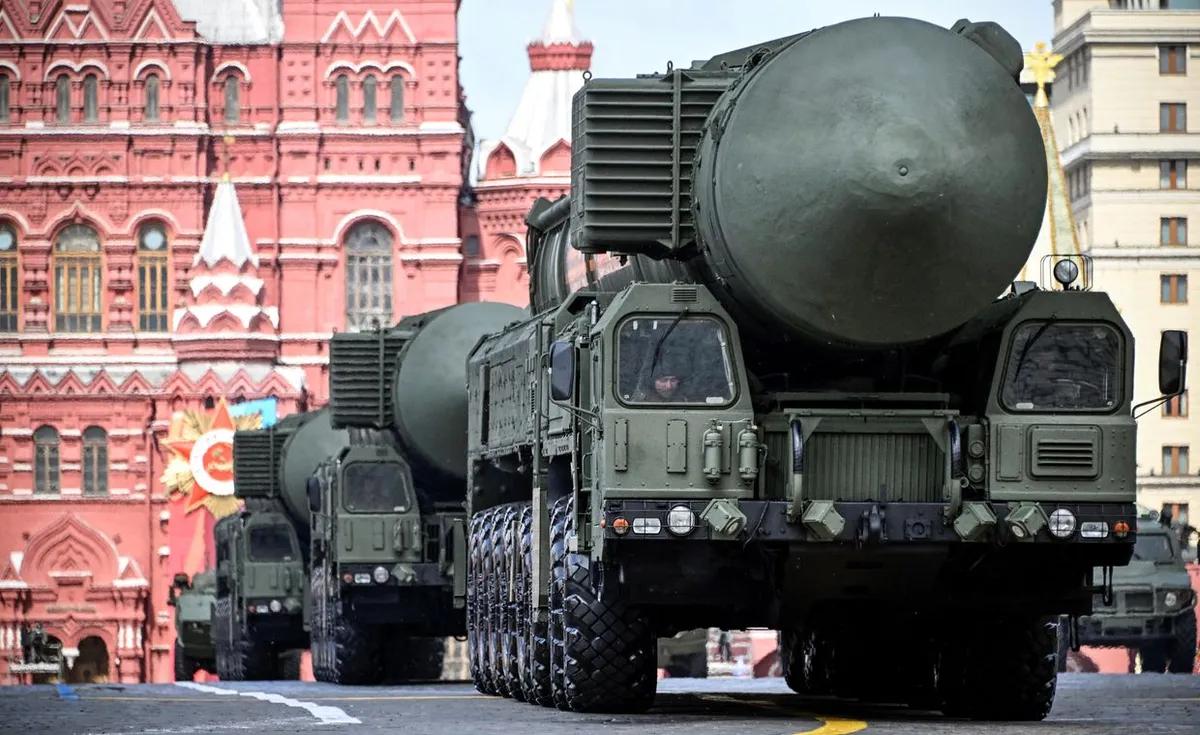
In a significant escalation of the conflict, Russia fired its new Oreshnik intermediate-range ballistic missile at the western Ukrainian city of Lviv overnight on January 9, 2024. The Russian Defense Ministry labeled this attack as retaliation following an alleged Ukrainian drone strike aimed at one of President Vladimir Putin's residences, a claim that the Ukrainian government has categorically denied.
The Security Service of Ukraine (SBU) showcased what it claimed were fragments from the ballistic missile involved in the strike, asserting that preliminary analysis indicated these components were indeed part of the Oreshnik missile system. According to a statement on the agency's Telegram channel, the SBU is currently investigating the use of this weapon against civilian infrastructure, which could constitute a war crime under Article 438 of Ukraine’s Criminal Code.
The Oreshnik missile, touted as a new and hard-to-intercept system, is designed to potentially carry nuclear weapons. However, reports indicate that the missile used in the attack on Lviv, located approximately 60 kilometers (37 miles) from the Polish border, was not equipped with nuclear warheads. Eyewitness accounts from reporters on the ground in Lviv noted a rapid sequence of approximately four to five explosions around midnight, coinciding with an air raid alert, though there was no prior warning of an incoming missile or drone.
While Ukraine's Air Force did not explicitly identify the weapon as an Oreshnik, it confirmed that one medium-range ballistic missile was launched from the Kapustin Yar test site in Russia’s Astrakhan region as part of the assault. In light of this strike, Ukraine's Deputy Foreign Minister Andriy Sybiha announced plans to convene an emergency meeting of the United Nations Security Council and a session of the Ukraine–NATO Council. Additional discussions are also set to take place within the European Union, the Council of Europe, and the OSCE.
Sybiha emphasized that such a strike near the EU and NATO border constitutes a serious threat to security on the European continent and serves as a test for the transatlantic alliance. He criticized Moscow for lacking legitimate reasons for the attack, accusing it of utilizing fabricated justifications to rationalize its aggression. "Putin deploys an intermediate-range ballistic missile near EU and NATO borders in response to his own delusions—this poses a global threat that requires a global response," Sybiha remarked on social media platform X.
Furthermore, he called on the international community to implement stricter measures against Russia, particularly targeting the nation’s oil revenues, disrupting its shadow tanker fleet, and freezing Russian assets globally. In contrast, Russia’s Defense Ministry claimed that the Oreshnik strike was aimed at energy infrastructure and drone production facilities, while Ukraine's Deputy Energy Minister Mykola Kolisnyk reported damage to gas distribution pipelines in Lviv.
This incident marks the second deployment of the Oreshnik missile in a strike against Ukraine, following its initial use against Dnipro on November 21, 2024. Defense expert and doctoral research fellow at the University of Oslo, Fabian Hoffmann, indicated that he would be surprised if the Oreshnik contained more than 10% new components, suggesting it likely relies heavily on the RS-26 Rubezh, a nuclear-capable intermediate-range ballistic missile first produced in 2011. The RS-26 has a known range of 5,800 kilometers (3,604 miles) and is capable of carrying a MIRV payload, featuring multiple independent reentry vehicles.
This ongoing conflict continues to pose serious implications for regional stability and international security, with the situation in Ukraine remaining a focal point of global concern.