

On Tuesday, the People’s Liberation Army (PLA) of China continued its extensive military exercises around Taiwan, marking the second day of operations under the banner of “Justice Mission 2025.” These drills aim to showcase China's military strength and deter any external support for Taiwan, a self-governed island that China claims as part of its territory. The PLA's Eastern Theater Command deployed an array of military assets, including destroyers, frigates, fighters, and bombers, to test its sea-air coordination and blockading capabilities in the waters surrounding Taiwan.
The military maneuvers involved long-range, live-fire drills conducted by ground forces in the waters north of Taiwan, where they also executed training exercises simulating joint strikes using air, naval, and missile units. Command spokesperson Li Xi stated that these exercises achieved the "desired effects," contributing to heightened tensions in the Taiwan Strait as 2025 approaches.
In response to the drills, Taiwan's Civil Aviation Administration reported the establishment of seven temporary "dangerous zones" around the strait. This announcement disrupted the operations of Taiwan’s four international airports, resulting in over 100 international and domestic flights facing schedule changes, delays, or cancellations.
Xinhua, China's state-run news agency, emphasized that the drills were a clear warning from Beijing, stating that the Chinese government is always prepared to prevent any attempts to separate Taiwan from China. The commentary criticized Taiwan's ruling Democratic Progressive Party (DPP) for aligning itself with the United States and pursuing a path towards independence, which it claims jeopardizes public opinion and regional stability.
Taiwan’s President Lai Ching-te responded to the escalating situation by asserting that Taiwan would act responsibly and avoid escalating conflict. He expressed concerns over China's increasing military pressure, which he deemed inappropriate for a major nation.
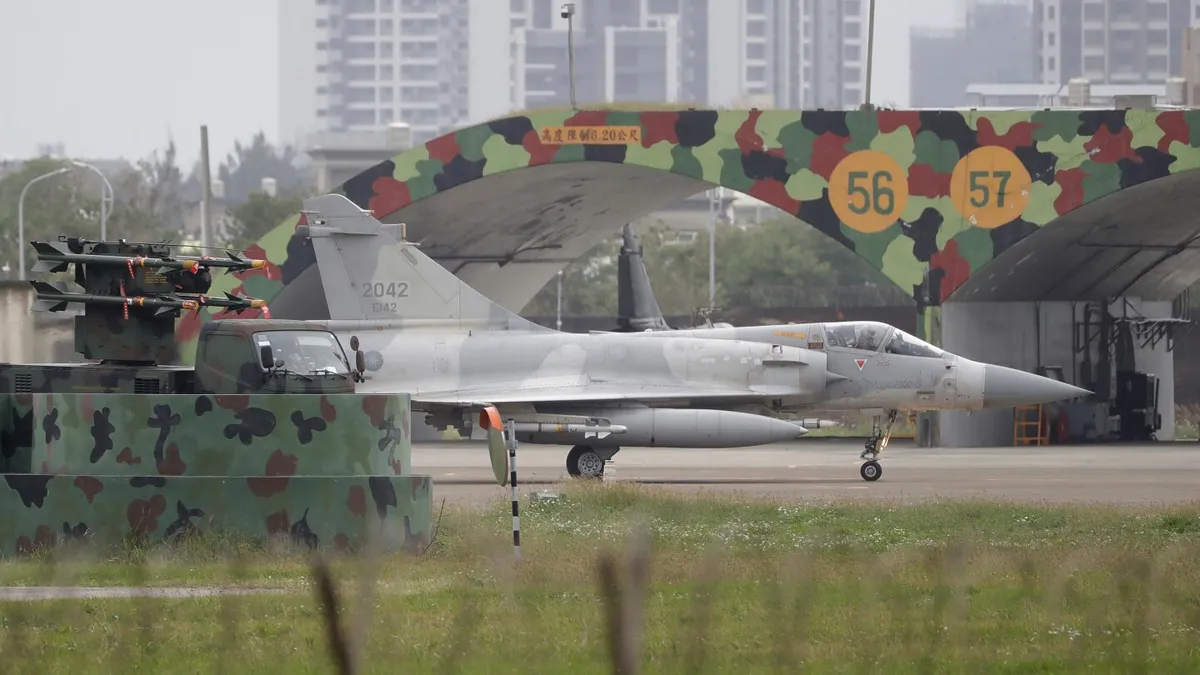
According to Taiwan’s Defense Ministry, from 6 a.m. Monday to 6 a.m. Tuesday, they detected 130 Chinese aircraft, including fighters and bombers, as well as 14 military ships and eight other official vessels in the vicinity of the island. The Taiwanese forces remained vigilant, deploying aircraft, naval ships, and coastal missile systems in response to the heightened military activity. Notably, 90 of the detected Chinese aircraft crossed the median line of the strait, and a military balloon was also reported.
In a provocative display, a long-range artillery unit from Fujian Province fired live rounds toward a target zone located 44 kilometers (approximately 24 nautical miles) off Taiwan's coast. Taiwan’s Defense Minister Wellington Koo condemned these actions as highly provocative, undermining regional stability and posing significant security threats to maritime and air traffic.
The scale of these military exercises has heightened tensions between Taiwan and China, especially given Beijing's ongoing commitment to reclaim the island, even by force if necessary. Chinese Defense Ministry spokesperson Zhang Xiaogang indicated that the drills served as a stern warning to both "Taiwan independence" separatist forces and external parties, without specifically naming any countries.
Last week, in a related development, Beijing imposed sanctions against 20 U.S. defense-related companies and 10 executives following an announcement from Washington regarding a substantial arms deal with Taiwan, valued at over $10 billion. This arms deal is still pending approval from the U.S. Congress, but it underscores the complex relationship between the U.S. and Taiwan, which has become increasingly contentious over the years.
In a recent statement, U.S. President Donald Trump remarked that, while he was not informed of the military exercises beforehand, he was not particularly concerned about them. He emphasized his "great relationship" with Chinese President Xi Jinping and expressed skepticism that Xi would order an attack on Taiwan.
The situation has also sparked tensions between China and Japan. Beijing reacted strongly to comments made by Japanese Prime Minister Sanae Takaichi, stating that Japan's military could intervene if China took military action against Taiwan. This reaction is rooted in historical grievances stemming from Japan's wartime actions in China.
Since 1949, when China and Taiwan began to be governed separately, Taiwan has transitioned from martial law to a multiparty democracy, while China has maintained its claim over the island. In light of the recent military drills, Taiwan has labeled the Chinese government as "the biggest destroyer of peace," warning that live-fire exercises around the strait pose significant challenges for the international community.
To mitigate the impact on local fishermen, the Keelung District Fishermen’s Association began hourly radio broadcasts to inform fishers about the locations of Chinese military exercises, advising them to steer clear of danger zones. Chairman Chen Wen-chin highlighted the economic burdens these exercises have imposed on local fishing communities, severely disrupting their livelihoods.