

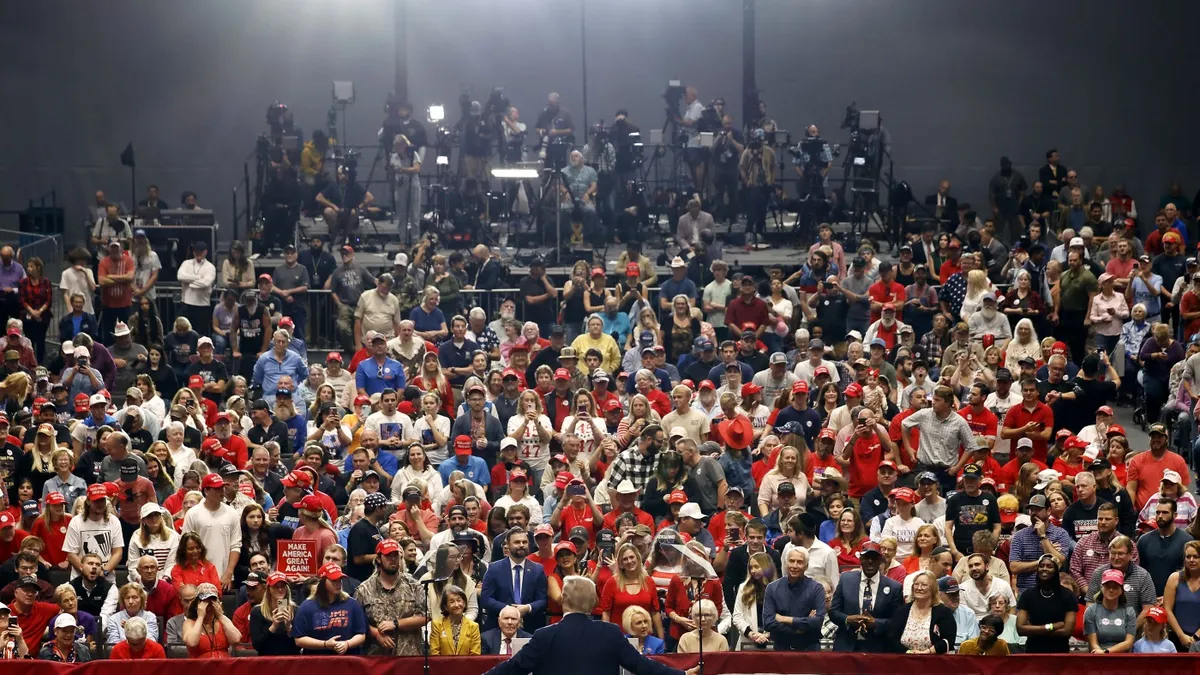
Rocky Mount, N.C. – President Donald Trump is set to visit Rocky Mount, North Carolina, on Friday, bringing attention to his administration's ongoing efforts to reassure the American public about the improving state of the nation’s economy. This visit comes after a week in which Trump addressed the economic challenges facing the country, attributing them to the policies of former President Joe Biden. In a primetime address on Wednesday, Trump emphasized that the current economic situation is a direct result of the previous administration's decisions.
Earlier this month, the President also traveled to the swing state of Pennsylvania to deliver a similar message, blaming the Biden administration for the difficulties his own administration is now facing. He declared that he is actively working to ignite an economic turnaround. Despite his efforts, recent polling data indicates that only 36% of voters approve of Trump's management of the economy, marking the lowest approval rating in six years according to a NPR/PBS News/Marist poll.
Moreover, Trump’s popularity appears to be waning in North Carolina, a pivotal state he has successfully won in the last three presidential elections. A late November poll conducted by High Point University revealed that approximately 60% of North Carolina voters disapprove of Trump’s approach to inflation, while 52% disapprove of his tariff policies. Nonetheless, Trump is focusing his efforts on a crucial area of this purple state, particularly in a congressional district that has been redrawn to help Republicans maintain control of Congress.
Local residents in Rocky Mount have mixed feelings about Trump's policies. For instance, Ronnie Peede, an HVAC technician who voted for Trump in the previous election, expressed his desire to see more people return to work and reduce dependency on government assistance. Peede acknowledged that while HVAC prices initially surged due to Trump’s tariffs, they have since stabilized and even decreased in some cases.
Conversely, Jonathan Sutton, a barbershop owner and Democrat, reported experiencing higher costs for certain products sourced from Europe, attributing this to Trump's tariffs. However, Sutton refrained from placing the blame entirely on the President for broader inflation trends, stating, "I think prices just go up, period." He also criticized Trump’s communication style, citing recent comments made by the President that he found insensitive.
Trump's visit to Rocky Mount is particularly significant as it coincides with the closing of the filing period for North Carolina's 2026 elections. The state is gearing up for highly competitive races in both the U.S. House and the U.S. Senate. North Carolina is poised to host one of the most closely watched U.S. Senate races, with Democratic and Republican voter registrations nearly evenly matched.
Former Governor Roy Cooper is anticipated to secure the Democratic nomination for the Senate race, having previously won two terms while Trump was also on the ballot. Among the GOP candidates, Trump has endorsed Michael Whatley, a former Republican National Committee chairman, while other candidates, including former U.S. Navy JAG officer Don Brown and state superintendent candidate Michele Morrow, are positioning themselves to the right of Whatley.
North Carolina has become a focal point in the nationwide redistricting battle, with Republicans drawing new congressional districts that strategically favor their candidates ahead of the upcoming midterm elections. Rocky Mount is located in the 1st congressional district, which has seen significant changes to enhance Republican prospects.
Historically, this district has been represented by Black Democrats since Eva Clayton became the first Black person elected to Congress from North Carolina in 1992. Recent legal challenges to the new district maps have raised concerns about diluting the influence of Black voters; however, federal judges have upheld the maps, citing their intent to minimize Democratic voter power.
As of now, four Republican candidates have declared their intention to run in this 23-county district, though Trump has yet to endorse any specific candidate in the primaries. Local voters like Peede express a desire to evaluate candidates on their merits rather than solely based on Trump's endorsement, stating, "I still like to look at the candidates to see what they stand for."
As the political landscape in North Carolina evolves, all eyes will be on the outcomes of these pivotal races and how Trump's influence plays a role in shaping the future of the state.