

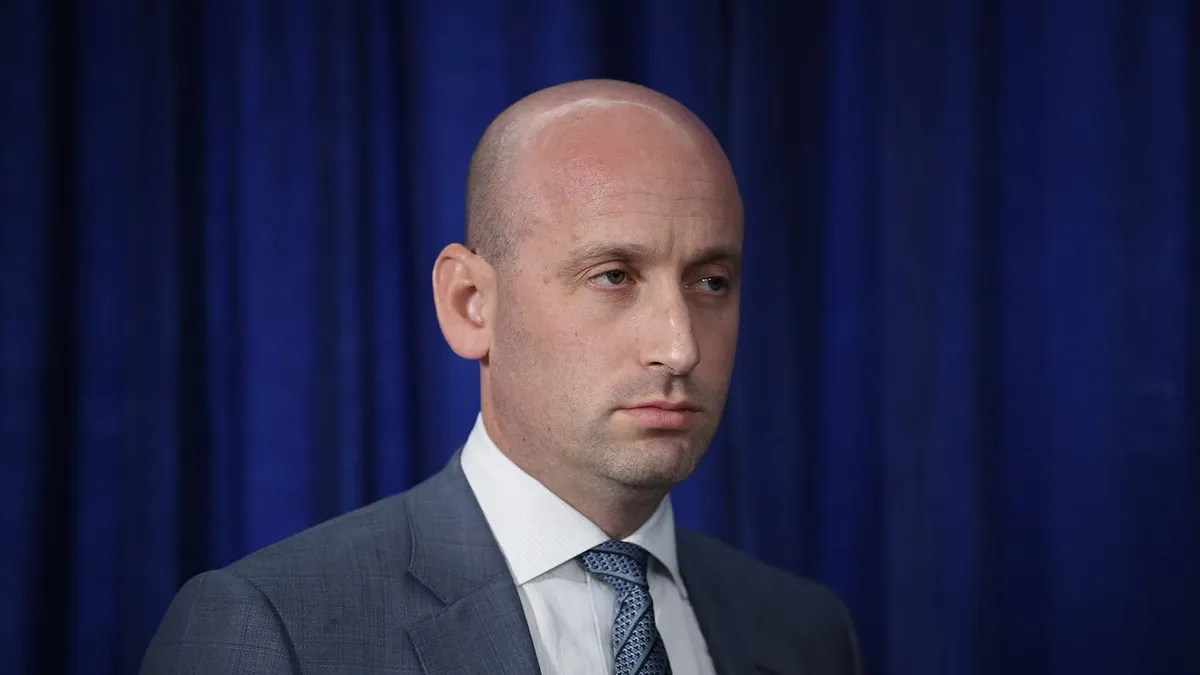
On Monday, Stephen Miller, the White House Deputy Chief of Staff, made controversial remarks asserting that Greenland should belong to the United States. Miller claimed that no nation would challenge the U.S. militarily if it decided to lay claim to the self-governing island. His statements have drawn significant attention as they escalate President Trump's ambitions for territorial expansion, raising alarms among NATO allies, particularly in Nordic and European countries.
Miller's comments come in the wake of heightened tensions after a social media post by former Trump official Katie Miller, who is also his wife. She shared an image of Greenland adorned with an American flag, captioned “SOON,” shortly after the U.S. conducted a notable operation in Venezuela. This has fueled fears of a potential U.S. takeover of Greenland, which would trigger a significant crisis within NATO.
During an interview with CNN's Jake Tapper, Miller was pressed multiple times about the possibility of military action against Greenland. He emphasized the U.S. military's strength and described Greenland as a territory that “should obviously be part of the United States.” When asked to clarify the president's intentions, Miller stated there was no need to link Trump's desire for Greenland to military operations, further complicating the narrative.
In his comments, Miller suggested that the international landscape is governed by “strength” and “power,” asserting that no country would engage in military conflict with the U.S. over Greenland's future. This stance raises serious implications for NATO, as any attempt to seize Greenland by force would mark the first direct military aggression between NATO members since the alliance’s formation in 1949.
Leaders from Greenland and Denmark have unequivocally rejected Trump's renewed interest in Greenland, which he claims is motivated by security concerns. In a statement released by Danish Prime Minister Mette Frederiksen, European leaders expressed solidarity with Denmark and reaffirmed their commitment to the principles of the UN Charter, which include sovereignty and territorial integrity. The statement emphasized that “Greenland belongs to its people,” asserting that decisions regarding the island should rest solely with Denmark and Greenland.
Additionally, individual Nordic leaders have echoed this sentiment, with Swedish Prime Minister Ulf Kristersson stating that only Denmark and Greenland have the authority to determine their future. This united front among Nordic countries highlights the gravity of the situation and the potential repercussions for international relations.
A White House spokesperson, Anna Kelly, stated that President Trump views Greenland as a strategically vital location essential for national security. Kelly believes that the people of Greenland would benefit from U.S. protection against modern threats in the Arctic region. However, Greenland's Prime Minister, Jens-Frederik Nielsen, has condemned the rhetoric from Washington, insisting that Greenland is not merely a pawn in geopolitical games but a distinct people, land, and democracy deserving of respect.
President Trump’s assertions reflect a broader strategy reminiscent of a “Donroe Doctrine” aimed at asserting U.S. dominance in the hemisphere, which includes aggressive posturing in Venezuela. Paula Pinho, a spokesperson for the European Commission, emphasized that any military action against Greenland would signify a monumental shift in NATO's dynamics, potentially fracturing the alliance.
Prime Minister Frederiksen articulated the severity of the situation, stating that if the U.S. were to launch a military attack on another NATO country, it would fundamentally alter international relations as we know them. The ongoing dialogue around Greenland not only impacts U.S.-Nordic relations but also has profound implications for the future of NATO and collective security.
In conclusion, the White House's stance on Greenland serves as a pivotal flashpoint in international diplomacy, raising questions about territorial integrity, national security, and the stability of longstanding alliances.