

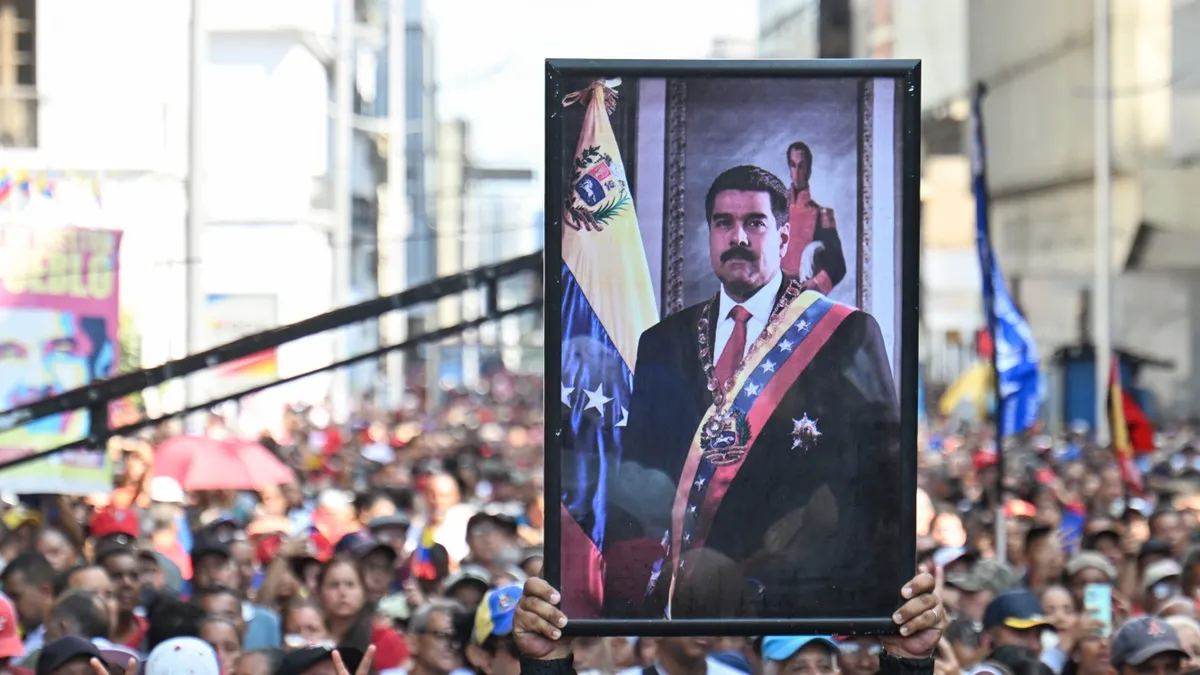
In a stunning turn of events, a prediction market trader capitalized on the recent capture of Venezuelan leader Nicolás Maduro by the Trump administration, resulting in a considerable profit of nearly half a million dollars. This profitable wager was placed on Polymarket, a leading platform for betting on real-world occurrences, where a user staked $32,000 predicting that Maduro would be toppled by the end of January. This wager was made mere hours before the operation was executed. Once the news broke that the U.S. had successfully captured Maduro, the trader reaped over $400,000 in profit.
The question arises: was this trader simply fortunate, or did they possess insider knowledge of classified government discussions? As of now, the answer remains elusive. Despite efforts by online investigators to uncover the identity of this trader, they have yet to succeed. Initially using the username Burdensome-Mix, the account later changed to a seemingly random assortment of letters and numbers. Notably, this account had joined Polymarket just weeks before placing the lucrative bet on Maduro.
Most users on prediction markets like Polymarket and Kalshi typically operate under pseudonyms rather than their real identities. However, if these accounts are linked to identifiable cryptocurrency wallets, there is a possibility of revealing the user’s identity. According to Chainalysis, a firm specializing in tracking cryptocurrency transactions, they have been unable to identify the account owner. They noted that the trader is utilizing several U.S. crypto exchanges for cashing out, which indicates a lack of intent to obscure their identity through offshore exchanges, a tactic often associated with fraudulent activities.
The incident raises important questions about insider trading within prediction markets. Daniel Taylor, a professor at the Wharton School of the University of Pennsylvania, points out that it is often easier to identify suspicious activities in hindsight than in real-time scenarios. The ongoing mystery surrounding the trader who placed the bet on Maduro has ignited discussions about the risks of insider trading on prediction markets, where financial experts warn that regulatory oversight may be insufficient.
Unlike the stock market, which is closely monitored by the Securities and Exchange Commission (SEC) for potential insider trading, prediction markets operate with far fewer regulations. Polymarket and Kalshi fall under the jurisdiction of the Commodity Futures Trading Commission (CFTC), which can enforce anti-fraud regulations, including those against insider trading. However, the CFTC's workforce is significantly smaller than that of the SEC, with only about one-eighth the staff, despite Kalshi processing more than $2 billion in trades within a single week.
The presence of Donald Trump Jr. as an adviser to both Polymarket and Kalshi raises concerns about potential conflicts of interest in regulatory oversight. Experts like Jeffrey Sonnenfeld from the Yale School of Management suggest that the CFTC's scrutiny may be compromised due to its ties to the Trump family. Similarly, Columbia Business School professor Yash Kanoria emphasizes that the connections to the Trump administration could undermine confidence in regulators to monitor these platforms effectively for insider trading.
The CFTC and Polymarket have not responded to requests for comment regarding these issues. In contrast, Kalshi has publicly stated that their platform prohibits insider trading, particularly by government employees engaged in prediction markets related to government activities. Likewise, Polymarket has established rules against market manipulation in a broader context.
The Biden administration has taken a more stringent approach toward prediction markets, contesting their legality in court concerning bets on U.S. elections and opposing sports betting, which remains illegal in nearly 20 states. In contrast, the Trump administration adopted a more relaxed stance, with the Justice Department and CFTC dropping investigations into prediction markets. Additionally, Trump’s social media platform, TruthSocial, has announced plans to launch its own prediction market.
There have been other notable instances of potential insider trading on Polymarket; for example, a trader once profited nearly $1 million by accurately predicting 22 out of 23 of Google’s most-searched terms. According to Professor Taylor, even if it could be proven that someone used non-public information to profit in a prediction market, a successful prosecution would hinge on demonstrating harm. The question remains: how would the U.S. government be harmed by a trader acting on advanced knowledge of the Maduro operation?
If it cannot be shown that such trading deprives someone of value, building a strong case against insider trading becomes exceedingly challenging. If you have insights or information regarding the Maduro trade or potential insider trading activities on prediction markets, feel free to reach out to Bobby Allyn via the encrypted messaging app Signal at ballyn.77.