

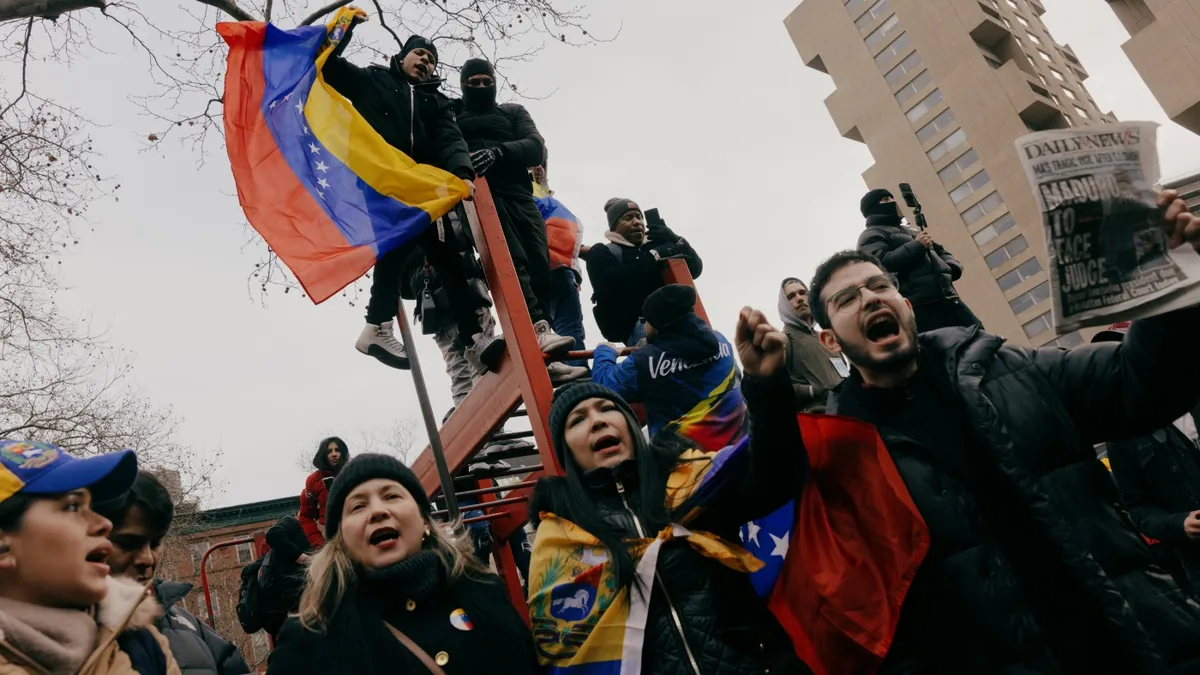
In recent days, Sebastian, a 28-year-old Venezuelan architect residing in Miami, has experienced a whirlwind of emotions. Identifying himself only by his first name due to his ongoing immigration case, Sebastian expressed his initial happiness upon hearing the news that U.S. forces had captured Venezuelan President Nicolás Maduro in the early hours of January 3. "I felt a relief because I thought that there'd be a radical change in the country," he told NPR. "Maybe things were going to be different."
However, his optimism was short-lived. During a press conference later that day, President Trump announced that his administration had engaged in discussions with Delcy Rodríguez, Maduro's deputy and vice president. Trump revealed that the U.S. was collaborating with her to implement plans for governance in Venezuela. This revelation left Sebastian feeling disheartened, as he believes the dangers in Venezuela continue to loom large. "I feel the danger is still as present in Venezuela," he stated.
The Trump administration has asserted that it is safe for Venezuelans to return to their homeland, particularly for those who previously held Temporary Protected Status (TPS) in the U.S.). Last year, the program was terminated for over 600,000 Venezuelans, with officials claiming that conditions in the country had improved. Tricia McLaughlin, assistant secretary of the Department of Homeland Security, mentioned on Fox News that the situation in Venezuela offers hope for those wishing to return home. She stated, "Now they can go home with hope for their country — a country that they love — that there is going to be peace, prosperity, and stability."
Despite these claims, Sebastian, who arrived in the U.S. in 2023 and was a TPS holder, found these statements deeply contradictory. "The Trump administration has been saying for a year that conditions have changed for good in Venezuela," he argued. "But if the U.S. has to extract a man who took over the government, how am I supposed to believe that the situation in Venezuela is good? It's contradictory; I see the opposite — the situation is worse."
The Department of State has issued strong warnings advising U.S. citizens against traveling to Venezuela due to significant risks, including wrongful detention, torture, terrorism, kidnapping, arbitrary enforcement of local laws, crime, civil unrest, and inadequate health infrastructure. Compounding these concerns, at least 14 journalists, primarily from international news organizations, were detained in Venezuela, according to the National Union of Press Workers. Reports indicate that armed groups are actively working to suppress any support for Maduro's ouster.
For many, like Luis Falcón, the prospect of returning to Venezuela under the current conditions is perilous. Falcón fled to the U.S. in 2017 after facing persecution for his opposition to the Maduro government. Having previously served in the Presidential Honor Guard, he was threatened with imprisonment for his dissent against the regime. "I'm grateful for the big step taken in Venezuela," Falcón stated, "but this is just the beginning of the end. There's still a long road ahead for Venezuela to become a country of liberties, opportunities, and justice for those Venezuelans who have been part of the opposition."
Falcón firmly believes that returning to Venezuela is impossible and equates it to facing severe consequences such as imprisonment or even death. He argues that TPS should be reinstated for Venezuelans until a governmental transition occurs. Meanwhile, the Trump administration has maintained that Venezuelans currently in the U.S. with TPS must leave. DHS Secretary Kristi Noem claimed in a recent interview that "Venezuela today is more free than it was yesterday," adding that individuals under TPS have the opportunity to apply for refugee status.
However, immigration attorneys have labeled this assertion as misleading. Lily Axelrod, an immigration lawyer based in Memphis, Tennessee, explained, "Saying that someone can apply for refugee status within the U.S. — the generous interpretation is that she misspoke. The less generous interpretation is that she doesn't know what she's talking about or is lying." Axelrod clarified that in order to apply for refugee status, an immigrant must be outside of the U.S. While Venezuelans can still apply for asylum, doing so may pose significant challenges, especially since the Trump administration halted all asylum decisions in November.