

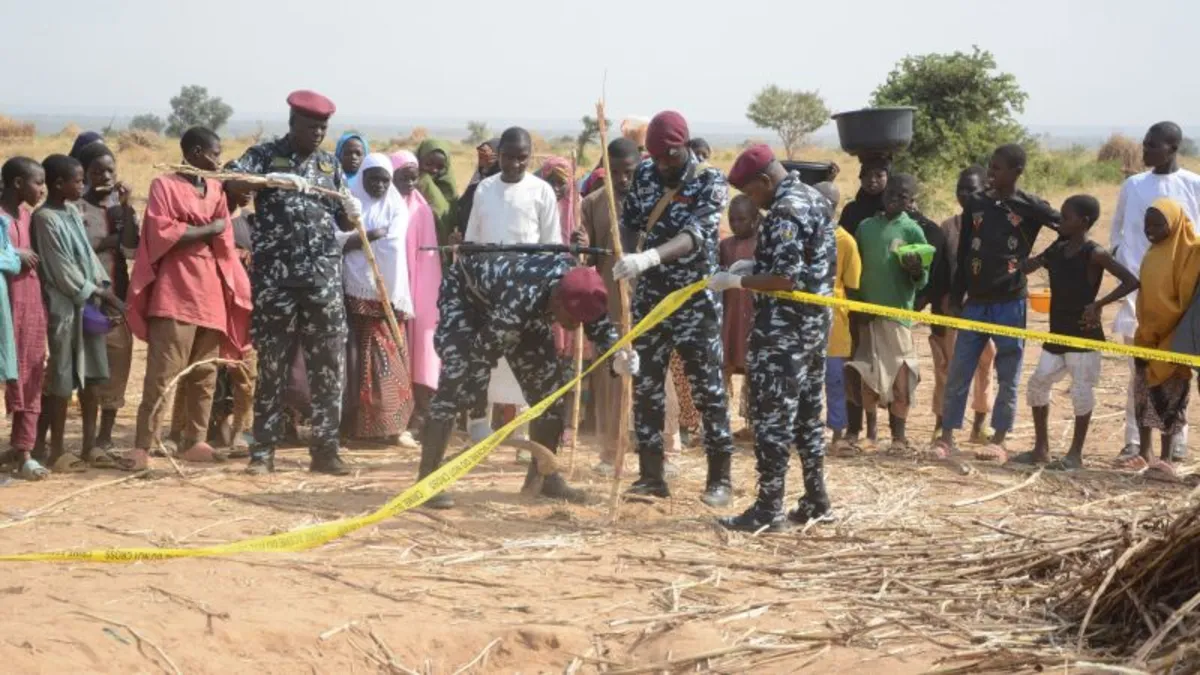
In the wake of a missile fired by the United States that struck near their village, the residents of Jabo in northwestern Nigeria are grappling with shock and confusion. Suleiman Kagara, a local farmer and resident of this predominantly Muslim community in the Tambuwal district of Sokoto state, recounted the harrowing experience to CNN. He described hearing a loud explosion and witnessing flames as a projectile flew overhead around 10 p.m. on Thursday. Shortly after, the missile impacted the ground, causing an explosion that sent villagers fleeing in fear. “We couldn’t sleep last night,” Kagara said. “We’ve never seen anything like this before.”
Unbeknownst to Kagara at the time, the explosion was part of a US military operation that President Donald Trump later dubbed a “Christmas present” for terrorists. Following the strike in Jabo, Trump announced that the US had executed a “powerful and deadly strike” against ISIS militants in the region, accusing them of targeting and violently killing innocent Christians at unprecedented levels. According to US Africa Command, the operation resulted in the neutralization of multiple ISIS militants.
Despite the US government's assertions, Kagara and his fellow villagers are left puzzled. While some areas in Sokoto face issues such as banditry, kidnappings, and attacks by armed groups—including Lakurawa, which Nigeria classifies as a terrorist organization due to its suspected ties to the Islamic State—villagers assert that Jabo is not a hotspot for terrorist activity. “In Jabo, we see Christians as our brothers. We don’t have religious conflicts, so we weren’t expecting this,” Kagara explained.
Bashar Isah Jabo, a lawmaker representing Tambuwal in the state parliament, echoed these sentiments, describing Jabo as “a peaceful community” without any known history of ISIS or other terrorist activities. He reported that the missile struck a field approximately 500 meters from the Primary Health Center in Jabo, causing no casualties but instilling fear and panic among the residents.
Nigeria’s Information Ministry later stated that the government, in collaboration with the US, had “successfully conducted precision strike operations” targeting ISIS hideouts in the forests of Tangaza district in Sokoto. However, it acknowledged that debris from the operation had landed in Jabo and another area in north-central Kwara state, while emphasizing that there had been no civilian casualties. This military operation aligns with Trump's previous claims regarding the significant threat posed to Christians in Nigeria, leading the president to instruct the Pentagon to prepare for potential military action.
Nigerian Foreign Minister Yusuf Tuggar informed CNN that he had discussed the operation with US Secretary of State Marco Rubio prior to the strike, and confirmed that Nigerian President Bola Tinubu had approved the action. Tuggar emphasized that the operation was not religiously motivated, but aimed at ensuring the safety of innocent civilians in the region. However, analysts argue that religion is merely one factor contributing to Nigeria's ongoing security challenges. Conflicts in the country often stem from communal and ethnic rivalries, as well as tensions between farmers and herders over access to limited land and water resources.
Nnamdi Obasi, a senior adviser at the International Crisis Group, expressed skepticism about the effectiveness of the US airstrikes. He noted that while these strikes may weaken certain armed groups and represent a significant escalation in the fight against violence, they are unlikely to resolve the multifaceted issues that have plagued Nigeria for years, which are largely rooted in governance failures.