

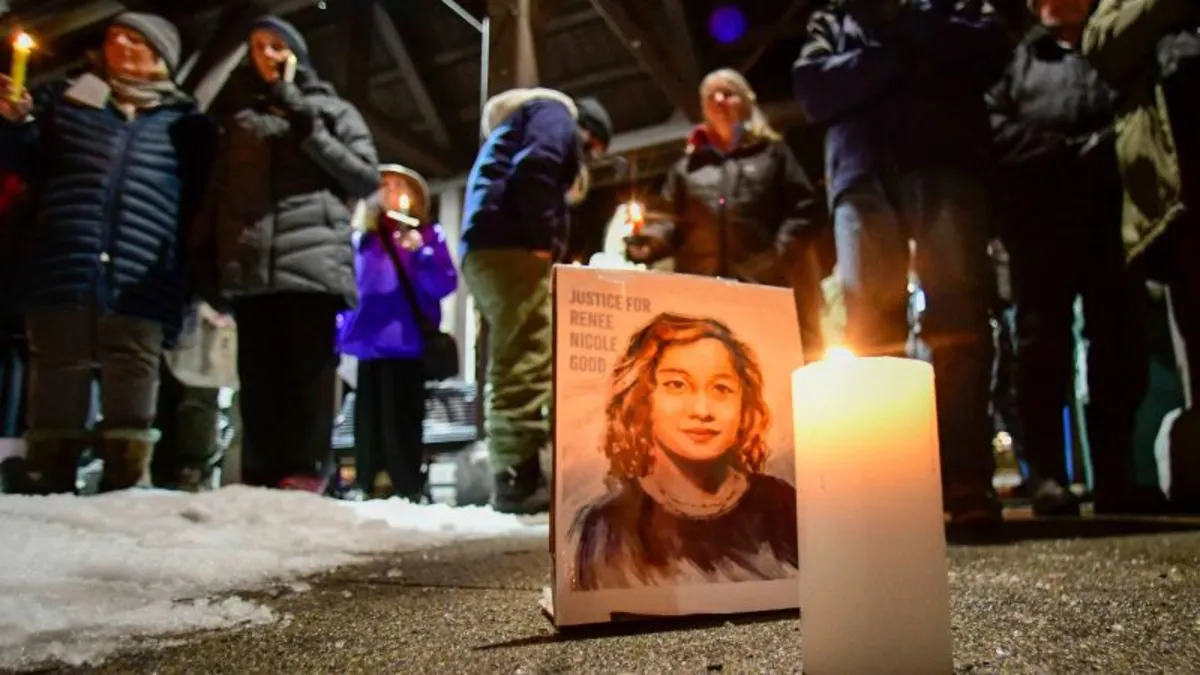
Renee Good, a woman tragically killed by an Immigration and Customs Enforcement (ICE) agent in Minneapolis last week, had an active role in her son’s school board. This connection has brought to light documents that encouraged parents to monitor ICE operations and provided training on how to respond to potential ICE raids. These documents reveal her involvement in community efforts aimed at overseeing and possibly disrupting ICE actions, which federal officials are closely examining in their investigation of the incident.
Four legal experts who reviewed the documents for CNN emphasized that they primarily describe nonviolent civil disobedience tactics—practices that have been a staple of American protests for decades. This stands in stark contrast to the portrayal of these actions as extremist or terrorist activities by officials from the Trump administration, including Homeland Security Secretary Kristi Noem and Vice President JD Vance. Timothy Zick, a professor at William and Mary Law School, stated, “There’s nothing in there that suggests attacking ICE agents or engaging in any other form of physical harm or property damage.” He described the situation as “authoritarianism 101,” where dissenters are blamed for their own demise.
In a significant move, three top federal prosecutors in Minneapolis resigned on Tuesday, reportedly due to pressure from the Trump administration to shift their focus toward investigating Good’s actions and those of her associates. This development raises concerns about the politicization of legal investigations and the treatment of community activists.
One of the documents linked to the school board was a message dated December 16, thanking families for participating in "ICE watch" efforts to protect their neighbors. This note included links to training documents, which provided guidance on how to alert neighbors to ICE raids and offered contact information for a school parent conducting “noncooperation training.” The training documents emphasized nonviolent responses to ICE agents and suggested creative tactics for community resistance.
On the day of the incident, Good was partially blocking a street with her SUV while ICE agents were operating nearby. An ICE officer, who was filming the confrontation, shot her as she began to accelerate. Video footage indicates that Good was turning her vehicle away from the agent, although it remains unclear if contact was made before the gunfire.
Following the incident, federal officials have labeled Good’s actions as “domestic terrorism,” claiming she had been “stalking agents all day long.” Many state and local lawmakers have criticized this characterization as misleading and inflammatory. Good’s family has recounted that she and her wife had just dropped off their son at Southside Family Charter School and intended to support their neighbors during the ICE operation.
Legal experts expressed deep concern that federal authorities were focusing on low-level violations by protesters rather than addressing the shooting incident itself. Gregory Magarian, a First Amendment expert, noted that while the noncooperation tactics described could potentially violate some laws, they generally represent standard nonviolent protest actions that should not warrant a federal investigation. He remarked, “The idea that the agency would investigate protesters instead of the use of deadly force is appalling and really dangerous.”
Renee Good was a dedicated member of the Southside school board, having joined in August 2025 after relocating to Minneapolis with her family. The Southside Family Charter School, founded in 1972, has a history of promoting social justice education, encouraging students to engage in activism from a young age. Good's involvement at the school was significant; she regularly attended board meetings and contributed to school events.
Tragically, in the wake of Good’s death, staff at the school have faced threats online, creating a tense environment of fear and uncertainty. Rashad Rich, a former physical education teacher at Southside, described Good and her wife as “awesome parents” who were actively engaged in their son’s education.
The shooting of Renee Good has sparked a complex discussion about the role of community activism, the response of law enforcement, and the implications of labeling protest actions as domestic terrorism. As the investigation unfolds, many in the community and beyond are calling for a focus on accountability and a reconsideration of how law enforcement interacts with peaceful protesters.