

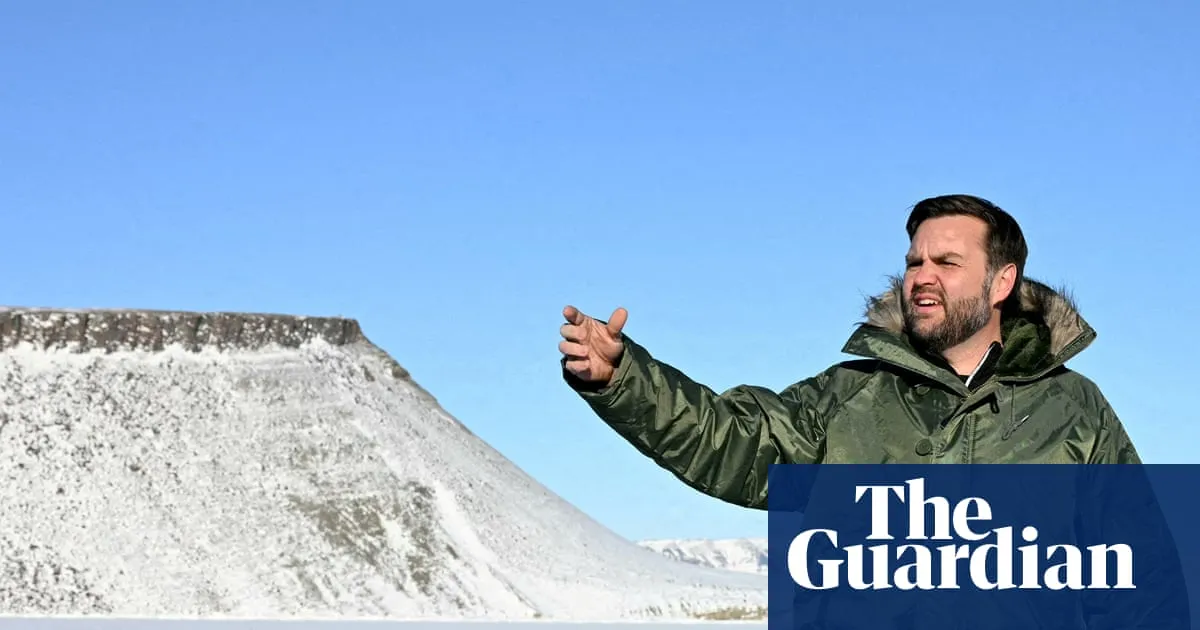
In a significant diplomatic development, JD Vance is set to host a meeting with the foreign ministers of Greenland and Denmark as tensions rise over former President Donald Trump’s renewed interest in acquiring the strategically important Arctic island. This meeting follows a request made by Denmark's top diplomat, Lars Løkke Rasmussen, and his Greenlandic counterpart, Vivian Motzfeldt, who sought to engage in direct discussions with US Secretary of State Marco Rubio. The meeting will take place at the White House on Wednesday, with Vice President Rubio indicating his desire to participate.
The discussions surrounding Greenland's status have been reignited following Trump’s controversial suggestion of a US takeover in 2019, during his first term. Recently, he intensified his rhetoric by asserting that the US would acquire Greenland "one way or the other." These comments have raised alarms within both the European Union (EU) and NATO, particularly as Trump has not dismissed the possibility of using military force to assert control over the mineral-rich island, which is largely self-governing but remains part of Denmark.
Danish Prime Minister Mette Frederiksen has warned that any attempt at a US invasion would signal the end of NATO, as European leaders stand firm in their commitment to support Greenland’s territorial integrity and the right to self-determination.
In light of these developments, Denmark’s Defence Minister Troels Lund Poulsen announced that he and Motzfeldt will meet with NATO Secretary General Mark Rutte in Brussels next Monday to discuss the ongoing situation. Poulsen indicated that Denmark plans to increase its military presence in Greenland alongside other NATO countries this year, emphasizing the need for "greater attention from NATO regarding issues in and around the Arctic."
Additionally, Denmark will host a meeting of the foreign, security, and defence policy contact committee of the Danish, Greenlandic, and Faroese governments on Wednesday. This gathering aims to provide an opportunity to assess the political and economic landscape surrounding Greenland.
In response to the prospect of a US takeover, Greenland’s coalition government stated unequivocally on Monday that it could "not accept" such an action under any circumstances. They reiterated their commitment to ensuring that Greenland's defence remains within the framework of NATO. The coalition expressed confidence that Greenland would maintain its membership in the western defence alliance "forever," highlighting a shared interest among NATO member states, including the US, in the island's defence.
Trump’s justification for seeking control over Greenland hinges on enhancing Arctic security amid perceived threats from China and Russia. In a statement, Rutte noted that NATO is "working on the next steps" to address these security concerns, with all alliance members acknowledging the importance of Arctic security. Suggestions have emerged from countries like France and Germany regarding strengthening NATO’s presence in the region, including the potential stationing of troops in Greenland. However, diplomats caution that discussions are still in the preliminary stages with no concrete plans established.
In Nuuk, the capital of Greenland, Pele Broberg, leader of the opposition party Naleraq, expressed hopes for a favorable outcome from the Washington meetings. He suggested that a deal with the US could be beneficial but criticized the lack of communication regarding the talks. Broberg raised concerns about Løkke’s involvement, asserting that the discussions primarily pertain to the future of the Greenlandic people rather than Danish foreign policy.
Since gaining self-rule in 1979, Greenland has been progressively moving toward independence, a goal supported by all political parties in the island's parliament, albeit with varying timelines. Broberg accused Copenhagen of leveraging NATO and Danish ownership over Greenland to maintain influence over its future, stating, "It shows that they are still not ready to actually let us go."