

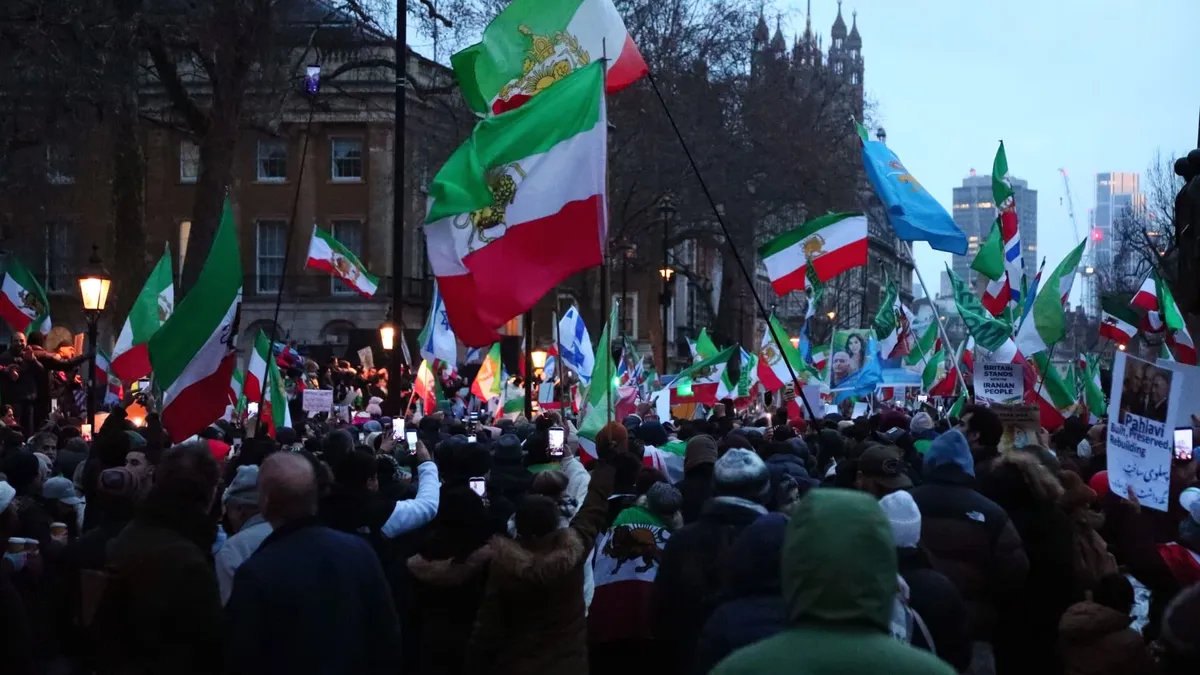
U.S. President Donald Trump is gearing up for a possible intervention in Iran, as the country faces a significant crackdown on protestors. Reports indicate that several hundred individuals have been killed, and the Iranian government has effectively cut off internet access to suppress dissent. According to a report from The Wall Street Journal, the Trump administration is considering various options, including boosting antigovernment sources online, deploying cyber weapons against military and civilian sites, implementing additional sanctions, and potentially conducting military strikes.
Trump's aides are scheduled to brief him on Tuesday regarding these potential intervention strategies. The options presented range from targeted airstrikes within Iran to offensive cyber attacks, as reported by Politico, citing an unnamed official familiar with the situation. Matt Gertken, chief geopolitical strategist at BCA Research, remarked that if the U.S. determines that action is necessary to protect its personnel or assets, it has a wide array of tools at its disposal, including cyber operations, sabotage, drones, and missile strikes from both air and sea.
Moreover, Gertken noted that the U.S. could target Iran’s nuclear or military infrastructure and government facilities to diminish the regime's capabilities and deter further disruptive actions. The unrest in Iran, which began in late December due to soaring prices and the collapse of the nation’s currency, has escalated into widespread antigovernment protests that pose a significant threat to the Islamic regime.
Over the weekend, Iranian authorities intensified their crackdown on protestors, with reports from the Human Rights Activists News Agency indicating that more than 500 individuals have lost their lives during the unrest. In response to the U.S. and Israel's potential involvement, Iranian President Masoud Pezeshkian accused both nations of inciting turmoil within Iran. Gertken emphasized that Iran possesses substantial capabilities to retaliate against the U.S., particularly by targeting regional energy infrastructure.
Despite the complex geopolitical landscape, Trump has consistently expressed his support for the Iranian protestors. He has hinted at possible U.S. intervention several times on his Truth Social platform, asserting that the U.S. would come to the aid of Iranians if the government continued its violent crackdown. In a recent post, Trump stated, "Iran is looking at FREEDOM, perhaps like never before. The USA stands ready to help!"
During a flight back to Washington from his Mar-a-Lago home in Florida, Trump told reporters, "We're looking at it very seriously. The military is looking at it, and we're considering some very strong options." He also mentioned exploring non-kinetic measures, including cyber actions, while emphasizing that he does not plan to deploy American forces into Iran.
In addition to military options, the U.S. is considering efforts to restore internet communications in Iran, where leaders have severely restricted internet and phone services. Trump indicated he might reach out to Elon Musk regarding this matter, especially since Iran has reportedly jammed Musk's Starlink satellite service during the protests.
However, experts warn that any military action, even a symbolic strike, could lead to significant escalation. Danny Citrinowicz, a senior researcher at the Institute for National Security Studies, pointed out that while a strong strike could undermine the regime's repressive measures, it might also lead to increased cohesion within the Iranian government and further escalation of conflict. He cautioned that the lack of cohesive leadership among the opposition could render any military action operationally successful but strategically ineffective.
In a live session broadcast by state television, Iranian Parliament Speaker Mohammad Baqer Qalibaf warned that any U.S. attacks would make American military centers, bases, and ships legitimate targets. Iran's Supreme Leader Ayatollah Ali Khamenei has also stated that the government will not yield to the ongoing protests. The situation is further complicated by the escalating economic crisis in Iran, with the national currency, the rial, losing half its value over the past year, plunging to record lows of approximately one million rials per U.S. dollar.
As the Iranian regime faces mounting internal pressures and public discontent, experts suggest that the current protests could inflict further damage on the already fragile legitimacy of a state system that appears to be nearing its end. According to Sanam Vakil, director of the Middle East and North Africa program at Chatham House, the repercussions of these protests will likely be profound, regardless of their eventual outcome.