

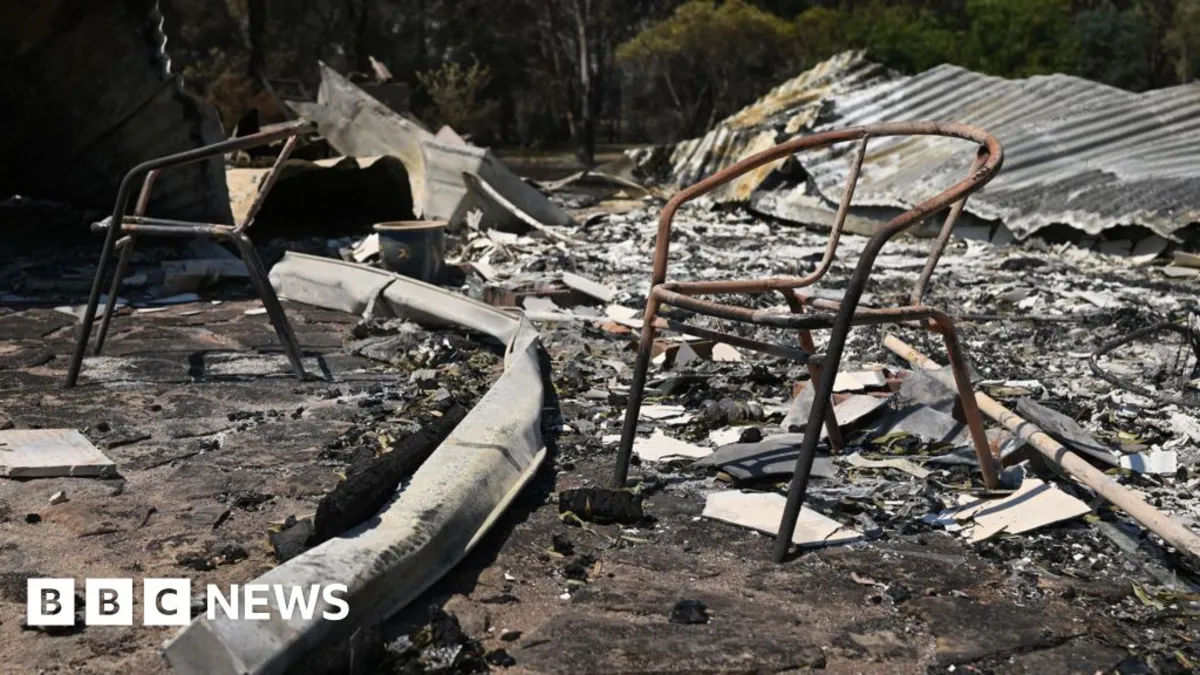
In a catastrophic event, one person has tragically died and approximately 300 properties have been devastated by rampant bushfires sweeping across south-east Australia. These devastating fires have been raging in numerous locations for several days, with the most severe impacts felt in the state of Victoria, although New South Wales is also affected. The scale of destruction is alarming, with the fires consuming land nearly twice the size of Greater London.
A state of emergency has been declared in Victoria as thousands of firefighters, supported by over 70 aircraft, battle the relentless blaze. Authorities have issued evacuation warnings to residents in more than a dozen communities, urging them to leave their homes for safety. The fires are being intensified by extremely hot, dry, and windy conditions, leading experts to predict that they could continue to burn for several weeks.
Victorian Premier Jacinta Allan reported that as of 08:00 local time on Sunday (23:00 GMT on Saturday), there are 30 active fires in the state, with 10 classified as particularly concerning. The Premier stated that an alarming 350,000 hectares have been scorched across Victoria. "We will see fires continue for some time across the state, and we are not through the worst of this by a long way," she informed Australian media. The fires continue to pose significant threats to homes and properties.
In a heartbreaking turn of events, human remains were discovered in the village of Gobur, located near Longwood and approximately 110 km (70 miles) north of Melbourne. The identity of the victim has not yet been confirmed. Premier Allan commended the emergency workers involved in the recovery efforts, emphasizing the emotional toll such tasks take on them. "The Gobur community is grieving," she stated.
The smoke from the bushfires is severely impacting air quality across various regions of Victoria, including metropolitan Melbourne. Authorities have indicated that the current bushfires are the most severe to affect south-east Australia since the devastating blazes of 2019-2020, which resulted in the destruction of an area comparable to Turkey and claimed 33 lives.
Among the most affected is the small town of Harcourt in the central highlands of Victoria. Firefighter Tyrone Rice faced a personal tragedy when he lost his own home to the fires while he was engaged in firefighting efforts. "It was like a kick in the guts," he expressed, reflecting on the difficult situation. "But I'm not the first person to go through it, and I won't be the last." Local fire captain Andrew Wilson described the destruction in Harcourt as "gut-wrenching."
Journalist Jack Ward from Australia's 9 News reported on the extensive damage he observed in various towns across Western Australia, describing the situation as catastrophic. In many locations, he noted, "all that's left of these houses is a tin roof lying on the ground." While it is challenging to directly link individual wildfires to climate change, experts agree that climate change is exacerbating the hot, dry weather conditions that facilitate bushfires, making such occurrences more common.
As the crisis unfolds, the focus remains on supporting affected communities and managing the ongoing threat posed by these devastating bushfires in south-east Australia.