

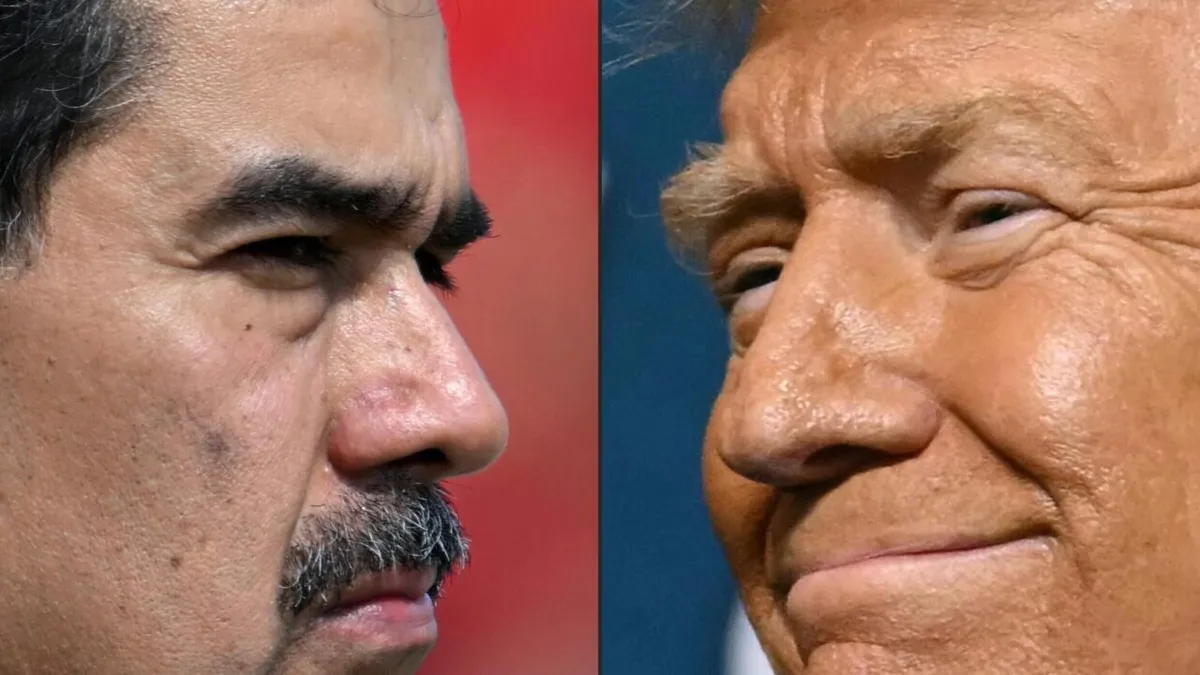
On Sunday, US President Donald Trump confirmed that he had recently spoken with Venezuelan leader Nicolas Maduro, a dialogue that comes amid escalating tensions between the two nations. The Venezuelan government responded harshly, accusing the United States of preparing for an attack against the country.
The United States has intensified its pressure on Venezuela, marked by a significant military buildup in the Caribbean. This includes the designation of an alleged drug cartel, purportedly run by Maduro, as a terrorist organization. In addition, Trump issued a stark warning that Venezuelan airspace should be considered closed. Officially, the US claims that the military deployment, initiated in September, aims to combat drug trafficking in the region. However, Venezuelan authorities insist that the true objective is regime change.
During his remarks aboard Air Force One, Trump characterized the phone call with Maduro as neutral, stating, “I wouldn’t say it went well or badly. It was a phone call.” Reports from The New York Times indicated that the two leaders discussed the possibility of a meeting, while The Wall Street Journal mentioned that the conversation also touched on conditions for amnesty should Maduro choose to step down.
Republican Senator Markwayne Mullin revealed on CNN's State of the Union that the United States has extended an offer for Maduro to escape to Russia or another location, further complicating the already tense political landscape. The US government has accused Maduro, who succeeded the late Hugo Chavez, of leading the so-called Cartel of the Suns and has placed a $50 million bounty on his capture. However, Venezuelan officials and their allies assert that no such cartel exists.
Experts on Venezuela argue that the term "Cartel of the Suns" may refer more to the corruption of high-ranking officials by criminal organizations rather than any formal drug trafficking network. Moreover, the US does not recognize Maduro as the legitimate victor of the last presidential election.
While Trump has yet to publicly threaten military action against Maduro, he has indicated that efforts to disrupt Venezuelan drug trafficking by land will commence imminently. This military escalation includes targeting alleged drug-trafficking vessels in the Caribbean and eastern Pacific, which has reportedly resulted in the deaths of at least 83 individuals.
Despite these aggressive actions, Trump's administration has not provided substantial evidence to validate the claims underlying its military operations. Concerns have also been raised regarding the legality of these strikes. Reports indicate that one US airstrike in September may have unintentionally killed survivors of an initial attack, raising ethical questions about the military's approach.
Following the reports of the airstrikes, Defense Secretary Pete Hegseth allegedly issued an order that led to further violence, although Trump denied that such an order was given. “We’ll look into it, but no, I wouldn’t have wanted that -- not a second strike,” Trump clarified to reporters, emphasizing that Hegseth had denied directing any lethal follow-up actions.
In response to the strikes, Jorge Rodriguez, the head of Venezuela's legislature, met with families of the victims. He refrained from commenting on the potential Trump-Maduro dialogue but remarked that if a state of war had been declared, the killings could be classified as war crimes. “Given that no war has been declared, what happened... can only be characterized as murder or extrajudicial executions,” he asserted.
The ongoing military buildup has seen the largest aircraft carrier in the world deployed near Venezuelan waters, with US fighter jets and bombers frequently flying close to the country's coast. Despite this, six airlines have suspended operations to Venezuela, yet the Caracas airport continues to function normally.
This series of events underscores the fragile state of US-Venezuelan relations and highlights the potential for further escalation in the region.