

On Wednesday, Russia’s Defense Ministry provided its first detailed account of an alleged Ukrainian drone attack targeting President Vladimir Putin’s Valdai residence. According to Russian authorities, more than half of the drones involved in this operation were intercepted hundreds of kilometers away from the estate. The claims suggest that Ukraine executed a large-scale drone operation aimed at Putin’s home in the northwestern Novgorod region during the night between Sunday and Monday.
In response to these allegations, Ukrainian officials have dismissed the claims as unfounded, suggesting that they serve as a distraction from ongoing U.S.-brokered negotiations aimed at ending the war. The timing and presentation of Russia’s accusations have raised eyebrows, as they were initially communicated not by the Defense Ministry or regional authorities—who typically report on such incidents—but rather by Foreign Minister Sergei Lavrov. This announcement coincided with a phone conversation between Putin and U.S. President Donald Trump, adding a layer of intrigue to the situation.
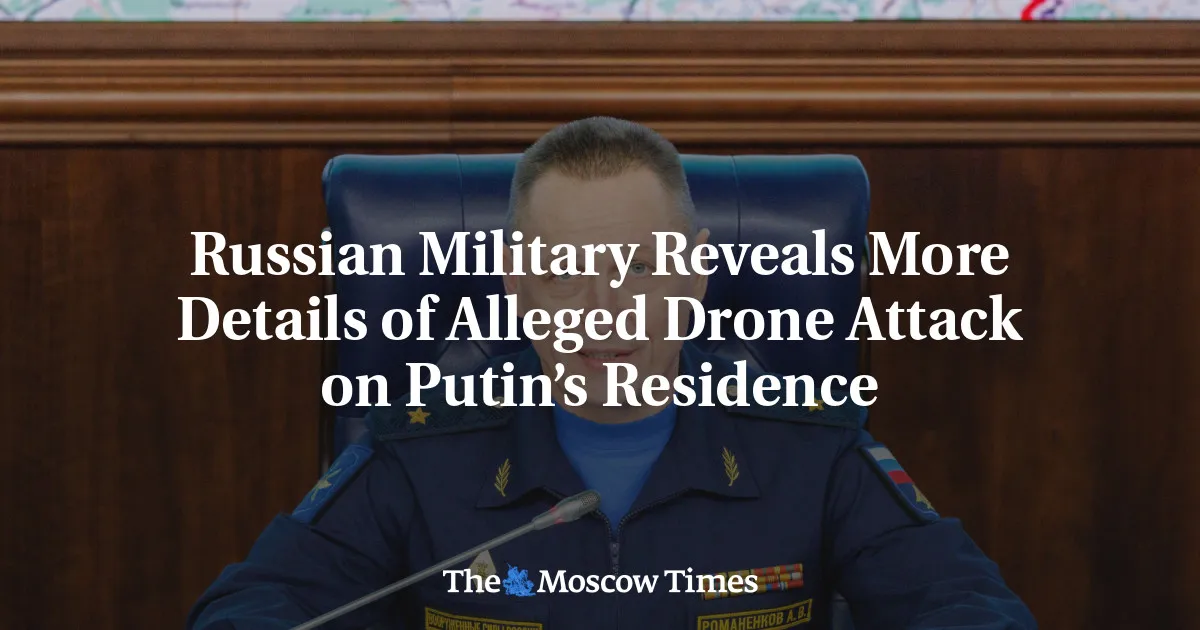
During a briefing on Wednesday, Major General Aleksander Romanenkov, head of the Russian Aerospace Forces’ air defense missile troops, stated that Ukraine conducted the drone assault “along several routes” toward the Russian president’s residence, traversing the Bryansk, Smolensk, Tver, and Novgorod regions. Romanenkov reported that out of 91 drones involved in the operation, 50 were intercepted over the Bryansk and Smolensk regions—both areas that frequently experience drone strikes from Ukraine. A map presented during the briefing indicated that the intercepts occurred approximately 520 kilometers (323 miles) south of Valdai.
Romanenkov characterized the nature of the attack as “deliberate, carefully planned, and conducted in a layered manner.” He asserted that another 41 unmanned aircraft were downed over the Novgorod region. Accompanying Romanenkov’s statements, the Defense Ministry released a video purportedly showing a downed Ukrainian drone in a snowy forest setting at night. However, the footage lacked sufficient details for independent verification regarding the time and location of the recording.
The Defense Ministry’s briefing is unlikely to quell skepticism from Ukrainian officials, who argue that Russia’s narrative regarding an attack on Putin’s residence may be fabricated. They suggest this could be an effort to create discord between the Trump administration and Kyiv during a critical juncture in peace talks. Following the incident, Trump expressed his anger, stating that he was “very angry” about the alleged attack. Meanwhile, Ukrainian President Volodymyr Zelensky mentioned that his negotiating team had discussed the allegations with U.S. officials, emphasizing the potential for verification by their partners.
U.S. Ambassador to NATO, Matthew Whitaker, indicated that Western intelligence agencies are currently evaluating the Russian claims. In an interview with Fox News, he remarked, “It is unclear whether it actually happened,” highlighting that Ukraine faces nightly drone and missile threats in its capital but can only focus on defense. If the allegations are confirmed, this incident would not mark the first time Ukrainian drones have reached locations associated with Putin; earlier in May 2023, two drones reportedly targeted the roof of the Kremlin, which Russian officials labeled as an attempted assassination.
As the situation unfolds, the implications of these allegations could impact ongoing diplomatic efforts between the U.S., Ukraine, and Russia. With both sides firmly entrenched in their narratives, the international community remains watchful, awaiting further developments and responses from relevant authorities.