

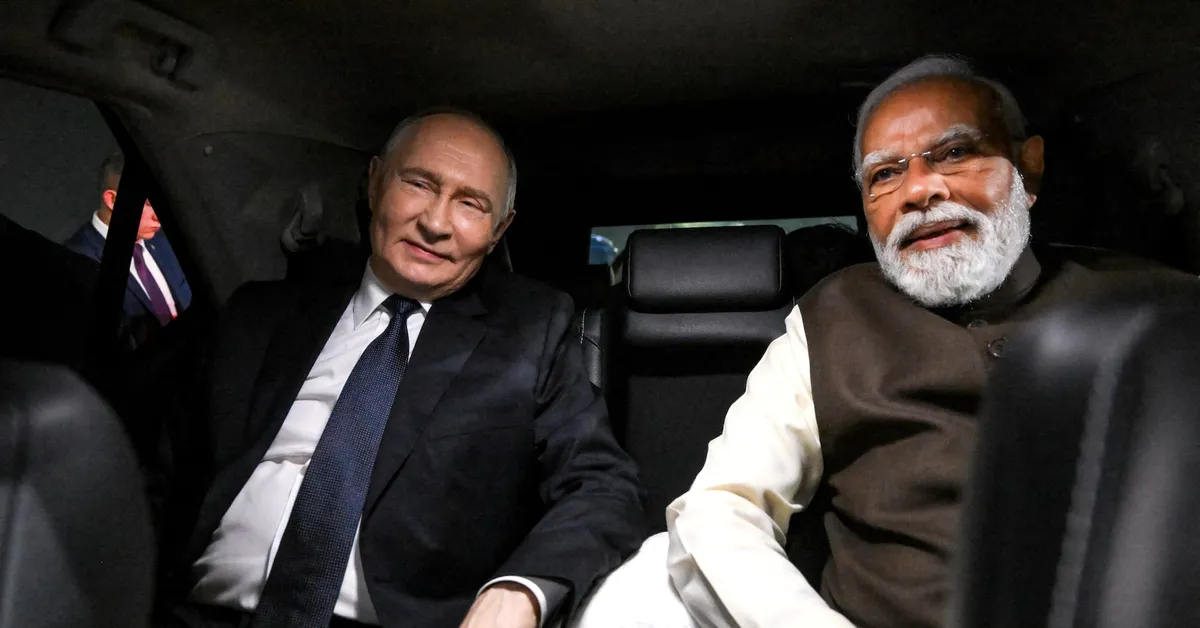
On December 5, 2023, Russian President Vladimir Putin arrived in New Delhi for a significant summit meeting with Indian Prime Minister Narendra Modi. This visit, marking Putin's first trip to India in four years, aims to enhance trade relations between the two nations, particularly as they navigate the challenges posed by Western sanctions that have impacted their longstanding partnership.
The summit is crucial as India continues to be the top buyer of Russian arms and seaborne oil. Amidst ongoing discussions with the United States regarding a potential trade deal to address tariffs imposed by former President Donald Trump, this meeting signifies a pivotal moment for both countries. The objective is to bolster trade to a target of $100 billion by 2030, a goal that has been predominantly tilted in Russia's favor due to India's substantial energy imports from Moscow.
In recent years, as European nations reduced their dependence on Russian energy following the invasion of Ukraine, India has significantly increased its purchases of discounted Russian crude oil. This shift presents a complex dilemma for New Delhi: strengthening ties with Moscow could jeopardize its relationship with Washington, and vice versa. Michael Kugelman, a senior fellow at the Atlantic Council, discussed this conundrum in a recent article for Foreign Policy magazine.
During the summit, Modi and Putin are also expected to address a variety of topics, including labor and civil nuclear energy. In an effort to showcase the resilience of their bilateral relations, both leaders are anticipated to announce new agreements that will solidify their partnership in various sectors.
Upon his arrival at a New Delhi airport, Modi greeted Putin with a warm hug and handshake as he walked down the red carpet. The Indian Prime Minister later hosted the Russian leader for an intimate private dinner at his residence, reflecting the cordial nature of their diplomatic ties.
Accompanying Putin on this visit is a robust delegation comprising business leaders and government officials, including Andrei Belousov, Russia's defense minister. Belousov engaged in productive discussions with India's defense minister, Rajnath Singh, emphasizing Russia's readiness to support India's goal of becoming self-reliant in defense production.
Putin's visit comes on the heels of discussions with U.S. officials regarding a potential peace deal to resolve the ongoing conflict in Ukraine. However, those talks did not yield a compromise. India has maintained a neutral stance on the war, advocating for peace through dialogue and diplomacy. The Indian government has expressed concerns that its relations with Russia are being unfairly scrutinized by Western nations that continue to engage with Moscow when it aligns with their interests.
This high-profile meeting between Modi and Putin is set to reinforce the longstanding ties between India and Russia, amidst a rapidly changing global landscape. As both leaders work to navigate the complexities of international relations, their discussions will likely have lasting implications for the future of Indo-Russian cooperation.