

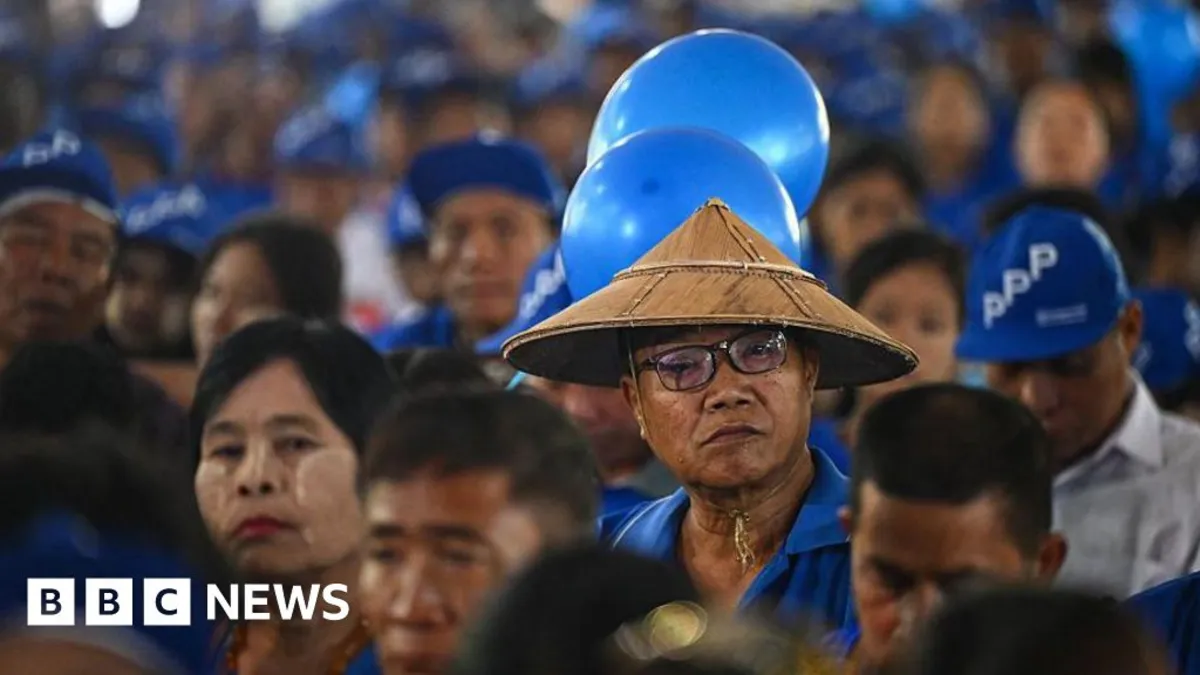
Myanmar is preparing for an election that has been widely criticized as a sham. Major political parties have been dissolved, many of their leaders are imprisoned, and approximately half the country is expected to abstain from voting due to an ongoing civil war. The military government is conducting a phased ballot nearly five years after its power grab during a coup, which ignited widespread opposition and led to protracted conflict.
Observers suggest that the junta, bolstered by support from China, is attempting to legitimize and strengthen its hold on power as it seeks a resolution to the devastating stalemate. More than 200 individuals have faced charges for disrupting or opposing the elections under a stringent new law that imposes severe penalties, including the possibility of the death penalty. Prominent figures such as film director Mike Tee, actor Kyaw Win Htut, and comedian Ohn Daing were convicted under this law after criticizing a film that promoted the elections, receiving seven-year prison sentences, according to state media reports.
The situation has raised serious human rights concerns, with the United Nations' top human rights official, Volker Türk, stating that there are no guarantees for the freedom of expression, association, or peaceful assembly in Myanmar. He pointed out that civilians are facing pressure from various factions, including armed rebel groups that are threatening to boycott the polls.
The military is engaged in combat on multiple fronts against armed resistance groups opposing the coup, as well as ethnic armies with their own militias. Although the junta has regained control over significant territories this year through relentless airstrikes supported by China and Russia, it has suffered major setbacks over the past few years. The civil war has resulted in thousands of deaths, displaced millions, devastated the economy, and created a humanitarian crisis. Compounding these issues, a catastrophic earthquake in March and reduced international funding have exacerbated the dire situation.
The ongoing conflict and the fact that large regions remain under opposition control pose significant logistical challenges for holding an election. Voting is scheduled to occur in three phases over the next month across 274 of the country's 330 townships, with the remaining areas deemed too unstable for voting. Results are expected by the end of January, but it is anticipated that as much as half of the country will not participate in the election. Even in townships where voting is taking place, not all constituencies will have polls, complicating predictions for voter turnout.
Six parties, including the military-backed Union Solidarity and Development Party, will field candidates nationwide. Meanwhile, another 51 parties and independent candidates will contest only at the state or regional levels. Notably, around 40 parties, including Aung San Suu Kyi's National League for Democracy (NLD), which won significant victories in 2015 and 2020, have been banned. Suu Kyi and many key leaders of the NLD are imprisoned under charges widely regarded as politically motivated, while others remain in exile.
By conducting the vote in phases, the authorities have the ability to adjust their strategies if the initial results do not favor them, as noted by Htin Kyaw Aye, a spokesperson for the election-monitoring group Spring Sprouts. Ral Uk Thang, an 80-year-old resident from western Chin state, expressed the sentiments of many civilians, stating, “The military does not know how to govern our country. They only work for the benefit of their high-ranking leaders. When Daw Aung San Suu Kyi's party was in power, we experienced a bit of democracy. But now all we do is cry and shed tears.”
Western governments, including the United Kingdom and the European Parliament, have dismissed the upcoming vote as a sham. In contrast, the regional bloc Asean has called for political dialogue prior to any election. The Burmese junta has consistently rebuffed criticism, asserting that the election aims to restore a multi-party democratic system in Myanmar. Junta spokesman Zaw Min Tun emphasized, “The election is being held for Myanmar. It is being held for the people of Myanmar. It is not being held for the international community.” Junta chief Min Aung Hlaing warned that those who refuse to vote are rejecting progress toward democracy.