

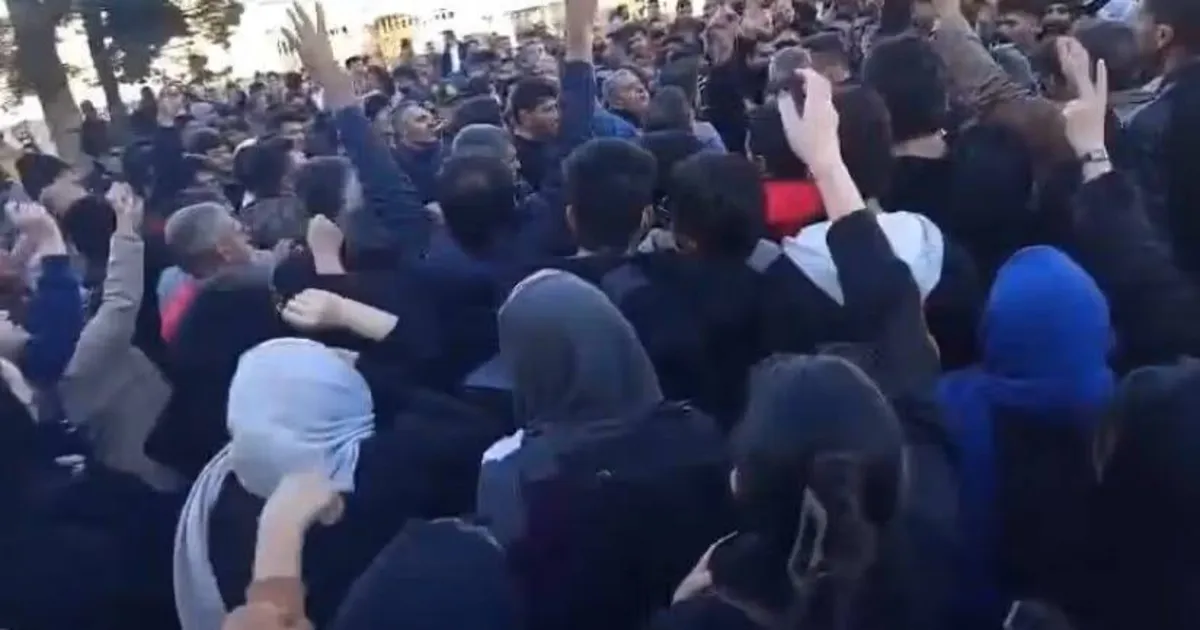
In the wake of recent protests across Iran, the government has adopted a notably restrained approach compared to previous waves of unrest. Unlike past instances, there has been no nationwide internet access shutdown, indicating a deliberate choice by officials to avoid escalating tensions that could lead to broader demonstrations. Instead, authorities have implemented a series of closures, justifying them with claims of “cold weather and energy saving.” As a result, government offices in 26 out of Iran's 31 provinces were closed on Wednesday, and major universities in Tehran transitioned to online classes, citing similar reasons.
On the third day of protests, President Masoud Pezeshkian publicly acknowledged the public’s right to protest. He has tasked the interior minister with initiating dialogue with representatives from Tehran’s bazaar merchants. Ali Ahmadnia, the head of the government’s information office, stated that the administration is open to listening to criticisms and emphasized a stance against violence, proclaiming, “The government will sit down and listen to all critics.” However, these statements have been met with skepticism on social media, where users expressed doubt regarding the government's genuine intentions.
While the government attempts to project a conciliatory tone, other influential entities have issued stern warnings. Iran's prosecutor general, Mohammad Movahedi-Azad, acknowledged “peaceful livelihood protests” as part of the social fabric but cautioned that any efforts to turn these economic demonstrations into acts of insecurity or destruction would provoke a strong governmental response. Additionally, the Islamic Revolutionary Guard Corps (IRGC) issued a statement reaffirming their readiness to confront any signs of unrest or sedition, accusing external forces of inciting discord through “psychological operations.”
In an attempt to alleviate tensions, President Pezeshkian met with trade guild representatives and announced a suspension of certain tax requirements for up to one year. However, these measures may not suffice to calm the unrest among merchants, whose survival is threatened by diminishing consumer purchasing power amid soaring inflation. Furthermore, the government’s promise of a monthly cash subsidy of 7,000,000,000 rials (approximately $5.17) per person has also been criticized, as many view it as inadequate in the face of rising living costs.
Reports indicate that while some protesters have been detained, the arrests have been less extensive than in previous protests. In Tehran, where demonstrations quickly spread, no confirmed incidents of security forces firing on protesters have occurred so far. However, there were reports of security forces opening fire in the towns of Fasa and Kouhdasht as protesters attempted to enter governorate buildings. Initial reports of fatalities were later contradicted by videos showing individuals unharmed.
The protests have also reached several universities, where students have been vocal in their dissent. Following incidents of confrontation, heads of campus security at key universities were dismissed for their mishandling of recent protests. Reformist figures have praised these actions as a necessary acknowledgment of the need to address protesters' concerns. The executive director of the Iran Human Rights Documentation Center (IHRDC), Shahin Milani, noted the significance of these dismissals as a signal that even mid-level officials may no longer feel insulated from accountability.
In a striking development, a group of survivors, supported by the IHRDC and the Strategic Litigation Project at the Atlantic Council, has filed a complaint in Argentina seeking investigation into alleged crimes against humanity committed during the Iranian government’s violent crackdown on protests. This legal move is significant as Argentina recognizes universal jurisdiction, enabling it to pursue accountability for atrocity crimes regardless of where they occurred. The case draws on extensive documentation of Iran’s repressive actions, with several complainants publicly sharing their harrowing experiences.
The economic hardships faced by the Iranian populace have become increasingly visible, particularly in the Grand Bazaar of Tehran. Merchants report that many traders have opted to close their shops as they can no longer afford to operate under current conditions. The economic situation has reached a point where individuals earning a monthly salary of 400 million rials (around $280) find themselves below the poverty line in Tehran, illustrating the profound economic distress affecting everyday Iranians.
State media, which is typically aligned with hardliners, has begun to acknowledge the protests, with coverage indicating a shift in the narrative surrounding the unrest. Merchants emphasized in interviews that their protests stem from economic grievances rather than political motives, yet social media continues to showcase the widespread anti-government sentiment among the population. The protests have not only focused on economic issues but also reflect a broader discontent with the government’s approach to governance and reform.
As protests continue to unfold across Iran, the government’s response remains a delicate balance between acknowledging public grievances and maintaining order. President Pezeshkian's efforts to engage with protest representatives are met with skepticism, and the economic strain faced by citizens poses significant challenges for the administration. The unfolding events highlight a pivotal moment in Iranian society, where the struggle for justice, accountability, and basic human rights takes center stage amid a backdrop of economic turmoil.