

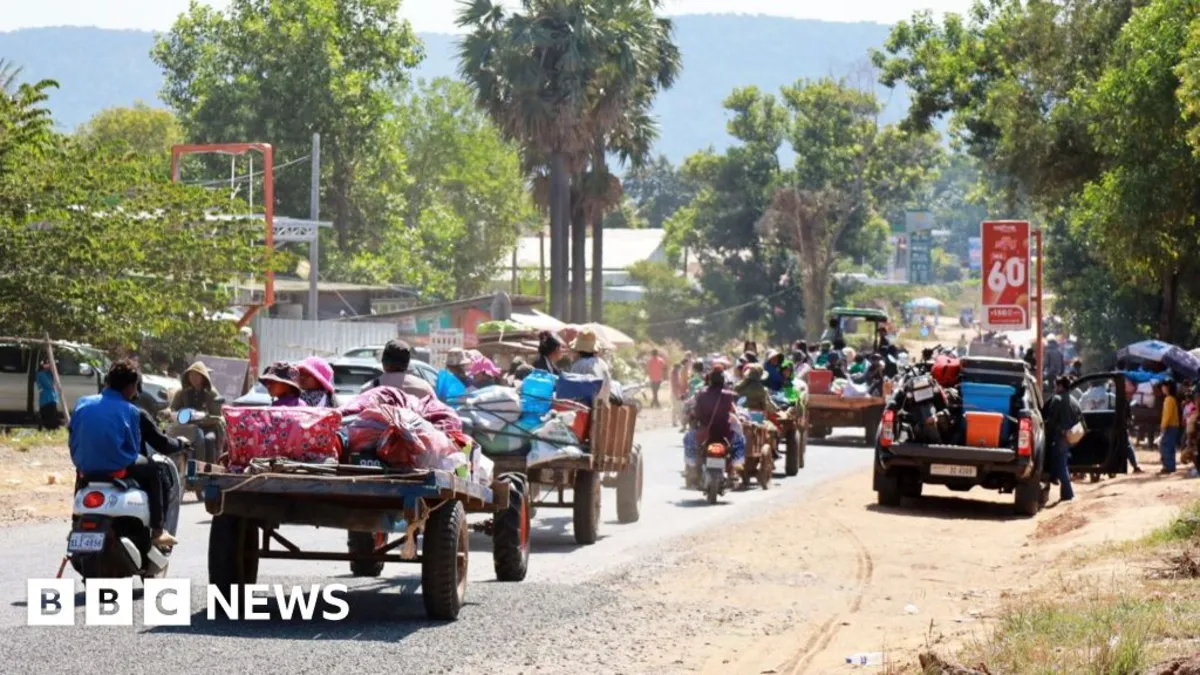
In a significant escalation of violence, thousands of residents on both sides of the Thai-Cambodia border have been forced to evacuate following deadly clashes. The violence, which erupted on Monday, has resulted in the deaths of at least five individuals, marking the most serious confrontation between these two Southeast Asian nations since they reached a ceasefire agreement in July.
Both Thailand and Cambodia have accused each other of instigating the violence. Thailand's Prime Minister Anutin Charnvirakul stated that the nation has no desire for conflict but will take necessary measures to safeguard its sovereignty. In contrast, former Cambodian leader Hun Sen labeled the Thai forces as invaders, claiming they provoked the recent clashes.
Since May, tensions have been rising sharply, leading to more than 40 deaths, along with import bans and travel restrictions. The Thai army reported that its troops retaliated against Cambodian fire in Ubon Ratchathani Province, employing air strikes along the disputed border. Conversely, Cambodia's defense ministry asserted that the Thai forces initiated the attack in Preah Vihear province.
The recent violence has not only resulted in tragic fatalities but has also severely affected local communities, particularly children. Thai teacher Siksaka Pongsuwan highlighted the plight of children living near the border, stressing that they are losing valuable educational opportunities compared to their peers in more peaceful regions.
In response to the escalating situation, Thailand's education minister announced the closure of nearly 650 schools across five provinces for safety reasons. Meanwhile, chaotic scenes unfolded in Cambodia's border provinces, as parents hurried to retrieve their children from schools. This disruption is not unprecedented; in July, during critical examination periods, intense fighting forced schools to switch to online learning, a transition that not all students could access due to a lack of internet connectivity.
Former journalist Mech Dara shared distressing footage on social media, depicting children fleeing their schools in panic. He poignantly questioned, “How many times do these kids have to suffer the shocking environment?” and highlighted the plight of a young boy in a bunker, still clad in his school uniform.
As the situation remains precarious, Pongsuwan expressed the emotional turmoil faced by him and his neighbors regarding whether to evacuate. With the sound of gunfire intermittently echoing in his village, he reflected, “If you ask whether we're scared, yes we are... Should we leave? Will it really be safer? Or should we stay?”
This escalating conflict is rooted in a century-old border dispute between Thailand and Cambodia, which has been a source of contention since the borders were drawn post-French occupation. The situation dramatically intensified on July 24, when a barrage of Cambodian rockets targeted Thailand, prompting retaliatory air strikes from Thai forces.
Following this incident, both nations agreed to an immediate ceasefire, facilitated by Malaysian Prime Minister Anwar Ibrahim. In October, they formalized this ceasefire agreement during a ceremony attended by former U.S. President Donald Trump, who heralded it as a historic achievement. However, just weeks later, Thailand suspended the agreement after two soldiers were injured by a landmine explosion near the border. Despite these setbacks, Cambodia has consistently asserted its commitment to the ceasefire.
The ongoing dispute over territorial sovereignty along the 800 km land border has persisted for over a century, underscoring the complexities of the relationship between Thailand and Cambodia as they navigate the challenges of peace and conflict.