

On Tuesday, China fired rockets into waters surrounding Taiwan as part of its most extensive military exercises to date, showcasing new assault ships and dismissing the likelihood of U.S. and allied intervention during a potential future attack. These drills, which are being dubbed as a rehearsal for a blockade, involved the Eastern Theatre Command conducting ten hours of live-fire exercises, launching rockets into the waters to the north and south of the democratically governed island.
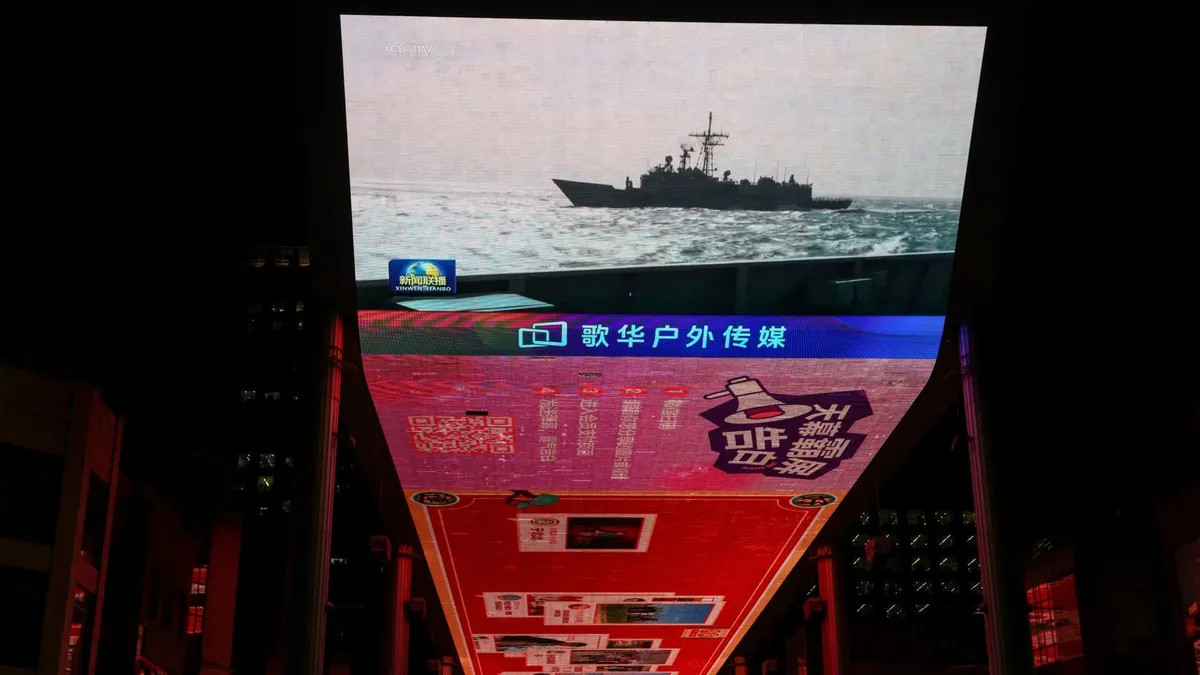
In addition to the rocket launches, Chinese naval and air force units simulated strikes on maritime and aerial targets while also conducting anti-submarine drills around Taiwan. State media broadcast images designed to highlight Beijing's technological and military superiority, emphasizing its capability to take Taiwan by force if necessary.
The military drills, named Justice Mission 2025, commenced just 11 days after the U.S. announced a historic $11.1 billion arms package to Taiwan. This announcement drew sharp criticism from the Chinese defense ministry, which warned that military measures would be taken in response. For the first time, China's military stated that these drills were specifically aimed at deterring external intervention in the Taiwan issue.
The Taiwan Affairs Office issued a stern statement, indicating that any external forces attempting to interfere would face severe consequences from the Chinese People's Liberation Army. This rhetoric has intensified in the wake of Japanese Prime Minister Sanae Takaichi's comments suggesting that a hypothetical attack on Taiwan could provoke a military response from Tokyo.
Chinese leader Xi Jinping recently promoted the commander of the Eastern Theatre Command, which oversees operations facing Taiwan, to full general—a move analysts interpret as an effort to enhance military readiness following a leadership purge. According to Lyle Goldstein, director of the Asia program at the U.S.-based think tank Defense Priorities, China now possesses both numerical and qualitative superiority in weaponry and training, indicating that this is an arms race Taiwan cannot win.
In contrast, U.S. President Donald Trump downplayed the significance of the drills, emphasizing his relationship with Xi and noting that China has engaged in naval exercises around Taiwan for the past two decades. These exercises are the sixth major round of military drills since 2022, marking the largest by area and the closest to Taiwan to date.
According to Hsieh Jih-sheng, deputy chief of the general staff for intelligence at Taiwan's Defense Ministry, China has ramped up its military drills in the region over the past three years, aiming to instill doubt among the Taiwanese public regarding the government's defensive capabilities. A senior Taiwanese security official indicated that China is likely simulating strikes on land-based targets, including the U.S.-made HIMARS rocket system, capable of hitting coastal targets in southern China.
Taiwan's President Lai Ching-te reassured the public via a Facebook post, stating that frontline troops are prepared to defend the island while emphasizing that Taipei does not seek to escalate tensions. Meanwhile, Chinese state media circulated propaganda posters, including one titled "Hammers of Justice," depicting Lai as being crushed by hammers striking different parts of Taiwan.
Chinese newspapers have also highlighted the debut of the Type 075 amphibious assault ship, a vessel capable of launching attack helicopters, landing craft, amphibious tanks, and armored vehicles simultaneously. Analysts believe that China is eyeing a 2027 readiness target for potential military operations against Taiwan, which is located along crucial commercial shipping routes, with approximately $2.45 trillion in trade passing through the Taiwan Strait annually.
Despite the extensive military exercises, Taiwan's Civil Aviation Authority reported that while 11 out of Taipei's 14 flight routes were affected, no international flights were canceled. However, routes to the offshore islands of Kinmen and Matsu near China's coast were blocked, impacting around 6,000 passengers. On Tuesday alone, Taiwan's defense ministry observed 71 Chinese military aircraft and 24 naval and coast guard vessels operating around the island, including the firing of 27 rockets into Taiwan's waters.
A recent report from the Pentagon indicated that the U.S. military believes China is preparing to be capable of winning a military conflict over Taiwan by 2027, coinciding with the centenary of the founding of the PLA. The military drills included a simulation of a blockade of Taiwan's deep-water Port of Keelung to the north and Kaohsiung to the south, Taiwan's largest port city, underscoring the seriousness of China's military intentions.