

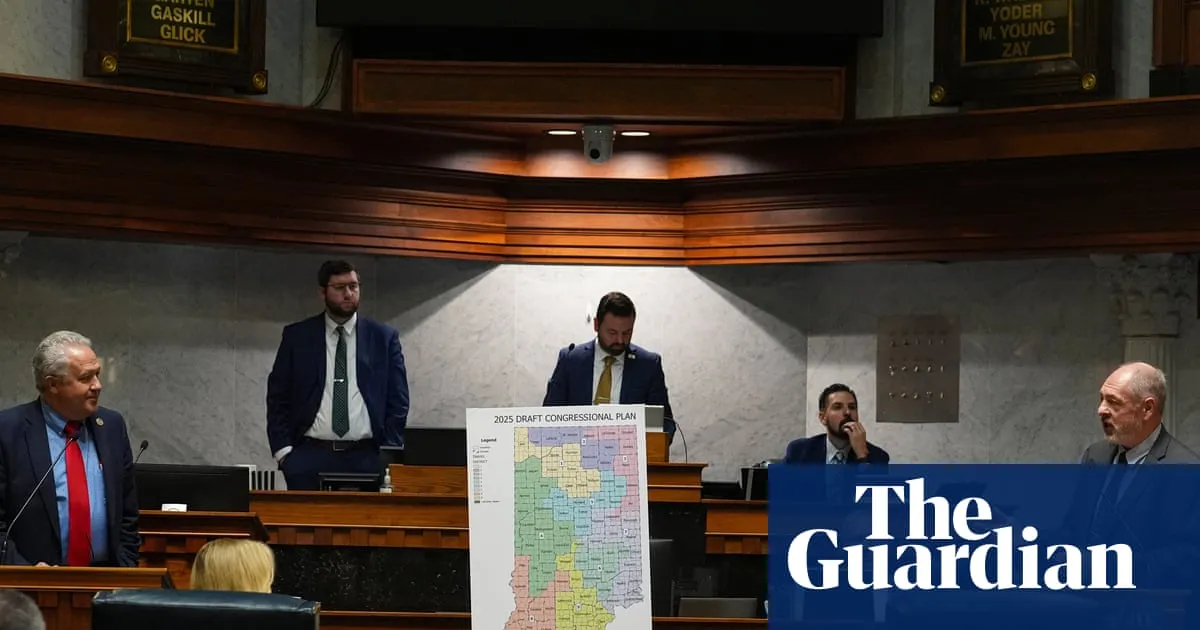
The recent rejection of a new congressional map by the Indiana legislature signifies one of the most substantial political defeats for Donald Trump during his second term. This decision not only hampers Republican efforts to reshape congressional districts ahead of the upcoming midterm elections but also highlights the limitations of Trump’s political influence. The legislative defeat underscores the complexities of the redistricting battle as Republicans aim to secure their majority amid a turbulent political landscape.
For several months, President Trump actively campaigned to persuade Indiana lawmakers to support a new congressional map that would have added two Republican seats. His efforts included sending JD Vance to meet with state legislators, as well as mobilizing outside groups to apply pressure. One notable entity, Heritage Action, the political arm of the Heritage Foundation closely aligned with the Trump administration, issued a stark warning prior to the vote: failure to pass the map could result in Indiana losing crucial federal funding. The group ominously stated, “Roads will not be paved. Guard bases will close. Major projects will stop. These are the stakes, and every NO vote will be to blame,” on the social media platform X.
Moreover, the state’s Republican lieutenant governor echoed this sentiment in a now-deleted post, suggesting that Trump administration officials had made similar threats. However, this aggressive approach may have backfired, as several Republican state senators expressed their discontent with the intimidation tactics. During the vote, they faced not only political backlash but also death threats and swatting attempts, ultimately leading them to reject the bill. Indiana Republican state senator Jean Leising articulated this sentiment, stating, “You wouldn’t change minds by being mean. The efforts were mean-spirited from the get-go.”
This defeat for Trump complicates the national landscape for Republicans as they strive to redraw congressional districts in a contentious redistricting battle. Earlier this year, Trump had urged Texas Republicans to adjust their congressional map to secure additional GOP seats, a notable departure from the typical practice of redistricting only once at the start of the decade. According to Dave Wasserman, a US House races expert at the non-partisan Cook Political Report, this situation is significant because “it changes the trajectory of this redistricting war from the midpoint of possible outcomes being a modest Republican gain to a wash.”
In various states, both Republicans and Democrats have been actively engaged in redistricting efforts. Republicans in Texas and Democrats in California have recently redrawn their maps, each aiming to add up to five seats for their respective parties, effectively canceling each other out. Additionally, Republicans in North Carolina and Missouri have altered their congressional districts to secure one additional Republican seat in each state. However, the Missouri map might face challenges due to a voter-initiated referendum aimed at blocking it.
Meanwhile, Democrats are looking at potential gains in Utah following a favorable court ruling, while Ohio's new map has created a more competitive Democratic district along with both Democratic-friendly and Republican-friendly districts. The biggest opportunity for Democrats to gain seats lies in Virginia, where they currently hold six of the state’s eleven congressional districts. House Speaker Don Scott has indicated that Democrats are considering a map that could add four Democratic seats in Virginia. In contrast, Republicans in Florida are contemplating a new congressional map that could potentially add five Republican seats.
The ongoing legal battles surrounding redistricting have only heightened the stakes. In Wisconsin, a favorable GOP congressional map is under legal scrutiny, while a Supreme Court case in Louisiana could significantly impact the future of redistricting. This case threatens to undermine a crucial provision of the Voting Rights Act designed to protect the political influence of Black voters. The court's oral arguments suggest a potential curtailment of this measure, which could allow states like Louisiana and Alabama to eliminate districts currently held by Democrats.
The timing of the Supreme Court's decision remains uncertain, yet it could have profound implications for the midterm elections, especially with two to four seats potentially at stake. Wasserman emphasizes the significance of this decision, stating, “We haven’t seen the last plot twist in this redistricting war, but the outlook is less rosy for Republicans than it was at the start.” As the political landscape evolves, the redistricting battle will remain a critical focal point heading into the midterms.