

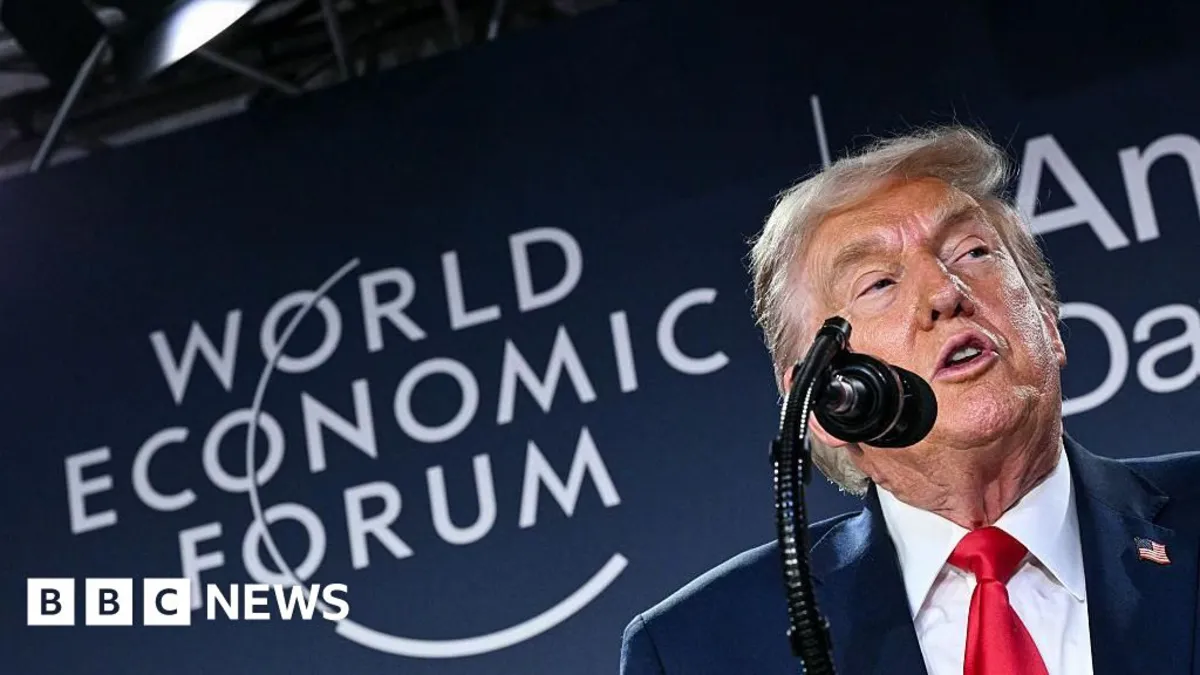
During a recent address at the World Economic Forum in the Swiss Alps, President Donald Trump made a provocative statement, claiming, "Without us, right now you'd all be speaking German." This remark sparked outrage among European leaders, especially considering that German is the most widely spoken of the four official languages in Switzerland. Many officials from Brussels to Berlin and Paris found Trump's speech to be not only insulting but also overbearing and factually inaccurate.
In his speech, Trump suggested that Europe is heading down a misguided path. This theme is not new for the president; however, it carries a heavier weight when voiced in front of supposed allies on European soil. Despite the tension, there was a palpable sense of relief across Europe when Trump ruled out the use of military force to acquire Greenland during the forum. Nevertheless, the core issue persists: Trump desires a piece of land that its current owners have declared is not for sale.
Following the forum, Trump took to social media to announce that he would be dropping his latest tariff threat against eight European countries, which he had accused of obstructing his Arctic ambitions. He claimed to have laid the groundwork for a deal regarding Greenland and the Arctic after discussions with Nato Secretary General Mark Rutte. However, it remains unclear how this plan aligns with Trump’s stated goal of outright ownership of Greenland, especially considering the proposed 10% tariffs that were set to take effect on February 1.
Danish Foreign Minister Lars Løkke Rasmussen stated that Trump's comments on military matters were, in isolation, positive. However, as thousands of miles away in Nuuk, the capital of Greenland, local officials released a brochure advising residents on crisis management, emphasizing that this information was merely a precaution. Greenland's Self-Sufficiency Minister, Peter Borg, asserted that the government did not anticipate needing to implement such measures.
Trump's insistence on framing the acquisition of Greenland as a reasonable transaction, considering the military support the US has provided to Europe over the decades, did not sit well with many. He argued that the US had made a mistake by returning Greenland after securing it during World War II, ignoring the fact that Greenland has never been part of the United States. Furthermore, his comments disparaging Denmark for its inability to defend itself in 1940 overlooked Denmark's significant contributions as a partner in the US-led invasion of Afghanistan, where they suffered considerable losses.
French President Emmanuel Macron was notably singled out by Trump for ridicule, particularly for his appearance in sunglasses due to an eye issue. Trump’s jest about Macron's tough rhetoric is starting to wear thin for many European leaders, who have dedicated the past year to flattering and appeasing Trump, only to face what they perceive as the greatest threat to their transatlantic relationship.
In light of these developments, the European Union is set to convene an emergency summit in Brussels, where top European politicians are likely to adopt a firm stance in response to Trump's policies. As tensions escalate, the dynamics of international relations between Europe and the United States continue to evolve, raising questions about the future of transatlantic cooperation.