

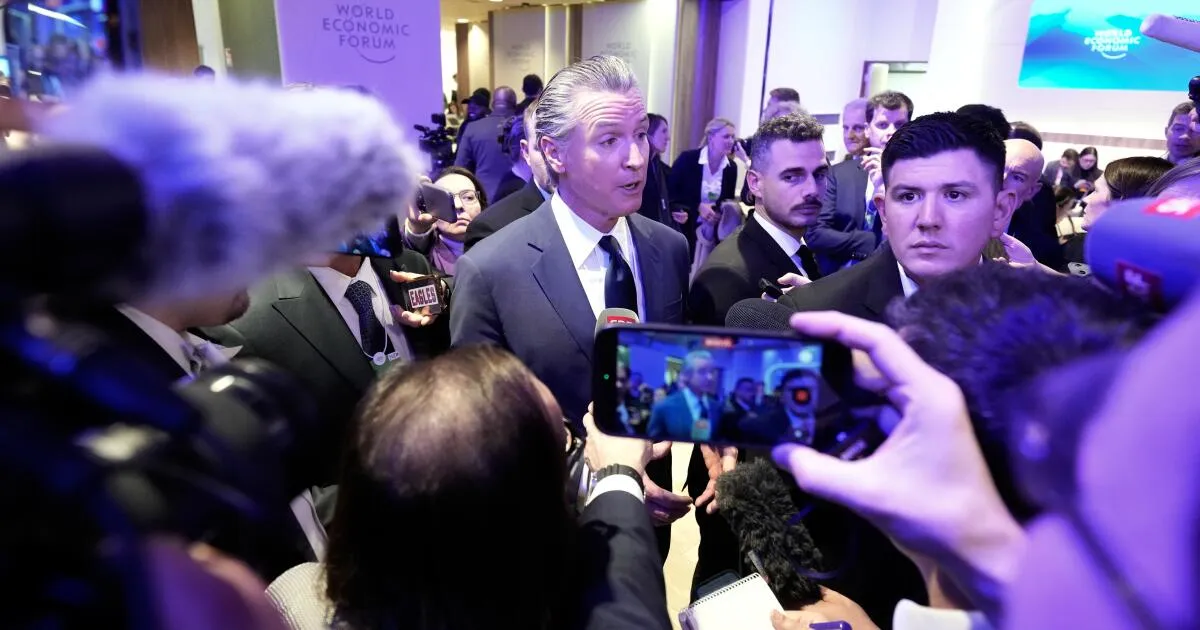
California Governor Gavin Newsom faced a setback when his planned speaking engagement at the World Economic Forum in Davos, Switzerland, was canceled by the Trump administration. Newsom had been invited to participate in a fireside chat at USA House, the American pavilion at the annual gathering of global leaders. However, his office reported that a "venue-level decision" was made to exclude any elected U.S. officials from the event's programming.
The fireside chat was scheduled for Wednesday evening, coinciding with the time difference of nine hours ahead of Pacific Standard Time. Frustrated by the cancellation, Newsom took to the social media platform X, expressing his disbelief: “How weak and pathetic do you have to be to be this scared of a fireside chat?” His office also indicated that he had intended to respond to a speech made by former President Donald Trump earlier that day in Davos.
During his address at the World Economic Forum, Trump made headlines by expressing interest in acquiring Greenland, stating he would pursue this goal without using force. He also criticized European allies and suggested that the North Atlantic Treaty Organization should not interfere with U.S. expansionist ambitions. Newsom's absence from the event was further emphasized when a spokesperson for the White House dismissed him, referring to him as “third-rate governor Newscum” and questioning his presence in Switzerland instead of addressing issues in California.
The ongoing conflict between Newsom and Trump intensified during the event, particularly after Trump publicly acknowledged Newsom in his speech. Trump commented, “We’re going to help the people in California. We want to have no crime,” while reminiscing about their past relationship. Following the speech, Newsom described Trump's remarks as “remarkably boring,” criticizing the lack of new insights for American audiences.
Adding to the tension, Treasury Secretary Scott Bessent criticized Newsom's economic policies during the forum, highlighting California's struggles, including outward migration, a significant budget deficit, and a high homeless population. Bessent stated, “He is too smug, too self-absorbed, and too economically illiterate to know anything,” a remark that underlines the political friction between the two leaders.
As he weighs a potential presidential run in 2028, Newsom has increasingly positioned California as a counterbalance to Washington politics. In Davos, he challenged world leaders to take a stand against Trump’s aggressive policies, urging them to “stand tall and firm” rather than “rolling over” in response to his actions and rhetoric. Newsom's remarks reflect his growing ambition on the global stage.
During a rare press briefing, Trump declined to comment on the specifics of Newsom's foreign policy statements but expressed his discontent with how California is being managed. He stated, “I just hate how California is being run. We actually have people leaving; it’s never happened before.” This critique underscores the ongoing rivalry and contrasting visions between the two leaders.
In addition to political disagreements, Newsom has accused the Trump administration of delaying crucial recovery funding for wildfire victims in Los Angeles County. He has expressed frustration over the slow response from the Federal Emergency Management Agency regarding California’s appeals for disaster funding, which has left many communities in a state of uncertainty.
This recent incident at the World Economic Forum not only highlights the contentious relationship between Newsom and Trump but also sets the stage for the ongoing political battles that may shape the future of California and national politics.