

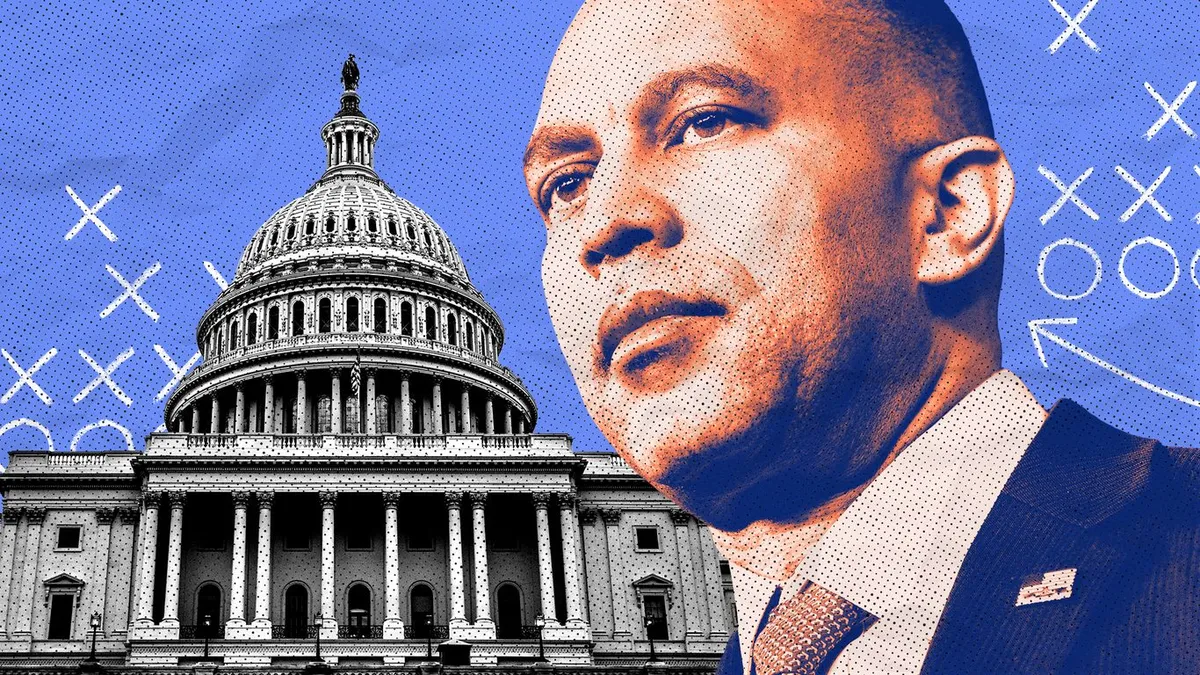
During a recent closed-door meeting on Wednesday, House Minority Leader Hakeem Jeffries (D-N.Y.) expressed significant opposition to a bill intended to fund the Department of Homeland Security (DHS). Sources familiar with his remarks reported to Axios that Jeffries' stance reflects a growing dissent among Democrats regarding the bill, especially following the tragic shooting of Renee Good.
Jeffries' opposition is crucial as it highlights the discontent among Democrats both within Congress and outside of it. Many members argue that the funding proposed in the bill is inadequate to impose necessary constraints on Immigration and Customs Enforcement (ICE). During the meeting, at least five House Democrats voiced their disagreement with the bill, while no one spoke in favor of it. Notably, Rep. Gabe Vasquez (D-N.M.) emerged from the gathering declaring, "I am a hell no."
The progressive organization MoveOn has mobilized against this funding effort, generating over 40,000 letters in just three days, urging Congress to halt any funding for ICE and the Border Patrol. According to spokesperson Britt Jacovich, this demand is rooted in concerns over what they describe as "lawless and dangerous behavior."
In his address to the caucus, Jeffries revealed that Democratic leadership had made five specific requests aimed at ensuring ICE accountability. These requests, however, were rejected by Republican lawmakers. As a result, Jeffries announced his opposition to the bill, even while he expressed support for other appropriations bills scheduled for votes this week.
Several prominent Democrats, including Reps. Jerry Nadler (D-N.Y.), Pramila Jayapal (D-Wash.), Madeleine Dean (D-Pa.), Raul Ruiz (D-Calif.), and Lizzie Fletcher (D-Texas), also voiced their opposition during the meeting.
Despite the vocal opposition from progressive members, several centrist and battleground-district Democrats emerged from the caucus meeting undecided about the bill. Notable figures include Reps. Susie Lee (D-Nev.) and Brad Schneider (D-Ill.), both of whom hold influential positions within the party. Rep. John Mannion (D-N.Y.) commented, "I’m going to continue to speak with my colleagues and speak to my team around it," indicating a desire for further discussion among lawmakers.
As lawmakers navigate their positions, grassroots organizations like MoveOn are exerting pressure for a strong stance against the bill. They have encouraged their members to contact representatives and senators to voice their opposition. Additionally, MoveOn and Indivisible are organizing a pause on economic activities across Minnesota, including schools and workplaces, demanding Congress not to fund ICE.
Rep. Mannion highlighted the urgency of the situation, stating, "The American people are demanding, certainly in my district, that there has to be something that resembles law enforcement in this country ... and this is not it."
The DHS funding bill is slated for a vote this week, separate from a larger government spending package that covers various departments, including Defense, Health and Human Services, Housing and Urban Development, Labor, and Transportation. While the DHS bill is expected to pass along party lines, Rep. Henry Cuellar (D-Texas), a centrist involved in negotiating the bill, has indicated his support.
The broader government package, often referred to as a minibus, is anticipated to receive bipartisan support. However, as Jacovich pointed out, if Democrats genuinely wish to take a stand against ICE funding in Minnesota and nationwide, this may be their opportunity to do so.
This article has been updated to reflect ongoing developments in the situation.