

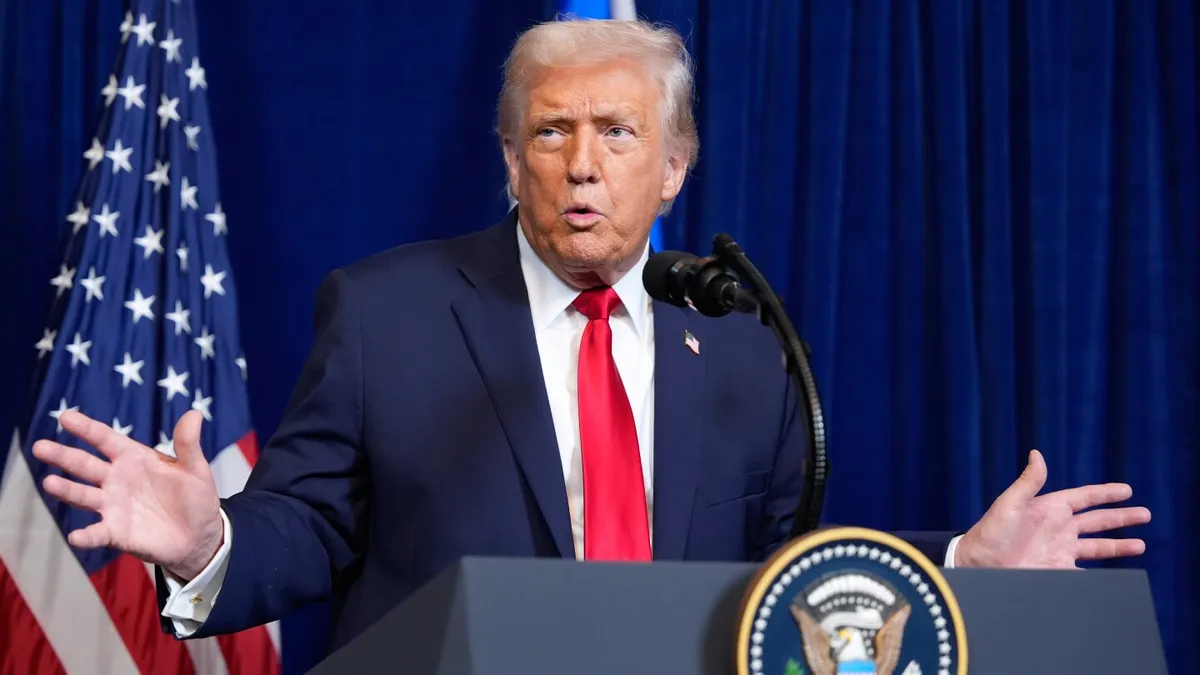
On Tuesday, President Donald Trump took a significant step in his second term by issuing his first vetoes, rejecting two bipartisan bills that were previously considered low-profile. This unexpected move is seen as a form of punishment towards lawmakers who have opposed the president on various issues, signaling a shift in the political landscape.
Among the vetoed legislation was a drinking water pipeline bill sponsored by Republican Rep. Lauren Boebert of Colorado. Boebert, who has been a loyal ally of Trump, broke ranks with the president in November by advocating for the release of files related to convicted sex offender Jeffrey Epstein. The second bill vetoed by Trump aimed to provide the Miccosukee Tribe of Indians of Florida with greater control over its tribal lands, a move that came amid ongoing legal disputes regarding an immigration detention center in the Everglades, often referred to as “Alligator Alcatraz.”
Both of the vetoed bills enjoyed bipartisan support and had been deemed noncontroversial until Trump’s announcement late Tuesday. In a letter to Congress explaining his decision, Trump noted the Miccosukee Tribe’s opposition to the detention facility, stating, “The Miccosukee Tribe has actively sought to obstruct reasonable immigration policies that the American people decisively voted for when I was elected.”
While Trump did not specifically mention Boebert in his veto message, he expressed concerns regarding the costs associated with the drinking water pipeline project. In a later interview with Politico, Trump criticized Colorado’s Democratic Governor Jared Polis, asserting that “they’re wasting a lot of money and people are leaving the state. They’re leaving the state in droves. Bad governor.”
In response to the veto, Boebert issued a statement on social media, suggesting that the veto might be a form of “political retaliation.” She expressed hope that her call for accountability regarding corruption was not the reason behind the veto. “Americans deserve leadership that puts people over politics,” Boebert stated, adding, “This isn’t over.”
The Florida legislation was sponsored by Republican Rep. Carlos Gimenez, who has received Trump’s endorsement. Both Gimenez and representatives of the Miccosukee Tribe were not available for comment following the veto announcements. When questioned about whether the vetoes were intended as punishment, the White House declined to respond directly and instead referred to Trump’s earlier comments.
Congress has the power to override the vetoes with a two-thirds vote in both the House and Senate. However, it remains uncertain if there is sufficient support within the Republican-controlled chambers to achieve this, especially as many members face upcoming midterm elections where Trump’s backing will be crucial.
Boebert’s legislation, known as the “Finish the Arkansas Valley Conduit Act,” was designed to enhance access to clean drinking water in eastern Colorado. Despite her strong support for Trump in the past, her advocacy for the Epstein file release created a rift between her and the president. Republican Rep. Jeff Hurd of Colorado, a co-sponsor of the pipeline bill, expressed his deep disappointment at Trump’s veto, emphasizing that the legislation was a bipartisan effort aimed at fulfilling a long-standing federal commitment to southeastern Colorado. Hurd clarified that the bill did not authorize new construction spending or expand the federal government’s original commitment to the project, but rather adjusted the terms for repaying its costs.