

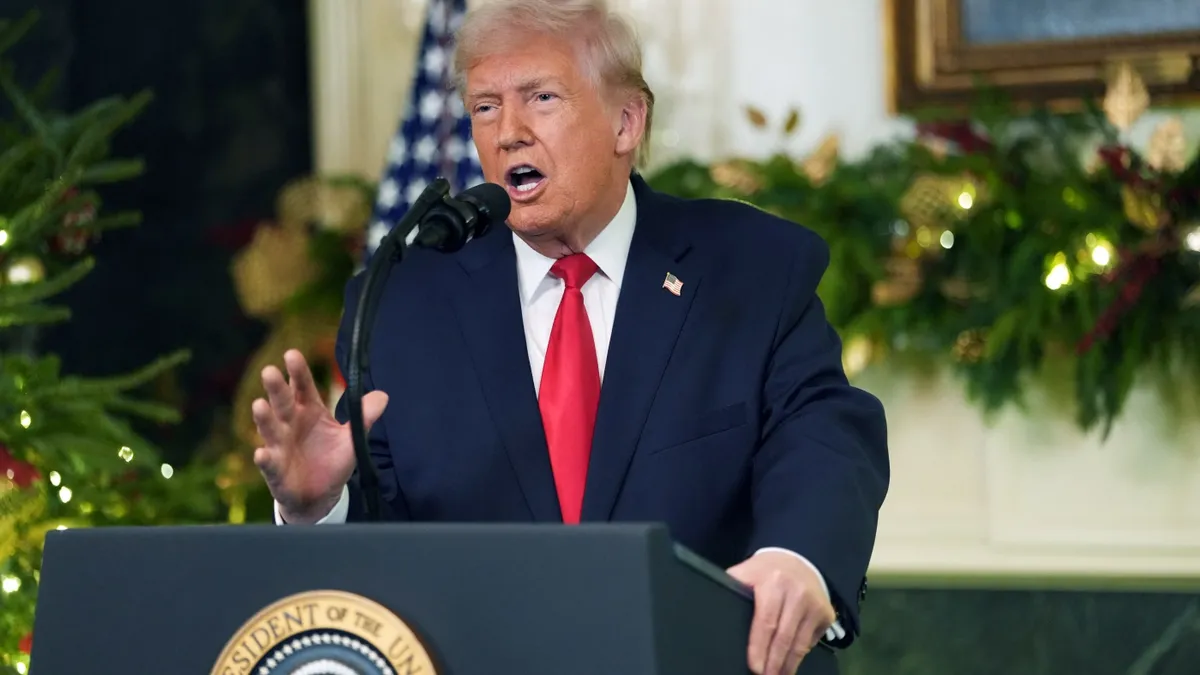
In a recent prime-time address, President Trump expressed his belief that the United States is on the brink of an economic boom. He emphasized that rising prices are beginning to decrease, attributing many of the nation’s ongoing challenges to previous administrations and immigration. This assertion comes at a time when Trump's ratings concerning the economy are historically low, with high prices remaining a significant concern for many Americans, as highlighted by the latest NPR/PBS News/Marist poll.
During his speech, Trump urged the public to be patient, suggesting that the policies he implemented earlier this year will yield positive results in the upcoming year. He promised that families could expect larger tax refunds next year. Additionally, he introduced a new initiative aimed at providing service members with a payment of $1,776 and outlined plans to reduce housing costs. According to NPR's Deepa Shivaram, Trump's address followed a familiar pattern, listing his perceived accomplishments in a manner consistent with his previous speeches.
On the legislative front, the House of Representatives conducted a vote on a Republican-led health care plan that notably did not extend enhanced health care subsidies. These subsidies are crucial for over 20 million Americans and are set to expire at the end of this month. Interestingly, several Republicans broke ranks with party leadership to support a bipartisan push for a three-year extension of these vital subsidies. As reported by NPR's Barbara Sprunt, the House Speaker now faces a critical decision regarding whether to expedite the vote.
If the vote does not occur by the end of this week, it will be postponed until next year, as lawmakers prepare to leave for the holiday season. Some Republicans appear to be reconsidering their stance on these subsidies, especially with midterm elections approaching. Lawmakers are acutely aware of the impact that expiring subsidies could have on insurance premiums and their constituents’ needs.
In international news, Trump has enacted a ban on all sanctioned oil tankers traveling to and from Venezuela. This move escalates the administration's pressure campaign against Venezuelan President Nicolás Maduro and raises concerns about the potential for direct military conflict between the two nations. NPR's Greg Myre reports that while a full blockade could be perceived as an act of war, the Trump administration is focusing on tankers already on the sanctions list.
The U.S. has a history of targeting "ghost ships"—tanker vessels that attempt to disguise their identities to evade sanctions. This recent action could severely impact Venezuela, which heavily relies on oil exports. A fully loaded large tanker can carry oil valued at over $100 million, and if the U.S. begins seizing numerous ships, it may deter non-sanctioned vessels from approaching Venezuelan ports.
In educational developments, a recent poll by the Center for Democracy and Technology revealed that over 40% of surveyed 6th- to 12th-grade teachers utilized AI detection tools during the previous academic year. Despite the widespread use of these tools, studies have raised concerns about their reliability. Popular detectors such as Turnitin, GPTZero, and Copyleaks have been shown to misidentify non-AI content as automated and vice versa, according to findings by Mike Perkins, a prominent researcher in academic integrity at British University Vietnam.
Despite these issues, NPR reports that school districts across the U.S. continue to invest significant funds in these tools. For instance, John Grady, a language and literature teacher, employs AI detection as a conversation starter about the use of AI in writing. He scans all essays with GPTZero and, if the tool indicates a 50% chance of AI involvement, he conducts further investigations using revision history tools.
Meanwhile, students like high schooler Zi Shi, who speaks Mandarin as a first language, express concerns about being unfairly flagged for their unique writing styles and limited English vocabulary.
As the holiday shopping season gains momentum, more consumers are opting for buy now, pay later (BNPL) options. On Cyber Monday alone, shoppers financed a record $1 billion in online purchases through BNPL, according to data from Adobe Analytics. The company projects that this figure could rise to $20.2 billion by the end of the season, reflecting an 11% increase from the previous year.
BNPL allows consumers to make immediate purchases through lenders like Afterpay and Klarna, with the flexibility to repay over time. However, experts caution that this payment method comes with its own set of risks. Finance professionals have shared essential tips on using BNPL responsibly, including being cautious if you already have credit card debt, limiting loans to a single lender for easier tracking, and avoiding impulse purchases.
The National Oceanic and Atmospheric Administration has released its Arctic Report Card, revealing that the Arctic is warming at a pace faster than the global average, leading to significant environmental changes. In Chile, stores on Chiloé Island are selling images of witches, a cultural phenomenon explored in this week's Far-Flung Postcards series.
As we embrace the holiday spirit, the tradition of kissing under the mistletoe is examined in NPR's Word of the Week, uncovering the plant's name origins and the science behind this festive custom. Stay informed and subscribe to our newsletters for expert advice on a variety of topics, including love, finance, and relationships.