

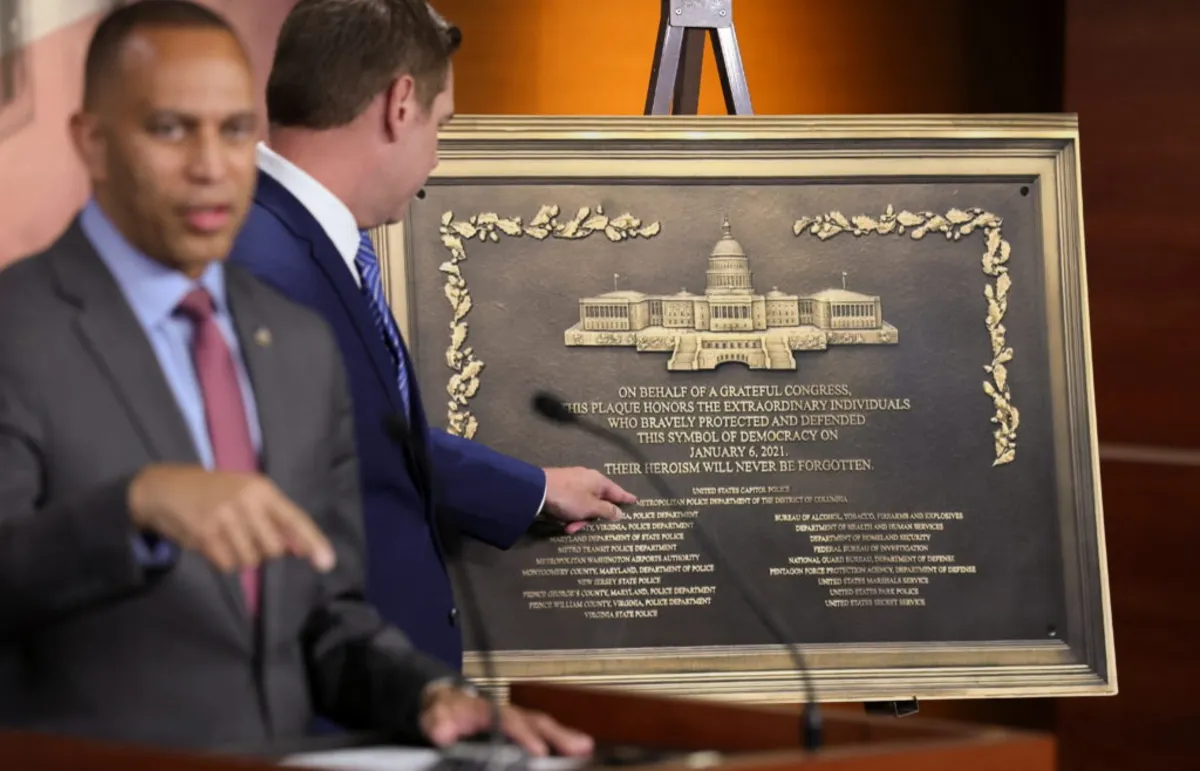
As the fifth anniversary of the January 6, 2021 attack on the U.S. Capitol approaches, a significant symbol of remembrance—the official plaque honoring the brave police officers who defended democracy that day—remains absent. Required by law to be displayed at the Capitol, the plaque's current location is unknown, but it is believed to be in storage. This absence has sparked controversy and concern among lawmakers and citizens alike.
House Speaker Mike Johnson, a Republican from Louisiana, has yet to formally unveil the plaque. Meanwhile, the Trump administration's Department of Justice is attempting to dismiss a lawsuit filed by police officers demanding the plaque be displayed as intended. The Architect of the Capitol, responsible for managing the plaque's installation, has refrained from commenting due to the ongoing federal litigation.
In a bid to preserve the memory of that fateful day, around 100 members of Congress, predominantly Democrats, have taken matters into their own hands. They have created poster board-style replicas of the Jan. 6 plaque and displayed them outside their office doors, turning the Capitol complex into a landscape of makeshift memorials. The faux bronze stand-ins convey a powerful message: "On behalf of a grateful Congress, this plaque honors the extraordinary individuals who bravely protected and defended this symbol of democracy on Jan. 6, 2021. Their heroism will never be forgotten."
In a city filled with monuments that reflect the nation’s history, the missing plaque was intended to serve as a simple yet permanent tribute, positioned near the Capitol's west front—the site of intense confrontations as rioters breached the building. Its absence not only erases a crucial reminder of that day but also fosters a culture of forgetting. Visitors can now traverse the Capitol without any formal acknowledgment of the events that transpired when a mob of supporters of then-President Donald Trump attempted to overturn the 2020 election results.
The events of January 6 have sparked significant debate among historians regarding their place in the broader narrative of 21st century U.S. history. Professor Douglas Brinkley from Rice University raises the critical question: “Will January 6 be seen as a pivotal moment when democracy was in peril, or will it be remembered merely as an unusual occurrence?” He suggests that there is no clear consensus as the anniversary approaches, indicating the complexities of collective memory.
The riot resulted in the tragic deaths of at least five individuals, including Trump supporter Ashli Babbitt, who was shot by police while attempting to gain access to the House chamber. Over 140 law enforcement officers were injured, with some suffering severe injuries, and several later died by suicide. Approximately 1,500 individuals faced charges related to the Capitol attack, marking one of the largest federal prosecutions in U.S. history. Following his return to power in January 2025, Trump issued pardons to all those convicted.
Unlike the commemorations for the September 11, 2001, attacks or the Oklahoma City bombing, the lack of recognition for January 6 has created a void not only in memory but also in the healing process for the nation. Rep. Mary Gay Scanlon of Pennsylvania emphasized the importance of memorializing such events: "That's why you put up a plaque. You respect the memory and the service of the people involved."
The speaker's office has previously indicated that it was working on the plaque’s installation but has not provided further comments amid the ongoing legal proceedings. Lawmakers approved the plaque in March 2022 as part of a wider government funding package, expressing deep gratitude to the officers who responded to the violence. The resolution included a deadline for installation, which has since been missed, prompting two officers to file a lawsuit over the delay.
Lawmakers who have displayed replicas of the plaque outside their offices argue for the necessity of public awareness regarding the events of January 6. Rep. Jamie Raskin of Maryland, a member of the Jan. 6 committee, asserted that younger generations must understand how perilously close the nation came to losing its democracy. He envisions the Capitol one day offering tours that detail the significance of that day in American history.
As time progresses, bipartisan memorial services for January 6 have largely dissipated. On the upcoming Tuesday, Democrats plan to reconvene members from the Jan. 6 committee to examine ongoing threats to free and fair elections, although participation from Republican lawmakers remains uncertain. Under Speaker Johnson’s leadership, Republicans are forming their own committee to investigate what they term the "full truth" of the events that unfolded. This raises concerns among some lawmakers, like Rep. Joe Morelle of New York, who firmly stated, "We should stop this silliness of trying to whitewash history—it’s not going to happen."
The increasing number of makeshift plaques throughout the Capitol serves as a testament to the enduring memory of January 6. Rep. Morelle believes that while the official plaque may be missing, the collective remembrance of that day will not fade from the hearts and minds of Americans.