

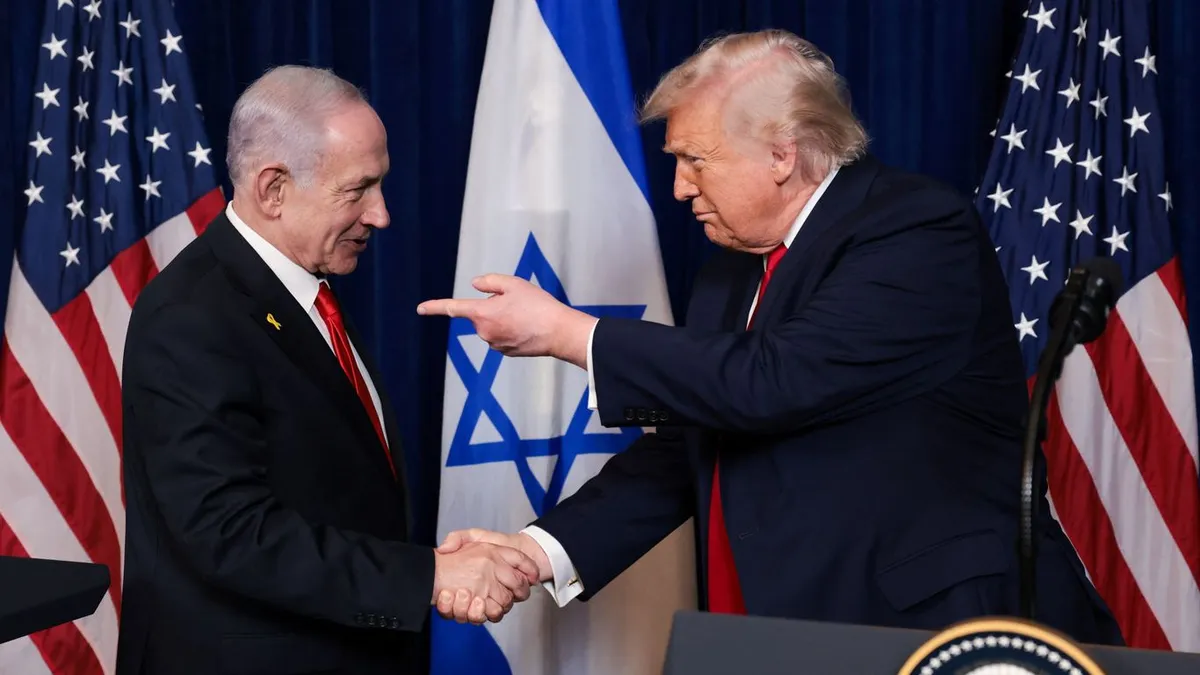
In a significant meeting on Monday, President Trump and his senior advisers urged Prime Minister Benjamin Netanyahu to reconsider Israel's policies in the occupied West Bank, according to a U.S. official and another source with direct knowledge of the discussions. This request marks a pivotal moment in U.S.-Israel relations as the security situation in the West Bank has worsened, drawing criticism from various Western governments.
The Trump administration, despite being viewed as supportive of Israel's stance in the past, has now taken an active role in discussing West Bank policy with Netanyahu for the first time during Trump's second term. The U.S. official indicated that the White House is concerned that escalating violence in the West Bank could jeopardize efforts to implement the Gaza peace agreement and hinder the expansion of the Abraham Accords before the conclusion of Trump’s presidency.
Over the last three years, Netanyahu's hard-right government has pursued several policies that have significantly weakened the Palestinian Authority, cut off funding, expanded settlements, legalized outposts, forcibly displaced Palestinian communities, and moved towards a de-facto annexation of the West Bank. In light of these developments, Trump and his administration expressed apprehension about the situation in the West Bank and implored Netanyahu to take steps to avoid provoking further violence.
During the meeting, Netanyahu also voiced his worries regarding Iran and Hezbollah enhancing their military capabilities, particularly concerning long-range missiles. Trump reaffirmed in public statements that additional military actions against Iran remain an option. Despite previous disagreements over the implementation of the Gaza deal, Netanyahu agreed to proceed to its second phase and accepted Trump's request to re-engage in discussions with the Syrian government regarding a potential security pact.
Following their discussions, Trump stated, “We have had a discussion, a big discussion, for a long time on the West Bank. I wouldn't say we agree on the West Bank 100%, but we will come to a conclusion on the West Bank,” during a press conference with Netanyahu. This acknowledgment of differing views yet a commitment to find common ground is indicative of the delicate balance both leaders must maintain.
Sources revealed that the topic of settler violence against Palestinian civilians, the financial instability of the Palestinian Authority, and the expansion of Israeli settlements were all raised during preparatory meetings involving Netanyahu, Secretary of State Marco Rubio, Steve Witkoff, and Jared Kushner, as well as during the main meeting with Trump. The U.S. emphasized that changing course in the West Bank is essential for restoring Israel's relations with European nations and potentially expanding the Abraham Accords.
Netanyahu responded strongly against settler violence, committing to take further action to address this issue, as per the source's account of the meeting. However, the White House has refrained from commenting on the specifics of these private discussions.
West Bank policies, especially concerning settlements, remain a politically sensitive issue for Israel. The settler lobby plays a crucial role in Netanyahu's coalition government and wields considerable influence within his Likud party. After returning to office, Trump lifted sanctions imposed during the Biden administration against violent settlers and appointed Mike Huckabee—known for his pro-settler stance—as ambassador to Israel. This has led to increased tensions, including the recent deaths of two Palestinian Americans in settler attacks.
While Trump did not disclose specific disagreements with Netanyahu regarding West Bank policy, he expressed confidence in Netanyahu’s decision-making, stating, “He will do the right thing. I know that. I know him very well.” Beyond this contentious issue, Trump has been largely complimentary of Netanyahu and Israel’s policies, including those in Gaza and toward Iran, in their joint appearances.
In a significant move last September, Trump intervened to prevent Netanyahu from annexing portions of the West Bank in response to a series of recognitions of Palestinian statehood by European countries. However, Trump did not delve into broader Israeli policies during that time.