

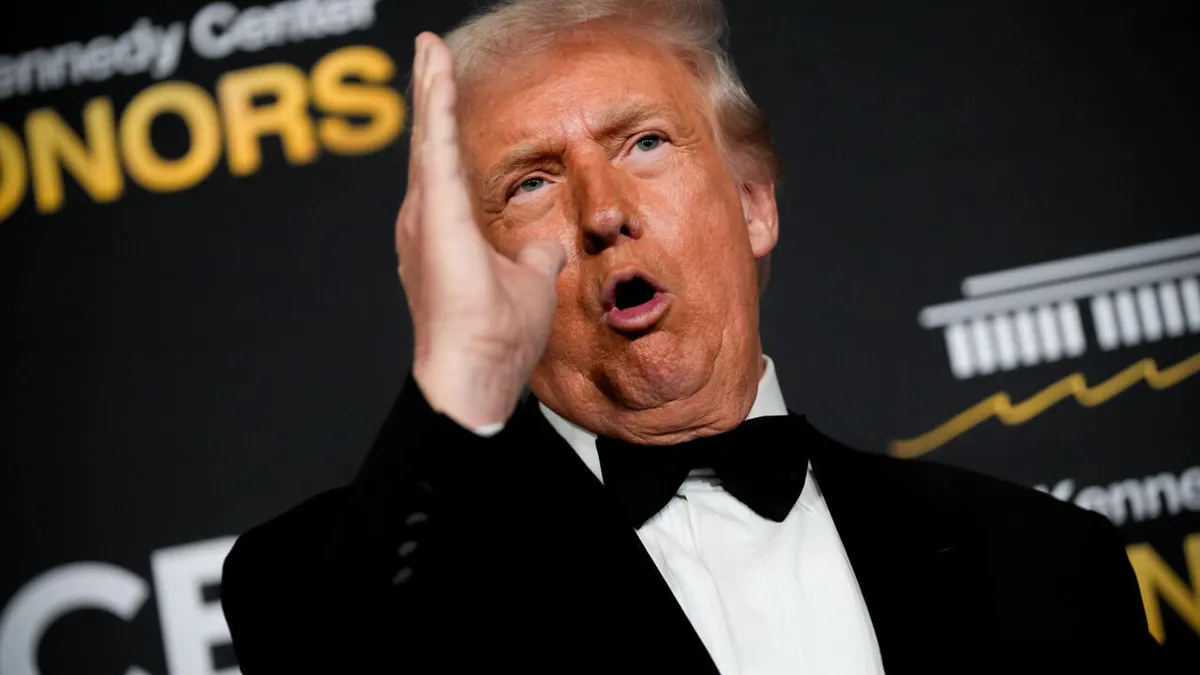
On Sunday, former President Donald Trump expressed disappointment in Ukrainian President Volodymyr Zelensky, suggesting that he “isn't ready” to endorse a US-authored peace proposal aimed at resolving the ongoing Russia-Ukraine war. Trump's remarks followed three days of negotiations between US and Ukrainian officials, which concluded on Saturday with the intention of reconciling differences on the proposal put forth by the US administration.
During an interaction with reporters, Trump indicated that Zelensky is impeding the progress of peace talks. “I’m a little bit disappointed that President Zelensky hasn’t yet read the proposal, that was as of a few hours ago. His people love it, but he hasn’t,” Trump remarked. He also mentioned that while Russia seems agreeable to the proposal, Zelensky’s lack of readiness is concerning. Trump added, “His people love it. But he isn’t ready.”
It is important to note that Russian President Vladimir Putin has not publicly endorsed the White House's plan. In fact, last week, Putin criticized certain elements of Trump's proposal as unworkable, despite its initial draft appearing to favor Moscow. Trump's relationship with Zelensky has been inconsistent; he has often emphasized that the war represents a misuse of US taxpayer money, and has suggested that Ukraine should consider ceding territory to Russia to expedite a resolution to the nearly four-year-long conflict.
In response to ongoing discussions, Zelensky stated on Saturday that he had a “substantive phone call” with American officials involved in the negotiations with a Ukrainian delegation in Florida. He conveyed his commitment to working collaboratively with the US to achieve a genuine peace. “Ukraine is determined to keep working in good faith with the American side to genuinely achieve peace,” Zelensky posted on social media.
Trump's criticism of Zelensky coincided with a favorable reception of the Trump administration’s newly released national security strategy by the Kremlin. Dmitry Peskov, the Kremlin spokesman, commented that the updated strategy aligns with Moscow’s vision, which emphasizes dialogue and constructive relations. Peskov noted, “There are statements there against confrontation and in favor of dialogue and building good relations,” expressing hope for improved cooperation with Washington regarding the Ukrainian situation.
The national security document issued by the White House outlines the US's desire to enhance its relationship with Russia after years of strained interactions, with the overarching goal of ending the war to “reestablish strategic stability with Russia.” At the Reagan National Defense Forum on Saturday, Keith Kellogg, Trump's outgoing Ukraine envoy, stated that the efforts to conclude the war are nearing their final stages, emphasizing that a deal hinges on two critical issues: the control of territory, particularly in the Donbas region, and the status of the Zaporizhzhia Nuclear Power Plant.
As the negotiations reached their conclusion, Ukraine faced intensified attacks from Russian forces. Reports indicated that missile, drone, and shelling assaults resulted in at least four casualties over the weekend. A drone attack in the northern Chernihiv region claimed the life of one individual, while a combined missile and drone strike on the central city of Kremenchuk led to extensive power and water outages. Kremenchuk is significant as it hosts one of Ukraine’s largest oil refineries and serves as an industrial hub.
Officials from Kyiv and Western allies have asserted that Russia is systematically targeting Ukraine’s power infrastructure, aiming to deprive civilians of essential services such as heat, light, and water as winter approaches. This tactic has been characterized by Ukrainian officials as an attempt to “weaponize” the cold against the population. Additionally, shelling incidents in Ukraine’s Kharkiv region on Sunday resulted in three deaths and ten injuries, according to the local prosecutor's office.