

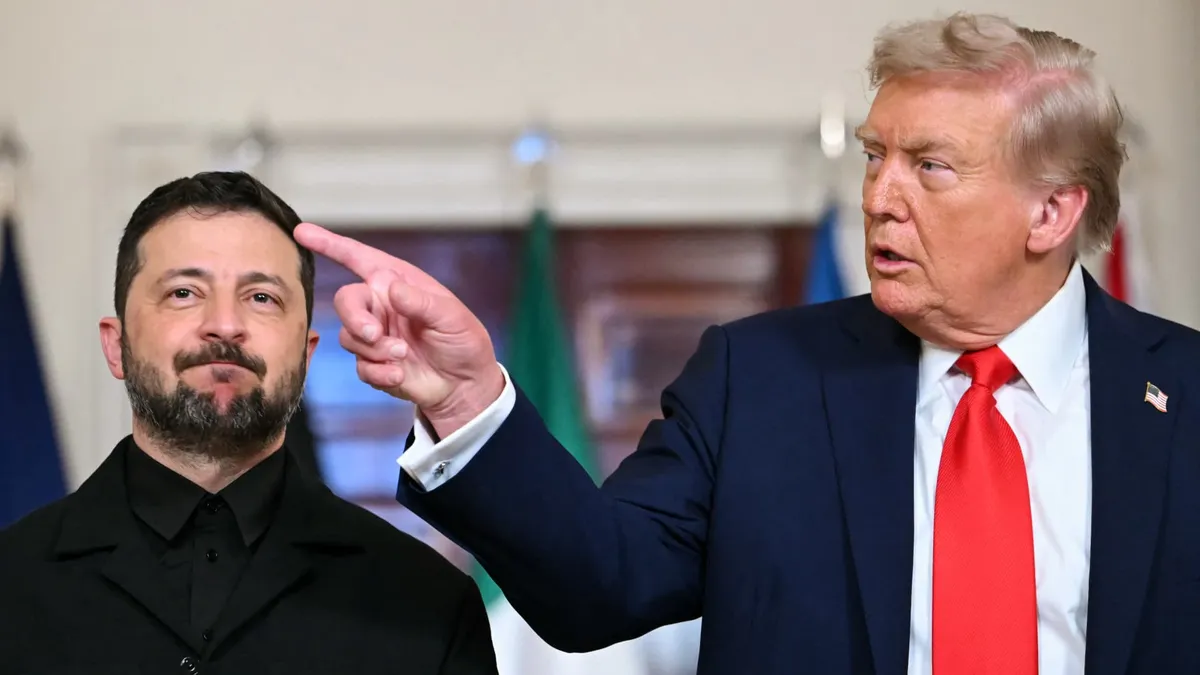
Increasing tensions are emerging between U.S. President Donald Trump and Ukrainian President Volodymyr Zelenskyy following Trump's recent comments regarding Zelenskyy's engagement with U.S. peace proposals. During a press conference on Sunday night, Trump expressed disappointment that Zelenskyy had not yet reviewed the peace proposal, stating, "I'm a little bit disappointed that President Zelenskyy hasn't yet read the proposal, that was as of a few hours ago." He further noted, "His people love it, but he hasn't read it."
Trump's remarks come amidst ongoing diplomatic discussions between Ukrainian and U.S. officials. The comments were made shortly after a meeting in Miami concluded without a definitive agreement on the latest iteration of the draft peace plan. Multiple versions of the peace plan have emerged as negotiations between Russia and Ukraine continue, with significant focus placed on territorial concessions and security assurances for Ukraine.
Former envoy to Ukraine, Keith Kellogg, suggested that a resolution to the conflict was "really close," contingent upon settling two main issues: the future of Ukraine's Donbas region, currently under Russian occupation, and the fate of the Russian-occupied Zaporizhzhia nuclear power plant.
In contrast to Trump's comments, Zelenskyy provided a more cautious perspective on the Miami talks. In his nightly address, he described the discussions as "constructive, though not easy." He emphasized the importance of in-person dialogues, stating, "some matters can only be discussed in person," indicating a preference for face-to-face communication over phone conversations.
On Monday, Zelenskyy is set to travel to London for further discussions with key European leaders, including U.K. Prime Minister Keir Starmer, French President Emmanuel Macron, and German Chancellor Friedrich Merz. These talks will focus on the ongoing peace negotiations and the next steps to ensure Ukraine's territorial integrity and future security amidst increasing U.S. pressure to finalize peace proposals perceived as favorable to Russia.
European allies are expressing concerns about the peace proposals being discussed without their input, particularly given the potential security implications for the continent. The U.K. and France are advocating for a Coalition of the Willing—a group of nations that could provide military support to ensure Ukraine's security post-conflict. However, Russia has strongly opposed the idea of foreign troops in Ukraine, with President Vladimir Putin labeling them as legitimate targets.
European leaders are becoming increasingly anxious about the U.S.'s willingness to accommodate Russian demands, especially following the recent release of Trump's national security strategy. The document warned that Europe risks "civilizational erasure" and questioned whether European nations could remain reliable allies. It also indicated a desire for the U.S. to restore strategic stability with Russia, a sentiment that the Kremlin has welcomed.
While both the U.S. and Russia express a mutual interest in future rapprochement, significant challenges remain regarding an immediate peace agreement over Ukraine. Recent discussions between U.S. officials and their Russian counterparts in Moscow ended without a breakthrough, although Russian presidential aide Yuri Ushakov described the talks as "very useful" and "constructive."
As negotiations continue, the Kremlin has responded to Trump's criticisms of Zelenskyy, with Press Secretary Dmitry Peskov noting the need for discreet negotiations. He emphasized, "This kind of work cannot be conducted entirely in public," highlighting the complexity of the ongoing discussions that require confidentiality to yield results.