

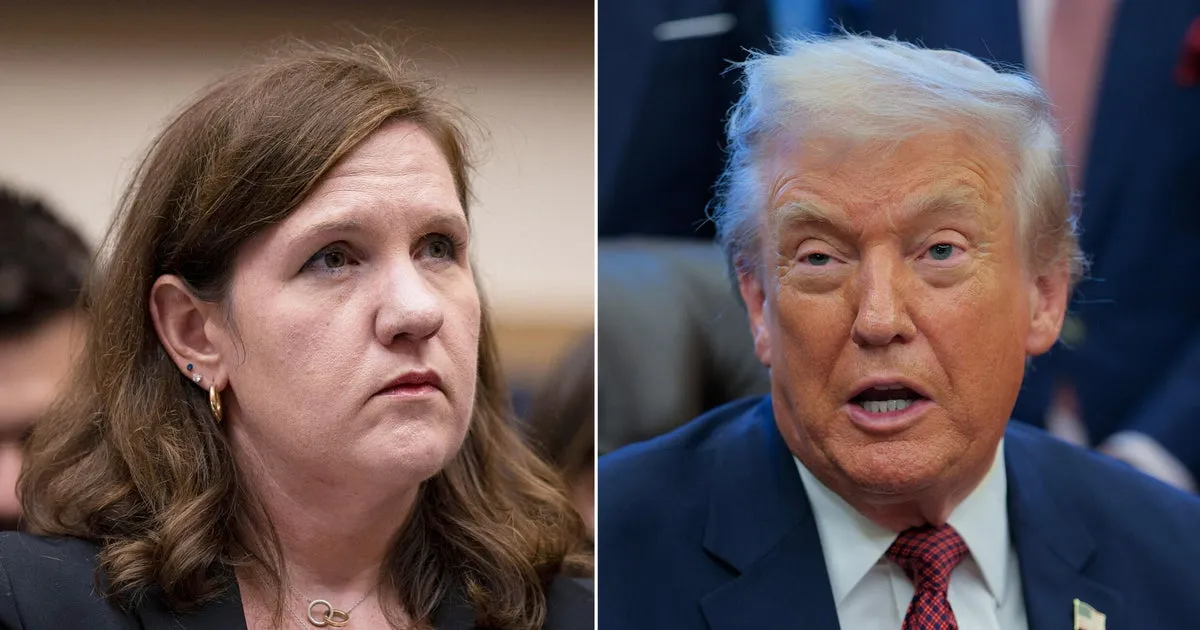
On Monday, the Supreme Court began hearing a significant legal case that revolves around President Trump's attempt to remove a member of the Federal Trade Commission (FTC). This case, known as Trump v. Slaughter, has the potential to reshape the extent of presidential authority over independent agencies that Congress has traditionally shielded from political interference.
The dispute originated from President Trump's effort to dismiss Rebecca Kelly Slaughter from her FTC position without proper justification. According to a federal law, a president can only remove a commissioner for reasons such as inefficiency, neglect of duty, or malfeasance while in office. The Supreme Court is now tasked with evaluating the constitutionality of these removal protections, which date back to a landmark 1935 ruling.
This case is critical as it may challenge the longstanding precedent established in Humphrey's Executor v. United States, which allowed Congress to protect members of independent agencies from arbitrary dismissal. Recent decisions by the Supreme Court's conservative justices have eroded that precedent, most notably in cases involving the Consumer Financial Protection Bureau and the Federal Housing Finance Agency in 2020 and 2021, respectively.
A ruling in favor of President Trump could dramatically alter the balance of power within the U.S. federal government by limiting Congress's ability to impose constraints on the president's removal authority. Since resuming office, Trump has actively sought to replace numerous Democratic-appointed officials across various independent bodies, including the FTC.
Rebecca Slaughter, who was initially appointed by Trump and later reappointed by President Joe Biden, received an email from Trump in March stating that her continued service was inconsistent with his administration's priorities. Following her dismissal, Slaughter filed a lawsuit claiming her firing was unlawful, arguing that Trump violated both federal law and established Supreme Court precedent.
A federal district court ruled in favor of Slaughter, reinstating her position at the FTC. However, the U.S. Court of Appeals for the District of Columbia Circuit issued a temporary order permitting her removal. Eventually, the appeals court decided that Slaughter should be reinstated again. As the Supreme Court prepares to hear the case, it has permitted Trump to dismiss Slaughter while deliberations on the constitutionality of the FTC's removal protections continue.
The Trump administration contends that the Constitution grants the president comprehensive authority over executive officers, arguing that removal protections hinder the president's ability to ensure the faithful execution of laws. Solicitor General D. John Sauer emphasized that Congress's role in structuring the executive branch does not extend to creating a "Fourth Branch" that limits presidential control.
Legal representatives for Slaughter warn that overturning the Humphrey's Executor ruling could destabilize key institutions built into the framework of U.S. governance. They argue that multimember independent agencies have a historical significance that aligns with the Constitution's text and structure. Slaughter's team asserts that the current organization of these agencies—composed of bipartisan members serving staggered terms—promotes stability and protects individual liberties more effectively than a single-party-controlled agency.
Moreover, they highlighted that even with existing protections, presidents retain influence over independent agencies through their nomination powers and budgetary controls. More than 200 congressional Democrats have also voiced their concerns, stating that the removal protections represent a crucial compromise between the legislative and executive branches established over a century of governance.
The outcome of this Supreme Court case could have far-reaching implications for the future of independent agencies and the balance of power between the presidency and Congress. As the court deliberates on this pivotal issue, the potential for a new precedent looms, which could redefine the contours of presidential power in the United States.