

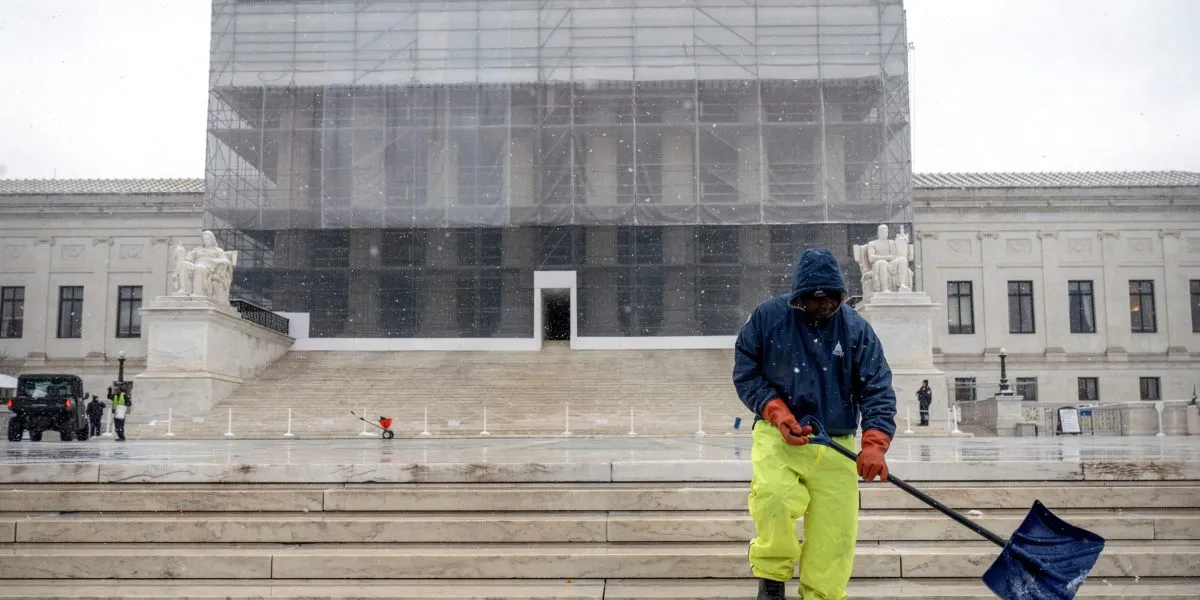
The Supreme Court is poised to take significant action regarding a case being argued on Monday that could lead to the overturning of a unanimous decision made 90 years ago. This landmark ruling, which limits executive authority, has come under scrutiny, particularly by the court's conservative justices. Liberal Justice Elena Kagan highlighted in September that these justices seem "raring to take that action."
In the early months of Donald Trump's second term as President, the Supreme Court has already permitted him to terminate a considerable number of officials across various independent agencies. This move appears to challenge the precedent set by the 1935 ruling in Humphrey’s Executor, which prohibits the president from dismissing the heads of independent agencies without just cause.
The current case revolves around the firing of Rebecca Slaughter from the Federal Trade Commission (FTC) and also includes officials from other agencies such as the National Labor Relations Board and the Consumer Product Safety Commission. Thus far, only Lisa Cook, a Federal Reserve governor, and Shira Perlmutter, a copyright official with the Library of Congress, have managed to retain their positions amid these dismissals.
The Supreme Court's potential inclination to overturn Humphrey’s Executor reflects a broader conservative legal movement that argues for an expansive interpretation of presidential power, known as the unitary executive theory. This case once again brings the FTC into the spotlight, similar to its role in the original 1935 decision. The ruling established that the president, at the time Franklin D. Roosevelt, could not arbitrarily remove appointed leaders of federal agencies.
This decision marked the beginning of a powerful era for independent federal agencies, which are responsible for regulating crucial aspects of society, including labor relations and employment discrimination. Advocates of the unitary executive theory contend that contemporary federal agencies misinterpret the Constitution, asserting that all agencies within the executive branch should be accountable to the president, including the ability to dismiss their leaders without restriction.
Since Chief Justice John Roberts took the helm in 2010, the Supreme Court has progressively chipped away at laws that limit the president's authority to remove officials from office. Notably, in a 2020 ruling, Roberts stated that "the President’s removal power is the rule, not the exception," thereby allowing Trump to terminate the head of the Consumer Financial Protection Bureau despite existing job protections akin to those upheld in Humphrey’s Executor.
Additionally, in a 2024 decision that protected Trump from prosecution regarding his attempts to overturn the 2020 election results, Roberts included the power to dismiss employees as one of the president's "conclusive and preclusive" powers, which Congress cannot restrict.
Legal historians and even some proponents of originalism argue that Roberts’ interpretation of the unitary executive theory may be flawed. Caleb Nelson, a law professor at the University of Virginia, suggests that both the text and historical context of Article II of the Constitution provide a more nuanced view than the current Court has acknowledged. Similarly, Jane Manners, a law professor at Fordham University, noted that she and fellow historians have submitted briefs to the court to shed light on the historical limits of the removal power as understood in the early years of the nation.
Slaughter's legal team supports the historians' stance, arguing that limitations on Trump's power align with constitutional principles and historical precedent. In contrast, the Justice Department maintains that Trump holds the right to terminate board members at his discretion as he pursues his agenda, advocating for the dismissal of Humphrey’s Executor as a precedent.
Moreover, a secondary question in the case may impact Lisa Cook, the Federal Reserve governor. The court is considering whether judges possess the authority to reinstate individuals even if a firing is deemed illegal. Justice Neil Gorsuch previously indicated that while fired employees might receive back pay, reinstatement is less likely, which raises concerns about Cook's future in her role.
The justices have expressed caution regarding the economic implications of allowing Trump to dismiss central bank leaders. Separate arguments are scheduled for January to determine whether Cook can continue her duties while her legal case progresses. The outcome of these proceedings could have far-reaching effects on the balance of power within the federal government and the future of independent agencies in the United States.