

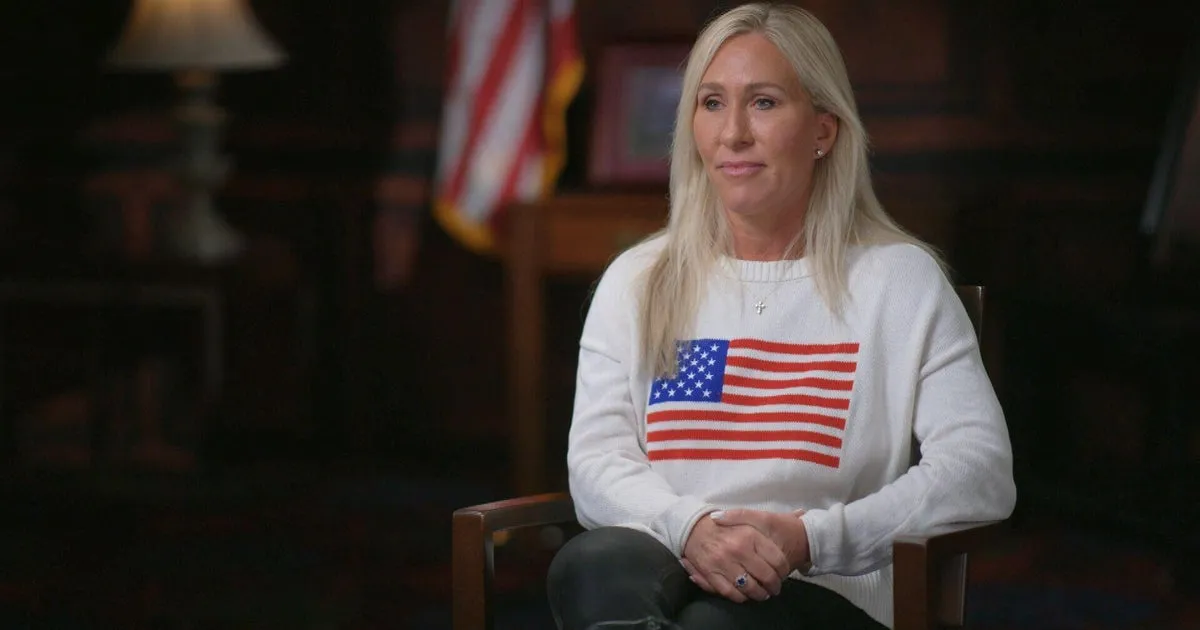
In a surprising twist that has sent shockwaves through the political landscape, Marjorie Taylor Greene, the fierce and outspoken congresswoman, has announced her resignation from Congress, a full year before her term is set to expire. This unexpected decision comes after a dramatic fallout with President Trump, who publicly stated he would support another candidate for her seat, effectively shattering their once-solid alliance.
Greene, who gained notoriety for her incendiary remarks and controversial conspiracy theories, including claims that September 11 was an inside job and the tragic shooting at Parkland School was staged, has been a polarizing figure in American politics. Once one of Trump's staunchest defenders, she has now become a symbol of a fractured MAGA movement.
In a resignation video released last month, Greene expressed that her decision was not made lightly, emphasizing the importance of prioritizing her family amidst the tumultuous political climate. During an interview with Lesley Stahl, Greene reflected on the sudden nature of her departure, citing a series of changes that altered her political landscape. "I stood for women who were raped when they were 14 years old, and the president I fought for called me a traitor for that," Greene stated, highlighting the personal and political struggles that led to her resignation.
Greene's relationship with Trump took a dramatic turn after he criticized her for her comments regarding Jeffrey Epstein, the convicted sex offender accused of trafficking underage girls. Greene revealed that following Trump's disparaging comments, she received numerous death threats, including direct threats against her son. She stated, "The subject line for the direct death threats on my son was his words: Marjorie Traitor Greene." This shocking revelation underscores the intensity of the threats she faced, which she attributes, in part, to Trump's rhetoric.
Greene's departure raises questions about the future of the MAGA movement. Is this resignation indicative of a broader split within Trump's base? Greene, who has fiercely defended her political stance, now identifies more with the America First ideology than with MAGA itself, stating, "I'm America first. MAGA is President Trump's phrase." This distinction highlights a potential evolution in her political identity.
In her resignation video, Greene criticized Trump for aligning with establishment figures and ignoring the needs of his base. She accused him of serving the interests of big pharma, foreign leaders, and a wealthy donor class, stating, "If I'm cast aside by the president and the MAGA political machine and replaced by NeoCons, big pharma, big tech, military industrial war complex, foreign leaders and the elite donor class…" This statement reflects her growing discontent with the direction of the MAGA movement and her commitment to advocating for the American people.
While Greene has firmly stated her intention to step away from the political arena, skepticism remains about her future ambitions. In her interview, she dismissed any plans to run for higher office, asserting, "I have zero plans, zero desire to run for president." However, many speculate that her resignation could be a strategic move in an ever-evolving political landscape.
Greene's resignation is not just a personal decision; it marks a significant moment in the ongoing evolution of the Republican Party and the MAGA movement. As she steps away from the public eye, the implications of her departure will undoubtedly be felt in the political arena, leaving many to wonder who will fill the void she leaves behind.
As the political narrative continues to unfold, Greene's resignation serves as a stark reminder of the volatility and unpredictability of contemporary politics, leaving both her supporters and critics to speculate on what lies ahead.