

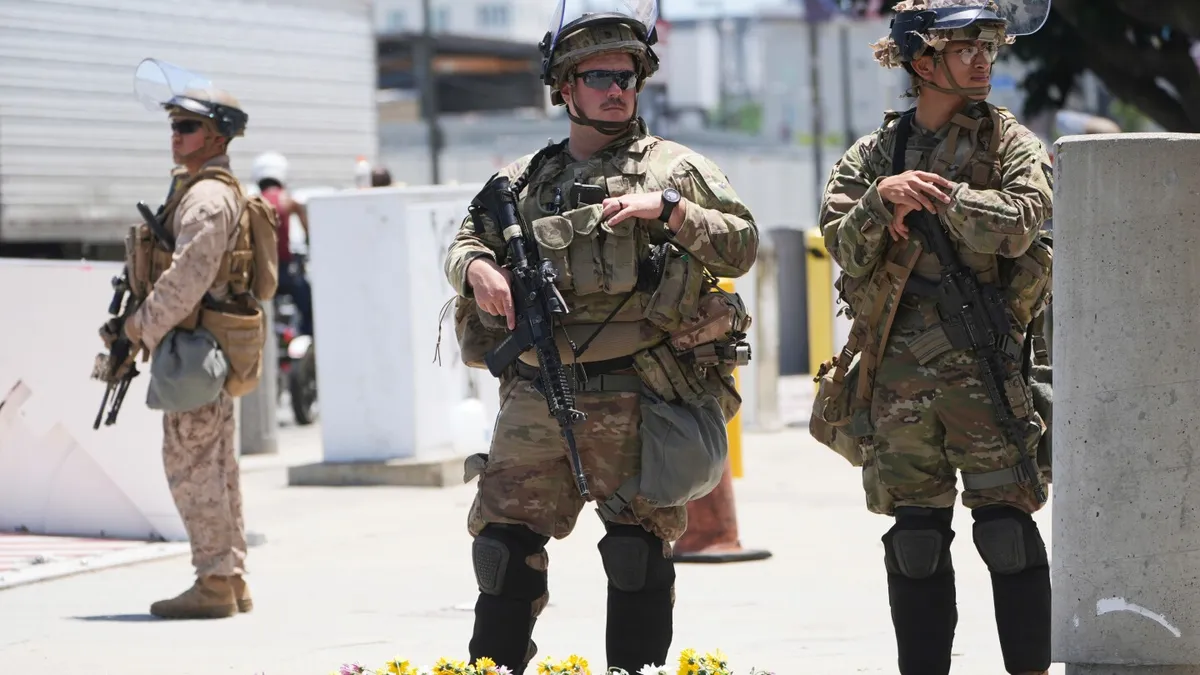
A federal judge has delivered a significant ruling, instructing the Trump administration to stop deploying the California National Guard in Los Angeles and to return control of the troops to the state. U.S. District Judge Charles Breyer, based in San Francisco, granted a preliminary injunction requested by California officials. However, he has placed this decision on hold until Monday, likely allowing the administration an opportunity to appeal the ruling.
In an unprecedented move, President Donald Trump authorized the activation of over 4,000 California National Guard troops in June without the approval of Governor Gavin Newsom. This deployment was part of the Trump administration’s broader strategy to enhance immigration enforcement. By late October, the number of deployed troops had decreased to several hundred, yet California's opposition to Trump’s control of the National Guard remained unwavering.
White House spokeswoman Abigail Jackson indicated that the administration is likely to appeal Judge Breyer's ruling. She stated that they look forward to an "ultimate victory on the issue." In her comments, Jackson emphasized that “President Trump exercised his lawful authority to deploy National Guard troops to support federal officers and assets following violent riots that local leaders like Newsom refused to stop,” using a derogatory term that Trump has used against the governor.
California Attorney General Rob Bonta celebrated the ruling as a triumph for democracy and the rule of law. He stated, “The President is not king, and he cannot federalize the National Guard whenever, wherever, and for however long he wants, without justification.” Judge Breyer dismissed the administration's claims that he lacked the authority to review the extensions of the National Guard's deployment, labeling the first assertion as “shocking” and suggesting that the second was a “misrepresentation.”
Judge Breyer emphasized the importance of checks and balances in government, remarking, “Defendants, however, make clear that the only check they want is a blank one.” Currently, about 100 California National Guard troops remain stationed in Los Angeles, primarily guarding federal buildings, and are not involved in street-level immigration enforcement, as per U.S. Northern Command.
California officials argued that the circumstances in Los Angeles have evolved since the initial deployment of the National Guard troops. This deployment followed clashes between federal immigration officers and protesters opposing Trump's intensified immigration policies. Notably, some protesters resorted to violence, including throwing rocks at Border Patrol vehicles. One individual later pleaded guilty to throwing a Molotov cocktail.
The Trump administration has extended the deployment of the California National Guard troops until February, while also attempting to utilize them in Portland, Oregon, as part of its controversial strategy to deploy military forces in Democratic-led cities against the wishes of local leaders. Additionally, some California National Guard troops have been sent to Illinois.
In his ruling, Judge Breyer accused the Trump administration of “effectively creating a national police force made up of state troops.” He argued that the notion that risks from protests in Los Angeles could not be managed without the National Guard was illogical, noting that local law enforcement agencies, including the LAPD and the California Highway Patrol, have effectively managed the protests since June.
This June call-up marked the first time in decades that a state's National Guard was activated without a request from its governor, representing a significant escalation in the Trump administration's efforts to implement its mass deportation agenda. The troops were initially deployed outside a federal detention center in downtown Los Angeles, where protests were prevalent, and were later sent to protect immigration officers during arrests.
California initiated a lawsuit, asserting that the President was misusing National Guard members as a personal police force, in violation of laws restricting the military's role in domestic matters. The administration contended that the courts could not challenge the president's decisions regarding violence during protests, which they claimed posed a risk of rebellion. Judge Breyer remarked that the administration's claims were even more “farfetched” at the time of the deployment extension than in June.
Prior to this ruling, Breyer had issued a temporary restraining order mandating the administration to relinquish control of the Guard members to California, though an appeals court paused this decision. After a trial, Breyer ruled in September that the deployment indeed violated the law. Other judges have previously blocked the Trump administration from deploying National Guard troops to cities like Portland and Chicago, reflecting ongoing legal challenges to the administration’s military policies.