

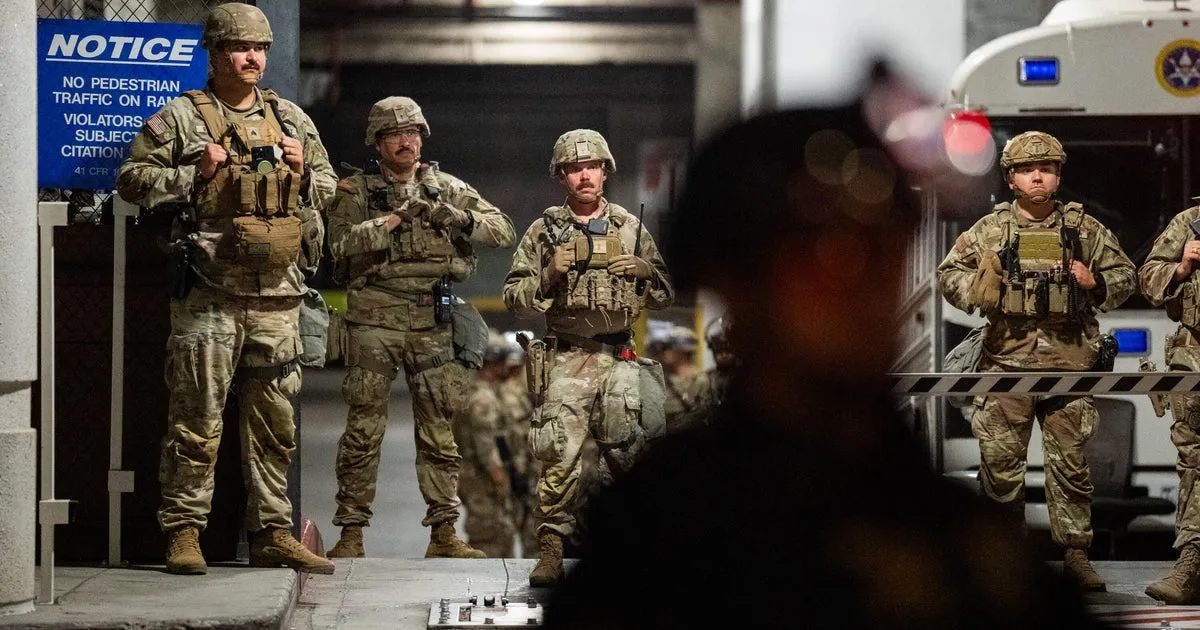
In a significant ruling, a federal judge in California has intervened to block the Trump administration's efforts to deploy members of the California National Guard to Los Angeles. U.S. District Judge Charles Breyer ordered the return of control of the National Guard to Governor Gavin Newsom, reinforcing the legal boundaries set forth in the Constitution regarding state and federal powers.
This decision, made on Wednesday, marks the second time Judge Breyer has ruled against the Trump administration's attempts to federalize the California National Guard under Title 10. The primary goal was to send troops to the streets of Los Angeles to protect federal personnel and property during immigration enforcement operations. Governor Newsom, a Democrat, has consistently opposed President Trump's initiatives to call the state's National Guard into federal service as part of the administration's broader immigration crackdown.
The preliminary injunction, granted at the request of California officials, stemmed from orders issued by Defense Secretary Pete Hegseth in August and October. These orders temporarily kept 300 California National Guard troops under federal control to protect federal immigration agents and other government entities. Notably, the October directive called for 200 troops to deploy to Oregon, with the remaining 100 allocated to various locations within Los Angeles. Currently, the California National Guard members are expected to remain in federal service until February 2, 2024.
In his comprehensive 35-page order, Breyer criticized the Trump administration for maintaining control over approximately 300 Guardsmen without any evidence that the execution of federal law was hindered. He emphasized that the framers of the Constitution designed the government to operate as a system of checks and balances. Breyer stated, "Defendants, however, make clear that the only check they want is a blank one," highlighting the administration's overreach in this matter.
Moreover, Judge Breyer accused the Trump administration of effectively creating a national police force composed of state troops. He remarked that by sending California Guardsmen to other states, including Oregon and Illinois, the federal government has adopted an overly expansive interpretation of presidential powers under Title 10.
The judge's order is temporarily on hold until Monday, allowing the Justice Department time to consider an appeal. California Attorney General Rob Bonta praised Breyer's decision, asserting that it represents a firm rejection of the President's attempts to transform the National Guard into a "traveling national police force." Bonta stated, "The President is not King," emphasizing that he cannot federalize the National Guard at will without proper justification. This ruling is seen as a victory for democracy and the rule of law.
President Trump first invoked Title 10 to federalize members of the California National Guard in June in response to protests against immigration raids in the Los Angeles area. Title 10 allows for the federalization of state guard members under specific circumstances, such as the inability to enforce U.S. laws with regular forces or in the event of rebellion or the threat of rebellion against the government.
Initially, Hegseth had federalized approximately 4,000 California Guardsmen. However, following a lawsuit from Newsom, Judge Breyer issued a temporary restraining order on June 12, ruling that the federalization did not meet the prerequisites outlined in Title 10. Although a three-judge panel for the U.S. Court of Appeals for the 9th Circuit temporarily lifted Breyer's order, allowing federalization and deployment to continue, the ongoing legal battles have raised questions regarding the authority of the Trump administration in this matter.
In recent months, the Trump administration has released most of the federalized members of California's National Guard but retained around 300 troops under federal control. California officials argued that the justification for maintaining federal control of the National Guard was nonexistent, especially given that violence during protests in June had significantly decreased. They accused the administration of imposing a prolonged military occupation without valid reasons and with no clear endpoint in sight.
The Trump administration contended that the court lacked the authority to review the federalization orders, claiming they were merely extensions of the initial June memorandum. Breyer found this stance shocking, arguing that such a position would allow a president to create a perpetual police force using state troops, undermining the federalism principle central to the U.S. government structure.
Judge Breyer also countered the administration's assertion that the National Guard troops were still needed in the Los Angeles area. By reallocating 200 of the 300 California Guardsmen to Oregon, the administration signaled that there was no urgent requirement for their presence in Los Angeles.
As President Trump seeks to federalize the National Guards of Oregon and Illinois for similar purposes, the legal landscape remains contentious. In Oregon, a federal judge ruled that Trump did not have a lawful basis to federalize the state's National Guard under Title 10, permanently blocking the administration from deploying troops to Portland. Meanwhile, in Illinois, a federal appeals court allowed the federalization of Guardsmen to remain but blocked deployment to the Chicago area. The Supreme Court is currently deliberating on whether to permit such deployments, indicating that the legal ramifications of this issue are far from settled.