

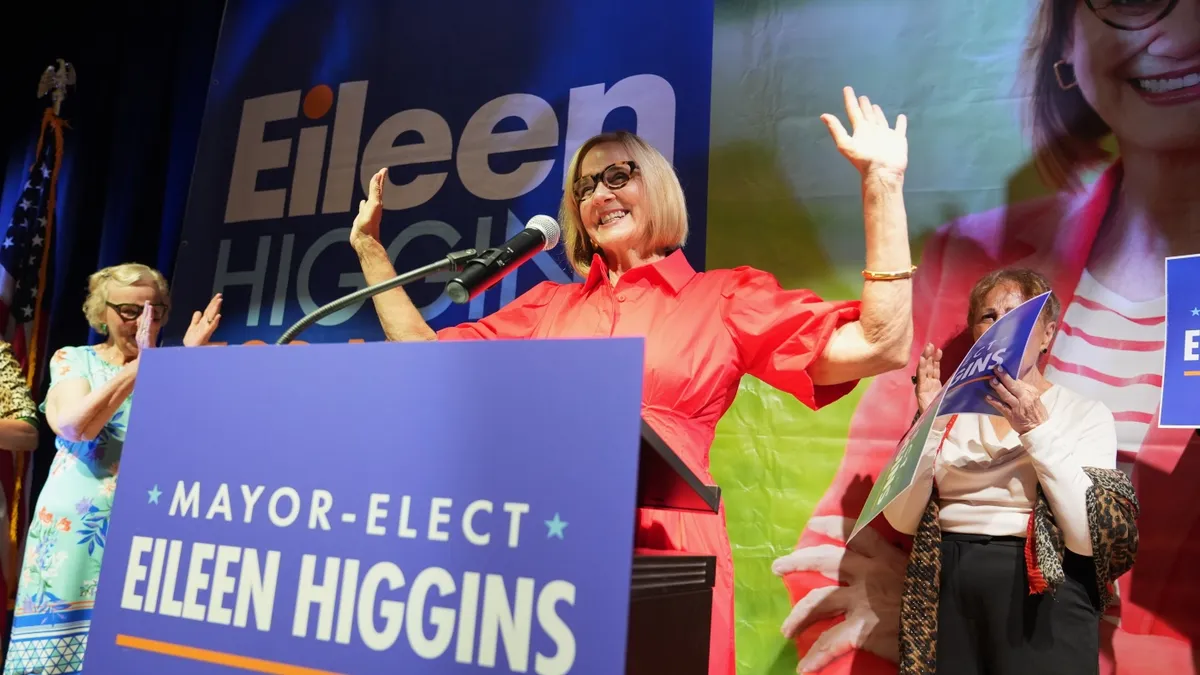
In a significant political shift, Democrat Eileen Higgins triumphed in the Miami mayor's race on Tuesday, defeating a Republican candidate endorsed by former President Donald Trump. This victory marks a crucial turning point for the Democratic Party, ending a nearly three-decade losing streak in Miami and providing much-needed momentum as the 2026 midterm elections approach.
At 61 years old, Higgins becomes the first woman to lead the city of Miami. Throughout her campaign, she focused on the concerns of the city's Hispanic majority, particularly addressing fears surrounding Trump's stringent immigration policies. Many residents expressed anxiety about the potential detention of family members, a sentiment Higgins highlighted during her campaign.
Running as a proud Democrat in a race officially designated as nonpartisan, Higgins secured a decisive victory over Trump-backed candidate Emilio Gonzalez, a former city manager. Following the election, Gonzalez extended his congratulations to Higgins, acknowledging her significant win.
In her victory speech, Higgins emphasized the need to combat what she termed "dehumanizing and cruel" rhetoric from elected officials, particularly towards immigrant populations. She stated, "The residents of Miami were ready to be done with that." With nearly all votes counted, Higgins emerged with a commanding lead of approximately 19 percentage points over her Republican opponent.
While the local race may not predict broader electoral trends, it has attracted considerable attention from both major national political parties. Higgins' win provides a boost for Democrats as they prepare for a critical midterm election cycle, especially in Florida, where the Republican Party has been vying to maintain its influence, particularly in the Hispanic-majority district of Miami-Dade County.
Ken Martin, chair of the Democratic National Committee, remarked that the results serve as a "warning sign to Republicans" who may be out of touch with the needs of voters. Nationally recognized Democrats, including former Transportation Secretary Pete Buttigieg, rallied behind Higgins during her campaign, further illustrating the significance of this victory.
Higgins, fluent in Spanish, previously served as a Miami-Dade County commissioner for seven years, representing a district that leans conservative and includes the Cuban neighborhood of Little Havana. When she first entered the political arena in 2018, she adopted the nickname "La Gringa" to help voters connect with her identity, acknowledging her background as a white American.
As Republicans grow increasingly anxious about their standing among Hispanic voters, they have noted a shift in sentiment. Many voters of Cuban, Venezuelan, and Nicaraguan descent have historically supported the Republican Party but are starting to express dissatisfaction with its direction. U.S. Rep. Maria Elvira Salazar, a Republican whose district includes Miami, labeled recent election outcomes as a "wake-up call" for the party.
Though the mayoral role in Miami is primarily ceremonial, Higgins has committed to treating it as a full-time position. Miami, recognized as Florida's second-largest city and a gateway to Latin America, holds substantial global prominence, which provides Higgins with a significant platform to address key issues. Her campaign promises include initiatives aimed at identifying city-owned land for affordable housing and cutting unnecessary government spending.
As Eileen Higgins prepares to take office, her victory not only represents a personal achievement but also signals potential changes in the political landscape of Florida, a state that has recently experienced shifts in voter sentiment.