

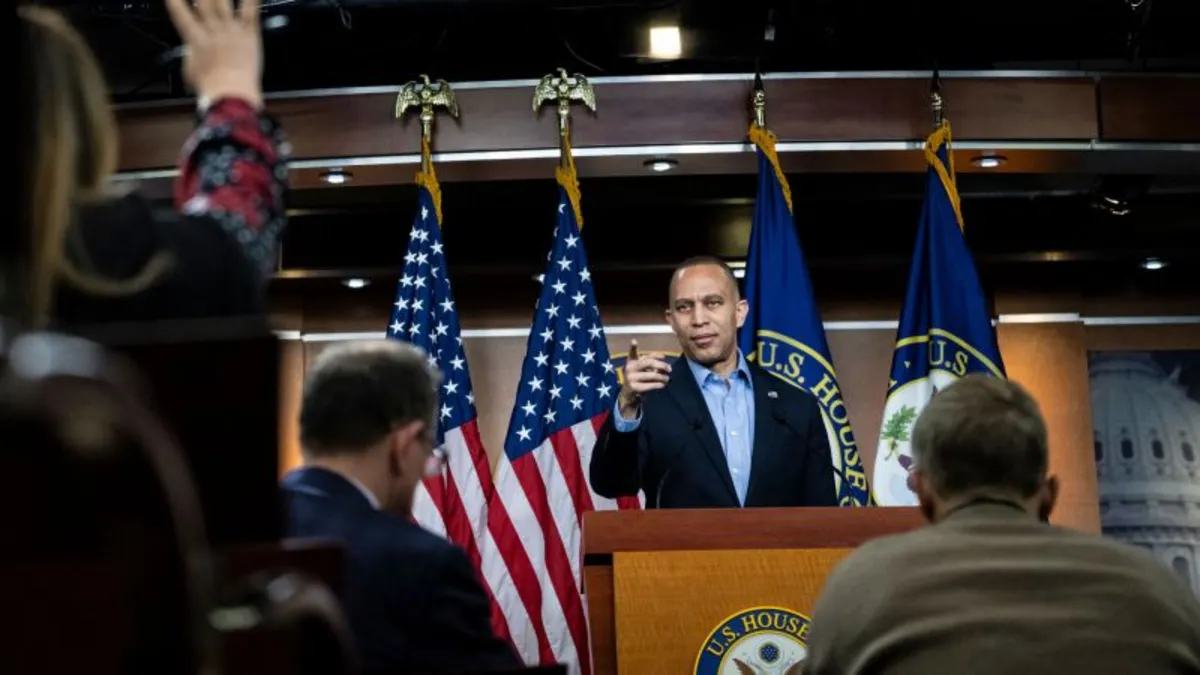
In a surprising turn of events, Indiana Republicans have opted to prioritize political integrity over potential gains by rejecting a new congressional map. This decision was made just one day before key Democratic figures articulated their intent to pursue redistricting efforts in states controlled by their party. House Minority Leader Hakeem Jeffries stated, “Donald Trump launched this unprecedented effort to gerrymander congressional maps all across the country as part of his scheme to rig the midterm elections,” highlighting the ongoing redistricting battle that has been ignited by Republican strategies.
As the political landscape shifts, Democrats in Maryland and Virginia are actively seeking methods to eliminate Republican-held seats ahead of next year’s midterm elections. This comes amidst concerns that Republicans could gain ground in states like Florida and other Republican-led territories. U.S. Representative Glenn Ivey, a Maryland Democrat, expressed his belief that the GOP's recent loss in Indiana would not deter redistricting efforts in his state. He noted that Democrats are eyeing a new congressional map that specifically targets the state’s only Republican lawmaker, Rep. Andy Harris.
“If Trump came out and said, ‘OK, I hear Indiana, let’s back off,’ I would think we’d rethink it. But yeah, good luck with that,” Ivey remarked in an interview. In Maryland, Governor Wes Moore and state lawmakers have already initiated the redistricting process, conducting public hearings and private discussions with the aim of voting on a new map in the coming months. Despite opposition from Maryland’s top Senate leader, Bill Ferguson, who has stated that redistricting won’t be addressed during the upcoming special session, discussions continue to move forward.
Virginia Senate President Pro Tempore Louise Lucas is not swayed by Indiana’s decision; she recently announced her plan to implement a new congressional map aimed at eliminating four of the state’s five Republican districts. This determination reflects a broader Democratic strategy to capitalize on redistricting opportunities where feasible.
Interestingly, the repercussions of Indiana's decision may resonate in nearby Illinois. Many Democrats perceive the political fate of Illinois as intertwined with that of Indiana. Illinois Governor JB Pritzker has publicly threatened to redraw the state’s congressional maps if Indiana proceeded with its original plan. “Our neighbors in Indiana have stood up to Trump’s threats and political pressure,” Pritzker stated, emphasizing the importance of maintaining integrity in the redistricting process.
While it remains uncertain how many seats could potentially shift as a result of these redistricting efforts, CNN’s analysis indicates that Republicans have created three additional favorable seats compared to Democrats. However, insiders from both parties suggest that the overall impact of these redistricting initiatives could ultimately balance out.
Amidst the fervor of political maneuvering, there are voices within the Democratic Party advocating for unity. Representative Frank Mrvan, whose seat was spared during the recent redistricting, commented on the need for bringing the country together. “I think the vote in Indiana, and the senators who made a decision against threats, politically and personally, made a choice to unify our country,” he remarked, suggesting that this example could serve as a model for others.
In contrast, Representative Julie Johnson, a Democrat from Texas, expressed skepticism about mid-decade redistricting. “I personally think mid-decade redistricting is not a good thing,” Johnson stated, acknowledging the complexities of navigating the political landscape. “But if those are the rules that everybody’s playing by, you’ve got to be in the same mud pit.” This highlights the ongoing debate within the party regarding the best course of action in a politically charged environment.