

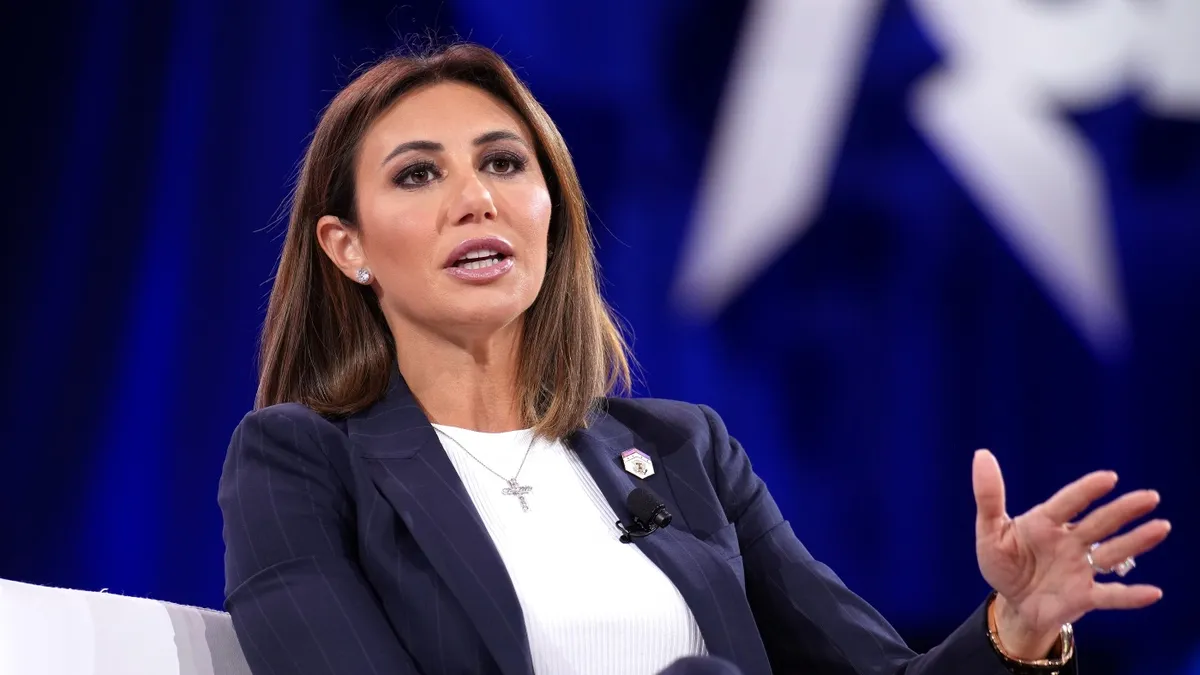
Alina Habba, the former personal attorney for President Trump, has announced her resignation from the position of top federal prosecutor in New Jersey. This decision comes in the wake of a recent ruling by an appeals court that determined she was unlawfully serving in this role. In a statement shared on social media, Habba emphasized that her resignation is not a retreat from legal challenges but a step taken to ensure the stability and integrity of the U.S. Attorney's Office.
Habba asserted in her statement, “This decision will not weaken the Justice Department, and it will not weaken me.” She confirmed that she will continue her work at the Department of Justice (DOJ) as a senior advisor to the attorney general for U.S. attorneys. This transition comes amid a series of legal setbacks for the DOJ, with multiple courts ruling that U.S. attorneys across the country, including those in Nevada, California, and Virginia, were not appointed legally.
Habba first came into the national spotlight as one of Trump's personal attorneys, representing him in various civil and criminal cases after his first term. Following Trump's return to the White House, he appointed her as the acting U.S. attorney for New Jersey in March on an interim basis. Additionally, Trump nominated her for the position permanently, but she was unable to secure sufficient support in the U.S. Senate for confirmation.
As her 120-day interim tenure neared its expiration, the U.S. District Court for New Jersey chose not to extend her appointment and instead appointed a career prosecutor, Desiree Grace, to fill the role. This transition was met with significant legal challenges, leading Attorney General Pam Bondi to dismiss Grace and pursue complex legal maneuvers to reinstate Habba. However, these efforts resulted in a series of legal confrontations that culminated in a unanimous ruling from a three-judge panel of the U.S. Court of Appeals for the Third Circuit.
The recent court ruling declared that Habba was unlawfully serving as U.S. attorney and disqualified her from supervising cases. This prolonged battle over her appointment has led to significant disruptions in New Jersey federal courts, causing a backlog and chaos within the judicial system. In response to the ruling, Bondi criticized the appeals court's decision, stating, “The court's ruling has made it untenable for her to effectively run her office, with politicized judges pausing trials designed to bring violent criminals to justice.”
Bondi's remarks highlight the ongoing tensions between the judicial and executive branches, as she asserted that these judges should not have the authority to negate the President's selection of attorneys tasked with the critical responsibility of prosecuting crime. As Alina Habba steps down from her role, the implications of her resignation and the court's ruling will continue to resonate within the legal and political landscape.