

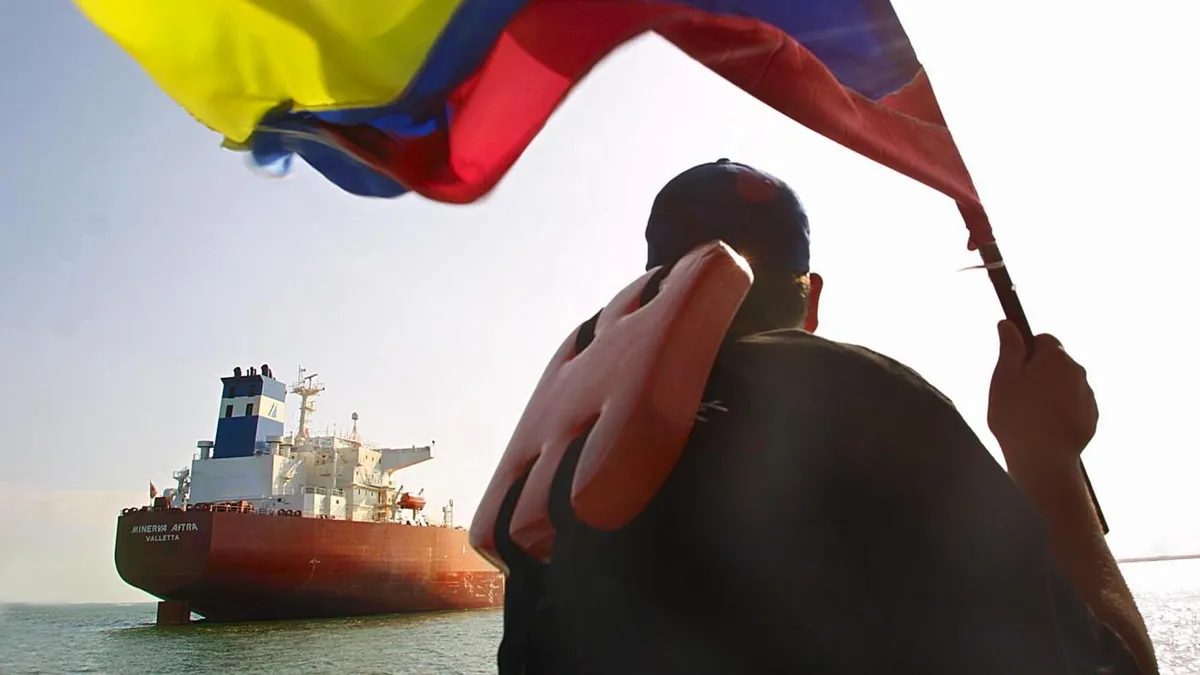
Just hours after the U.S. military captured Venezuelan president Nicolás Maduro, President Trump made it clear that the recent military operation was partly aimed at gaining control over Venezuela's oil. During a press conference, Trump stated, “We’re going to have our very large U.S. oil companies, the biggest anywhere in the world, go in, spend billions of dollars, fix the badly broken infrastructure, the oil infrastructure, and start making money for the country.” His remarks signal a significant shift in U.S. policy towards Venezuela, which traditionally has been a major player in the global oil market.
Venezuela is home to some of the largest proven oil reserves in the world, according to the Organization of Petroleum Exporting Countries (OPEC). Once a top oil producer, the country has seen its production plummet from over 3 million barrels per day a few decades ago to approximately 1 million barrels per day today, representing only about 1% of global oil output. In contrast, the U.S. currently produces around 13 million barrels daily.
Historically, much of Venezuela's crude oil was exported to U.S. refineries, but in recent years, the majority has shifted to China. However, not all crude oil is created equal; Venezuela's oil is known for being heavy and dense, which requires specialized refineries. Furthermore, the production process of Venezuela's oil is considered one of the dirtiest in the world, contributing significantly to climate change, as noted by energy experts.
Many U.S. oil companies, such as Chemron, have a long history in Venezuela, dating back nearly a century. However, the political landscape shifted dramatically during the presidency of Hugo Chávez from 2004 to 2007, when he renegotiated contracts with international oil firms. Companies like ExxonMobil and ConocoPhillips exited the country and sought compensation through international arbitration, leading to substantial financial claims against the Venezuelan government.
While Chevron has maintained a presence in Venezuela, producing roughly a quarter of the country’s oil, the future of U.S. investments remains uncertain. Chevron's spokesperson remarked that the company is focused on the safety of its employees and compliance with all regulations, amidst rising tensions and uncertainty in the region.
The potential return of U.S. oil companies to Venezuela raises questions about the risks and rewards involved. Venezuela's status as a brownfield—an established oil region—offers some predictability for companies considering a re-entry. Francisco Monaldi, director of the Latin America Energy Program at the Center for Energy Studies, believes that for companies like ConocoPhillips, returning could present an opportunity to recover some of the billions owed to them by the Venezuelan government.
However, the current global oil market is characterized by an oversupply, with prices hovering below $60 a barrel, making it less than ideal for new investments. Additionally, the environmental impact of Venezuelan oil production could deter European companies focused on sustainability.
In stark contrast, Venezuela’s neighbor Guyana has recently emerged as a significant player in the oil industry after discovering over 10 billion barrels of oil. Guyana’s lighter and less polluting oil, combined with lower taxes and the absence of a national oil company, makes it a far more attractive destination for investment. ExxonMobil, which is not currently operating in Venezuela, is a major player in Guyana's oil sector.
While there is potential for limited increases in Venezuelan oil production with better financial support and management, experts caution that the Trump administration's plans to revitalize the industry may face significant challenges. Historical precedents, such as the revitalization of Iraq’s oil sector, indicate that these efforts could take decades and may be hindered by ongoing corruption and mismanagement.
Ultimately, the lack of political stability in Venezuela remains a critical factor. Without a clear understanding of who is in charge and the viability of contracts, oil companies are unlikely to invest significantly in the region. As energy expert Gerald Kepes puts it, “No one’s going to start investing on the ground in a place where there’s no legal contract and viable permission to operate.” The future of Venezuela's oil industry, therefore, remains uncertain amidst a backdrop of geopolitical turmoil and economic instability.