

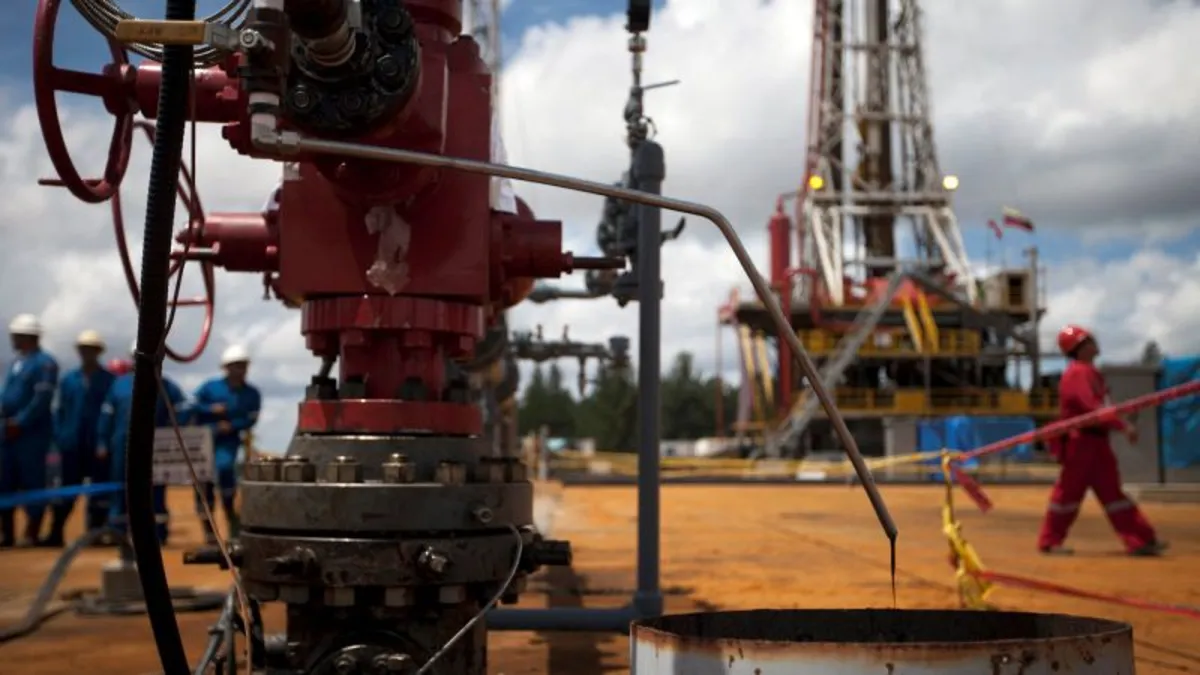
On Friday, President Donald Trump is scheduled to meet with top executives from the oil industry as part of a weeklong initiative aimed at encouraging America’s largest energy companies to invest in Venezuela. This meeting comes amid growing skepticism within the oil sector about the viability of committing tens of billions of dollars over the next decade to rejuvenate Venezuela’s ailing oil infrastructure. Insiders indicate that the executives attending this critical White House meeting are likely to refrain from making any binding investment commitments, citing concerns over Venezuela's current volatility.
Industry leaders have expressed that the risks associated with investing in Venezuela are too high. Sources familiar with the preparations for the meeting have noted that Trump and his advisors have yet to present a convincing strategy for rebuilding the country's energy framework and ensuring long-term stability. “They’re making this up as they go along,” remarked one insider involved in the discussions.
However, the potential for significant profits from Venezuela’s vast oil reserves could entice companies to reconsider their stance if the right conditions are established. The country’s military has increasingly involved itself in the state-run oil company Petróleos de Venezuela, SA (PDVSA), leading to rampant theft and heightened risks for foreign investors.
During discussions with Trump officials, oil executives have emphasized the urgent need for the establishment of the rule of law in Venezuela before any substantial investments can be made. Mike Summers, CEO of the American Petroleum Institute, stressed on Fox News that “there are going to be parameters that have to be put in place” to secure investments. This includes ensuring that employees and equipment sent to remote areas are safe from local threats.
Energy Secretary Chris Wright acknowledged the significant challenges involved, stating that for “very big, long-term investments” to materialize, the Venezuelan government must improve its stability and security.
To restore Venezuela’s oil production to pre-socialism levels, the industry would need to invest in laying pipelines, setting up drilling rigs, constructing port infrastructure, and establishing reliable electricity sources. Experts estimate that these efforts could exceed $10 billion annually and may require over a decade to yield returns. There is also concern that by the time investments pay off, the U.S. may have a different administration, and Venezuela would need to transition to a democratic government to ensure political stability.
Dan Pickering, founder and chief investment officer at Pickering Energy Partners, noted that oil companies are unlikely to be pressured into investing in a country with such inherent risks. He pointed out that guarantees from the Trump administration might only be reliable as long as Trump remains in power.
In pre-meeting preparations, oil executives expressed anxiety over the possibility of Trump demanding immediate commitments. They discussed the potential of increasing Venezuelan oil production by hundreds of thousands of barrels per day, contingent upon the administration lifting key sanctions and supplying necessary resources to manage Venezuela’s heavier crude oil.
The Trump administration has indicated a willingness to ease some sanctions as a step toward facilitating U.S. oil companies' return. However, Venezuela's stringent laws governing foreign oil companies, including requirements for public-private joint ventures and high royalty fees, present substantial hurdles. Luisa Palacios, former chairwoman of Citgo, remarked, “Venezuela has a very unfavorable fiscal regime – why would you go to a place like that?”
Many foreign energy firms, including Eni, Repsol, ConocoPhillips, and ExxonMobil, had their assets seized by the Venezuelan government in 2007 and are now seeking billions in compensation. Ryan Kellogg from the University of Chicago noted that Exxon will not forget its past experiences in Venezuela, stating, “At least some of that would need to be repaid – but the money isn’t there to pay them back.”
Wright informed CNBC that companies returning to Venezuela could eventually receive compensation through oil proceeds marketed by the U.S. government, although the immediate focus is on revitalizing Venezuela’s economy.
With moderate investment and a cooperative relationship with the U.S. government, it is feasible for Venezuela to restore its oil fields to operational capacity from a decade ago, according to Palacios. However, achieving more significant advancements will necessitate substantial investment and time. Financial guarantees, low-cost financing, and other incentives may be key to attracting oil companies back to Venezuela. The administration has suggested it could provide government-backed financing and political risk insurance to encourage private sector investments.
As the oil industry experts conclude, under the right conditions, Venezuela could draw considerable long-term interest from oil companies due to its significant oil reserves. Wright mentioned that he has been “barraged” with inquiries from oil companies regarding investment opportunities in Venezuela. While the Trump administration has assured that it will not pressure companies, it is committed to fostering a more stable political environment, acknowledging that this process will require time.