

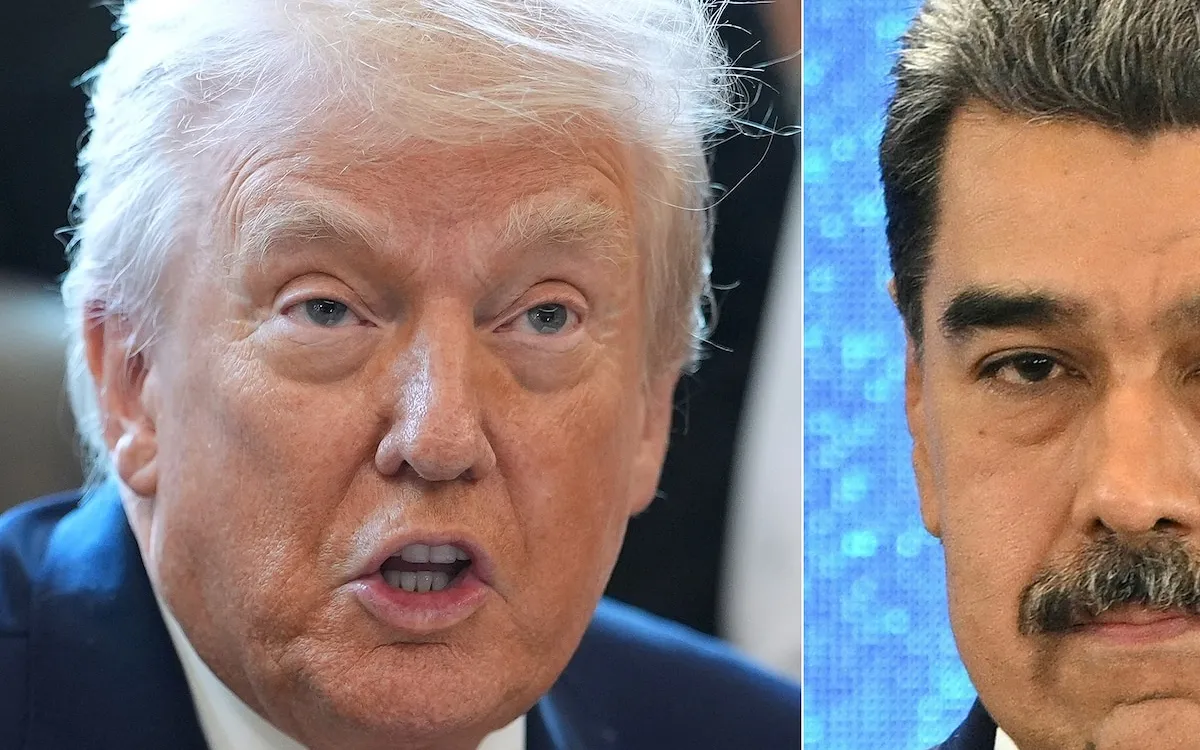
President Donald Trump is intensifying pressure on Venezuelan President Nicolas Maduro, suggesting that it would be wise for him to resign. During a press conference at his Mar-a-Lago club in Florida on Monday evening, Trump addressed inquiries regarding whether his administration's ultimate goal is to oust Maduro from power. He stated, "Well, I think it probably would. I can't tell him. That's up to him what he wants to do. I think it would be smart for him to do that. But again, we're going to find out." This statement underscores the U.S. administration's ongoing focus on the political situation in Venezuela.
Alongside urging Maduro to step down, Trump issued a stark warning: "He can do whatever he wants, it’s alright, whatever he wants to do. If he wants to do something, if he plays tough, it'll be the last time he's ever able to play tough." These comments highlight the heightened tensions between the U.S. and Venezuela, with Trump emphasizing the substantial military presence in the region. "We have a massive armada for him. The biggest we've ever had and by far the biggest we've ever had in South America," Trump added, indicating a strategic show of force.
The U.S. military has significantly increased its presence in the Caribbean, deploying 15,000 troops and several warships, ready to respond to any escalation in the region. Recently, Trump also declared a complete blockade on all sanctioned oil tankers entering or leaving Venezuela, targeting the government's primary source of revenue. This blockade aims to cripple Maduro's regime financially, further increasing pressure for a change in leadership.
In response to the U.S. blockade, Maduro has asserted that Venezuela will continue to trade oil, emphasizing that regime change "will just not happen, never, never, never." This defiant stance illustrates the ongoing struggle for power in Venezuela, as the Maduro government seeks to maintain its grip despite external pressures.
Separately, since September, the U.S. military has conducted numerous strikes on vessels in the Caribbean Sea and Pacific Ocean, targeting those allegedly involved in drug trafficking. These operations have reportedly resulted in over 100 casualties, raising legal concerns among lawmakers from both parties and legal experts. The Trump administration has justified these actions as a vital component of its war on drug cartels.
Trump hinted at expanding military operations, stating, "We’ll be starting the same program on land." He noted that land operations would be more straightforward, indicating a potential escalation of U.S. military involvement in the region. When asked if this plan included only Venezuela, Trump replied, "Anywhere drugs are pouring in. Anywhere, not just Venezuela." This broader scope suggests that the U.S. may adopt a more aggressive stance on drug trafficking across multiple countries in Latin America.
As the situation continues to develop, the international community watches closely, with implications for regional stability and U.S.-Latin American relations hanging in the balance. ABC News' Alexandra Hutzler contributed to this report, bringing attention to the complex and evolving dynamics surrounding Venezuela and its leadership.