

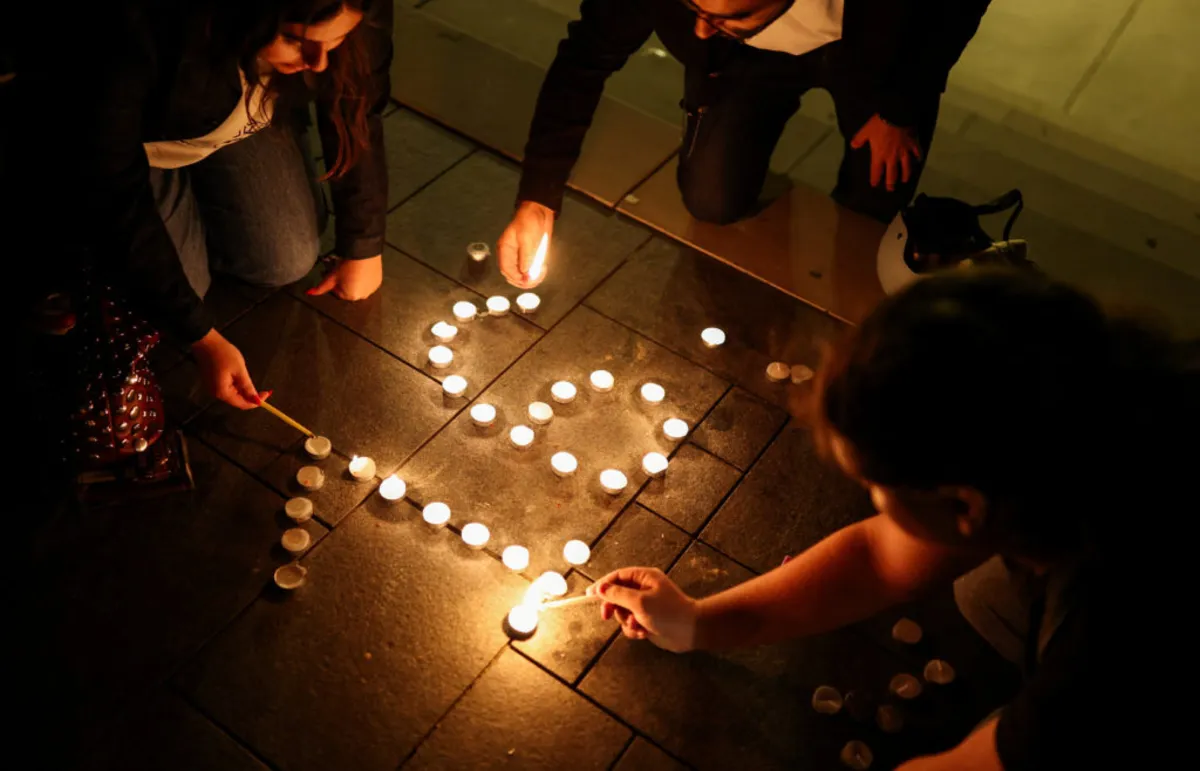
On Sunday, a devastating attack during a Hanukkah celebration at a popular beach in Sydney claimed the lives of at least 16 individuals. Australian Prime Minister Anthony Albanese promptly condemned the incident, labeling it an act of antisemitic terrorism. This tragic event underscores the alarming rise of antisemitism in Australia, a trend exacerbated by the ongoing conflict in Gaza. Local Jewish communities have expressed their distress over what they see as insufficient support from authorities in combating this growing threat.
According to a recent report by Uriya Shavit from Tel Aviv University, both Australia and Italy saw the most significant increases in antisemitic attacks in 2024. While the global trend showed a slight decline in antisemitic incidents, Australia reported a staggering 1,713 antisemitic incidents. With a population of approximately 28 million, Australia is home to around 117,000 Jews, highlighting the disproportionate impact of these incidents on such a small community.
Shavit remarked, “This was really one of the safest communities for Jews in history, characterized by religious tolerance and coexistence. Now, Australian Jews are seriously questioning their future in the country.” He pointed to the increasing normalization of antisemitic expressions within public discourse and the government’s failure to tackle this pressing issue.
Among the victims of the Hanukkah attack was Rabbi Eli Schlanger, a prominent figure within the Chabad community and a key organizer of the event. Chabad is an international movement of Orthodox Judaism renowned for its public candle lighting ceremonies. The Executive Council of Australian Jewry has called for immediate action from government leaders, emphasizing that “the time for talking is over.” They demand decisive leadership to eliminate the scourge of antisemitism from Australia’s public life, asserting that the government’s primary duty is to ensure the safety of its citizens.
Antisemitic incidents in Australia’s largest cities, Sydney and Melbourne—which are home to 85% of the Jewish population—have gained significant attention due to their severity and public nature. In August 2024, Prime Minister Albanese accused Iran of orchestrating two antisemitic attacks in Australia, leading to a severance of diplomatic relations with Tehran. It remains unclear whether the recent attack during the Hanukkah event is linked to Iran.
The Australian Security Intelligence Organization has suggested that Iran directed arson attacks on the Lewis Continental Kitchen, a kosher food establishment in Sydney, and on Melbourne’s Adass Israel Synagogue earlier in the year.
The shooting occurred during the first night of Hanukkah, which commenced on December 14 this year. Hanukkah, which means “dedication” in Hebrew, commemorates the rededication of the Second Temple in Jerusalem during the second century B.C. Traditionally, Jewish families light a menorah each night to honor the miracle of a small supply of ritually pure oil that lasted for eight nights instead of one.
Chabad has a longstanding tradition of hosting public candle-lighting ceremonies on Bondi Beach, attracting hundreds in previous years. During Hanukkah, Chabad leaders often display menorahs on car rooftops and organize large menorah displays in public spaces. With operations in over 100 countries, Chabad focuses on expanding Jewish observance and is particularly active in regions with minimal Jewish presence.
Chabad’s emissaries, known as shluchim, work globally, easily recognizable by their traditional attire. The movement has faced its share of violence, with notable attacks against Chabad institutions around the world, including the tragic 2008 Mumbai attack that resulted in nine fatalities and a 2019 shooting at a Chabad synagogue in San Diego.
The global headquarters of Chabad is located in Crown Heights, Brooklyn, which was once the office and synagogue of Rabbi Menachem Mendel Schneerson, affectionately known as “the Rebbe.” He led the movement from 1951 until his passing in 1994 and remains a revered figure among Chabad followers. His gravesite in Queens attracts approximately 400,000 visitors annually, reflecting the enduring legacy and impact of his teachings.
The tragic events in Sydney serve as a stark reminder of the challenges facing the Jewish community in Australia and the urgent need for collective action against antisemitism.