

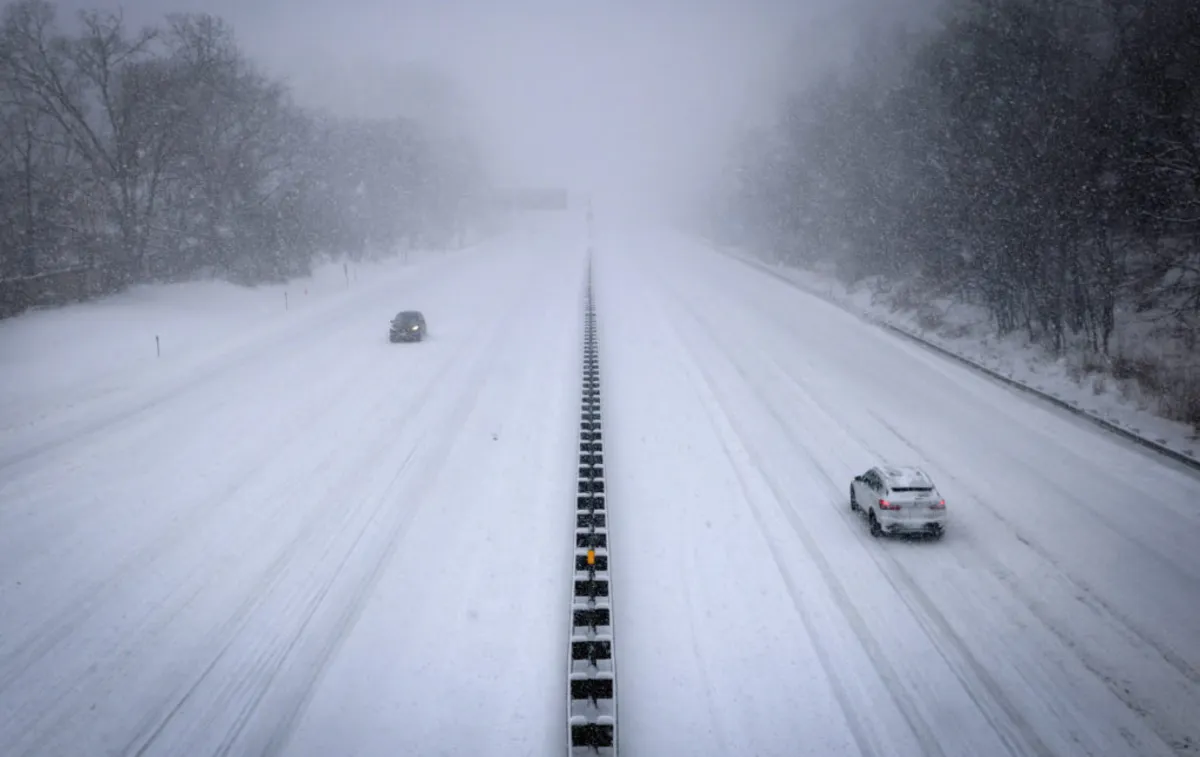
A massive winter storm swept across much of the United States on Sunday, dumping a mix of sleet, freezing rain, and snow. This severe weather event has led to subzero temperatures, resulting in significant disruptions to both air and ground travel. As ice accumulated on tree branches and power lines, many succumbed to the weight, causing widespread power outages. Hundreds of thousands of homes and businesses, particularly in the Southeast, were left without electricity.
The National Weather Service has warned that the ice and snowfall will persist into Monday, followed by dangerously low temperatures that could impact travel and infrastructure for days. Heavy snowfall is currently affecting regions from the Ohio Valley to the Northeast, while catastrophic ice accumulation poses a threat from the Lower Mississippi Valley to the Mid-Atlantic and Southeast.
According to weather service meteorologist Allison Santorelli, this storm is unique due to its extensive reach. "It is affecting areas all the way from New Mexico and Texas to New England, spanning approximately 2,000 miles," she stated in a phone interview. As the storm progressed, President Donald Trump approved emergency declarations for at least a dozen states by Saturday. The Federal Emergency Management Agency (FEMA) has pre-positioned rescue teams and supplies in various states, as noted by Homeland Security Secretary Kristi Noem.
In New York, communities near the Canadian border experienced record-breaking subzero temperatures. Watertown recorded a chilling minus 34 degrees Fahrenheit (minus 37 degrees Celsius), while Copenhagen registered an extreme minus 49 F (minus 45 C), as reported by Gov. Kathy Hochul.
In Corinth, Mississippi, Caterpillar instructed employees at its remanufacturing site to stay home on Monday and Tuesday due to the hazardous conditions. Local resident Kathy Ragan described the unsettling sounds of trees snapping from the weight of the ice on Facebook. In Clarksdale, Mississippi, resident Sanford Johnson noted that the weather kept most motorists off the roads, commenting, "We have no plans on driving."
In Nashville, Tennessee, Jami Joe expressed concerns about her electricity as ice-laden tree limbs crashed around her home. Meanwhile, Josh Martin described the icy roads as a barrier, stating, "Getting in and out of the neighborhood is not an option."
As of Sunday morning, approximately 213 million people were under some form of winter weather warning, according to Santorelli. The storm has led to hundreds of thousands of power outages, with Tennessee and Mississippi being particularly hard-hit. In addition, around 11,500 flights were canceled, and more than 16,000 were delayed on Sunday, according to FlightAware. Major airports in Philadelphia, Washington, Baltimore, North Carolina, New York, and New Jersey were among those severely impacted.
The National Weather Service cautioned that the danger will persist even after the ice and snow. Bitterly cold temperatures will sweep across the eastern two-thirds of the nation, which means that the ice and snow will take longer to melt, complicating restoration efforts. In New York City, Mayor Zohran Mamdani reported that five individuals were found dead outside as temperatures plummeted, urging residents to stay indoors.
In Oxford, Mississippi, local police advised residents to remain indoors as utility crews suspended operations due to life-threatening conditions. The utility company posted on Facebook, highlighting the dangers faced by their linemen. Dramatic images of slick roads and ice-coated trees were shared on social media, showcasing the storm's brutal impact.
In Tennessee, emergency officials urged motorists to provide space for road treatment crews, addressing the issue of drivers crashing into them. The icy conditions also rendered travel treacherous in north Georgia, where the Cherokee County Sheriff's Office humorously noted the closure of a local Waffle House, a well-known indicator of severe weather in the South.
The recovery from this massive winter storm is likely to take time, as communities come together to navigate the challenges ahead.